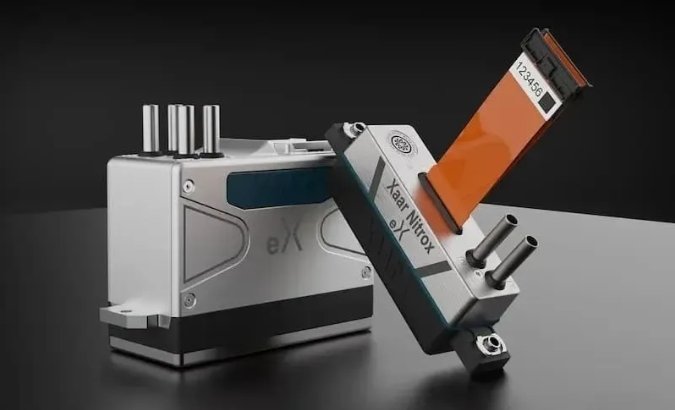
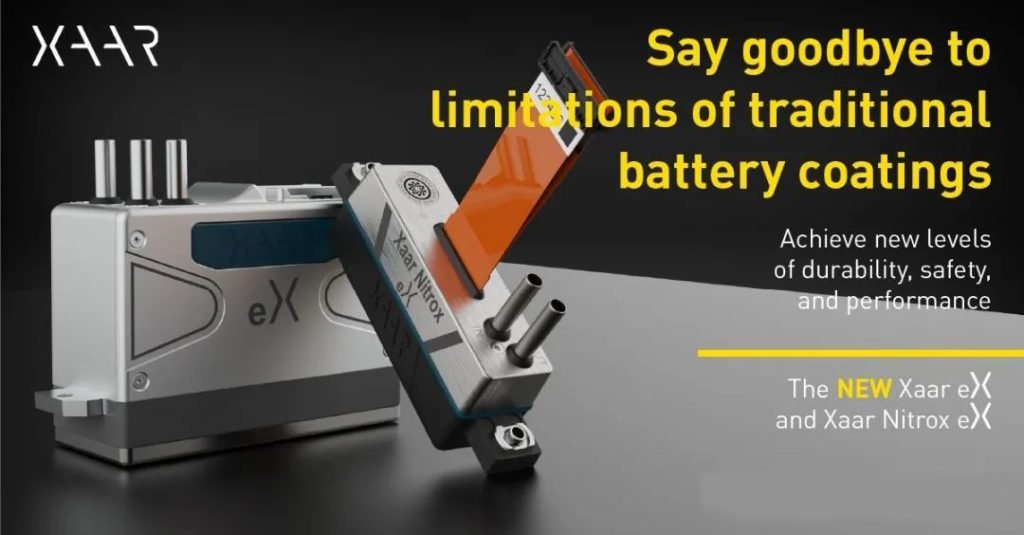
Xaar, a leading innovator in inkjet technology, has launched two new printheads, Xaar eX and Nitrox eX, designed for coating the next generation of batteries used in electric vehicles (EVs) and energy storage systems.
The launch marks Xaar as the first inkjet company to enter the battery sector and launch a printhead specifically for this application, setting a new benchmark in coating technology.
However, unlike most printheads, Xaar's two new printheads, the Xaar eX and the Nitrox eX, are targeted at a very specific market application—battery production, primarily for electric vehicles (EVs) but also for other energy storage uses.
To understand these new heads, it is first necessary to look at this specific application. Most batteries consist of several battery cells combined to form a larger battery pack. These individual battery cells have an insulating layer on the outside to reduce the risk of electrical and thermal transfer. This insulating layer is typically a PET film with a pressure-sensitive adhesive layer on one side to secure it to the battery.
However, this approach has some drawbacks, such as the potential for bubbles to form behind the plastic layer. If the battery gets hot, these bubbles can expand, reducing insulation. It also makes it harder to fit more cells into a small space, a problem that is becoming more serious as car manufacturers try to move to larger and more powerful batteries.
Graham Tweedale, chief operating officer at Xaar, explains: “Today, battery cells might be packaged in a frame and held together with fasteners, whereas they want to use a more structural adhesive to bond the cells together to form a battery pack. The problem is that the adhesive used to bond the battery cells is stronger than the PET film, so there is a risk that the film could delaminate and fall off, especially if there is some kind of mechanical impact, which is common in cars.”
This change in the way battery cells are assembled is because most electric vehicle manufacturers are now moving to higher voltages, typically around 800 volts, and faster charging. This also increases the temperature around the battery cells. “So, handling this assembly in a higher temperature environment exacerbates any issues that come with the PET film,” Tweedale noted.
This has prompted battery manufacturers to look for processes that are easier to manufacture and better able to cope with these issues. One option is to replace the plastic film with a liquid coating. Some manufacturers use spraying to apply this liquid, although it is difficult to control exactly where the liquid is sprayed. This is a problem for batteries because you want to insulate the entire battery cell, but you can’t spray the surface with the terminals. So where spraying has been used in the past, there is no insulation on the top surface with the terminals, which limits the way the battery cells can be combined to form a finished battery pack without the risk of short circuits.
As a result, many manufacturers are looking at inkjet as a more efficient way to apply liquid coatings. Often this means single-pass inkjet to fit into an existing production line that produces a battery cell every few seconds. “That requires fairly high throughput to ensure there is enough uptime to support that,” Tweedale noted.
The downside of inkjet is that it is more complex than spraying. Whatever the application, there is always a process to find the best formulation for the liquid to ensure it can be jetted through the printhead while still meeting all the performance characteristics of the end application.
Tweedale says Xaar has been working on this project for several years, noting: “We’ve worked with everyone in this application space. Obviously, you have to work with the fluid companies because the fluid in the printhead is key. We worked with the battery companies because they also have to acknowledge that this is possible, and ultimately they are the end customer. But our customers are the OEMs who build the machines and buy the printheads to install. So we had to work with all the different players in the space to find a solution.”
The coating uses UV light to cure it from a jettable fluid to a final coating, which itself can be over 100 microns thick. As a result, the chemistry within this coating is very different from standard UV inks. The fluid must provide electrical isolation and thermal protection without being affected by the adhesive used to bond the individual battery cells together.
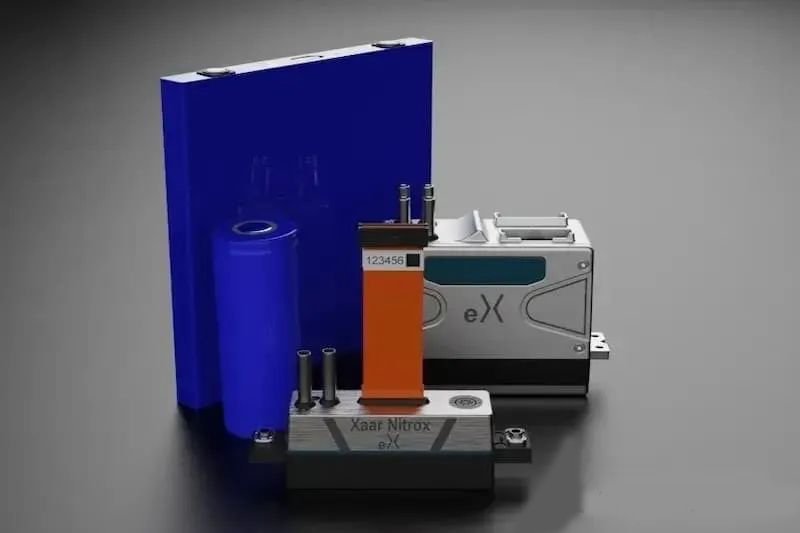
The battery cells themselves typically come in two shapes, cylindrical or prismatic (rectangular). Today, most EV battery cells are cylindrical, but demand for prismatic cells is increasing, primarily because the rectangular shape makes it easier for manufacturers to fit multiple cells directly into the vehicle chassis, meaning more power can be delivered in the same space. However, the rectangular shape presents a problem in that the coating cannot be applied around the corners while maintaining continuity and uniformity. As a result, Xaar has developed two printheads, one for cylindrical and one for prismatic cells.
eX Printheads
The main reason Xaar had to develop a printhead specifically for this application was that the chemicals in the liquid coatings could damage the printhead structure, specifically the epoxy used to bond the different components within the printhead. Tweedale explains: “We worked with the liquid companies to add a special coating to the printhead so that we could handle these UV liquids on the outside of the battery, which have very specific properties. We had to do all sorts of validation and testing for the battery company to prove that they would do the job and provide the functionality they needed.”
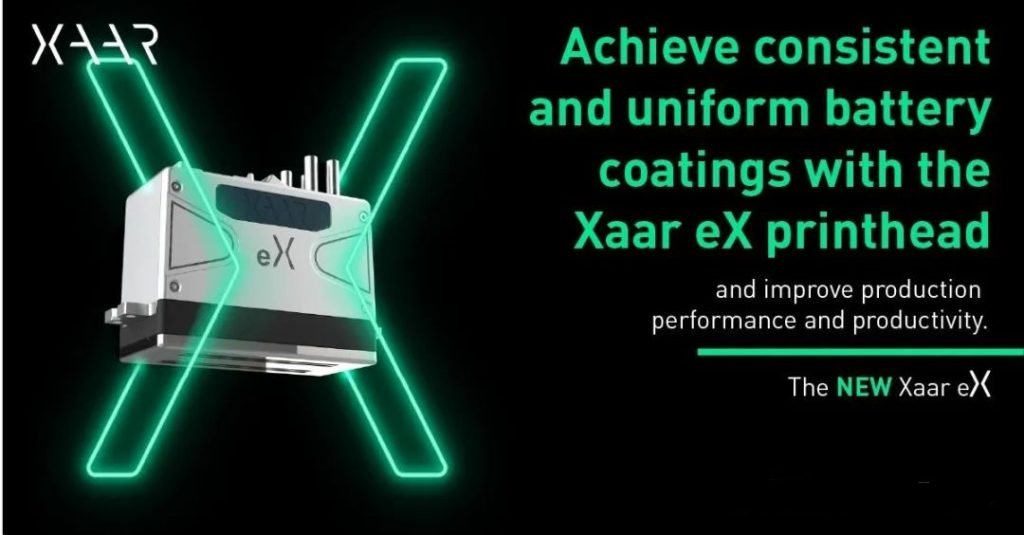
He adds: “That’s why we’re launching these two new printheads because we’ve done a lot of work to validate that these fluids jet well and that they won’t have any lifetime issues.”
So in reality these new printheads are variations of existing printheads. So the Nitrox eX is based on the Nitrox printhead. This is a relatively compact printhead with two rows of 1000 nozzles and a resolution of 360 nozzles per inch. It is designed for cylindrical cells, which rotate in front of the printhead, so it can spray an even coating across the cell in one go.
The eX printhead is larger, based on a 2002 Xaar design, and has four rows of nozzles for a total of 2000 and a resolution of 720npi. This printhead is designed for rectangular cells. There are two channels, but the process uses a single fluid type. “It’s really about spraying,” says Tweedale. “On a cylindrical cell, because it’s rotating, you can still get the right throughput with two rows of nozzles. On a prismatic cell, we have four rows so we can spray enough fluid quickly enough.”
Both printheads offer a choice of 12pl or 40pl native drop sizes, with jetting frequencies up to 36kHz and 24kHz respectively. This enables the Nitrox eX to jet up to 42g/sqm, and the larger eX up to 85g/sqm.
Both printheads feature Xaar’s ThroughFlow ink circulation system, which directs the liquid to the nozzle plate and uses very high flow rates to reduce clogging and bubbles. This is complemented by SureFlow technology, which pushes the liquid through at a higher rate to clear any blockages.
Another issue is that the viscosity of functional fluids tends to be quite high, much higher than most printheads can handle today. Xaar is well known for its ability to handle high viscosity fluids and this project is a great demonstration of this. The viscosity of these coatings is typically around 50cP and above, and Xaar printheads are able to handle fluids up to 100cP. For reference, most printheads will typically quote around 5-10cP for graphic arts inks.
Xaar has also partnered with Quantica, which has developed the NovoJet printhead, which is able to handle fluids with viscosities up to 400cP. This could open up other applications, such as jetting adhesives.
Most OEMs apply some level of heat to the printing system to increase the flow rate of the ink. Tweedale says that for this reason, UV fluids are typically jetted at around 45ºC, and Xaar did not have to make any changes to the temperature control for this battery cell application.
“The underlying performance we bring to the table that makes this possible is our ThroughFlow technology and high viscosity capability,” he adds. “The advantage of being able to jet high viscosity coatings is that it allows for a very uniform coating around the corners of the cell,” he continues. The eX printheads operate primarily in binary mode, but the greyscale capability can help manage the corners to ensure a consistent coating around the entire cell.
“We have four different suppliers of fluids that have been formulated to be approved by the battery companies,” says Tweedale. “So the fluids have to meet all of their current standards, including battery life and impact resistance.”
Other applications
Beyond electric vehicles, the batteries can be used for energy storage, and Tweedale says the process could be applied to consumer electronics in the future. He adds: “We are working with people to find other areas where inkjet can play a role in the battery manufacturing process. There are various processes currently, such as coating slurries when making certain active components in batteries, and we are looking at whether there are areas that can be done with inkjet. If you can jet, we have a great opportunity to do it because we can handle high viscosities, expanding the range of inkjet technology applications.”
He concludes: “We think this is a reasonably sized market for us. I think it’s a market where we can bring real value. Moving from analog to digital production processes requires our characteristics to achieve. This is an interesting area for us, batteries in general, not just coatings, but also the active elements within the battery.”
It seems inevitable that more printhead manufacturers will develop specialized printhead variants in the future to cope with specific fluids in specific industries. We have seen inkjet printing expand from graphics printing to industrial printing, and now we are seeing the same technology used directly for industrial manufacturing. This is not surprising, as inkjet printing is already widely used in additive manufacturing, which is 3D printing. This leads to the obvious question: How many other manufacturing industries would benefit from moving from analog to digital processes?