In industrial inkjet printing, the printhead determines print quality, speed, and drop placement accuracy. However, when it comes to long-term production stability, the ink delivery system can be just as important as the printhead itself.
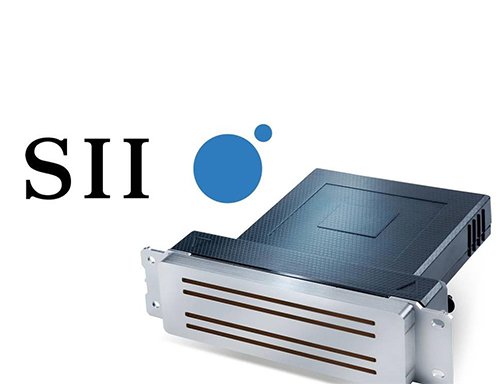
Seiko Instruments (SII Printek) printheads have been widely used in UV printing, ceramic printing, corrugated packaging, textile printing, and other industrial inkjet applications. From earlier models such as the 508GS and 1024GS to recirculating models such as the RC1536, Seiko's printhead technology has evolved alongside the industry's demand for higher speed, better reliability, and compatibility with more challenging inks.
In real-world production, printhead failures are not always caused by the printhead itself. Air bubbles, dissolved gas, unstable negative pressure, clogged filters, ink sedimentation, and poor sealing can all affect printhead performance.
This article explores Seiko printheads, their major applications, and the role of the ink delivery system in maintaining stable industrial inkjet printing.
What Are Seiko Printheads?
Seiko Instruments industrial printheads primarily use piezoelectric inkjet technology, in which piezoelectric actuators control ink droplet formation and ejection.
Unlike desktop inkjet printers, industrial systems are designed for long production cycles, high printing speeds, and a wide range of industrial inks. As a result, printheads need to provide:
- Stable inkjet performance
- Reliable continuous operation
- Good ink compatibility
- Precise droplet control
- Industrial durability
These characteristics have helped Seiko printheads find applications across advertising, ceramics, packaging, textiles, and other industrial sectors.
The development from models such as the 508GS and 1024GS to recirculating models such as the RC1536 also reflects a broader shift from simply achieving stable ink ejection to handling high-solid-content, high-viscosity, and sediment-prone inks.
Popular Seiko Printhead Models
Seiko 508GS: A Classic Industrial Printhead
The Seiko 508GS is one of the well-known printheads from Seiko's industrial inkjet lineup.
It has been used in wide-format and industrial printing equipment where stable ink ejection and continuous operation are important.
Depending on the printer design, the printhead can work together with heating systems, negative-pressure control, and ink filtration systems to support different industrial ink types.
For many older industrial printing systems, the 508GS remains a familiar printhead option.
Seiko 1024GS: Expanding Industrial Inkjet Applications
The 1024GS series further expanded the application range of Seiko printheads as industrial printers demanded higher productivity.
Typical applications include:
- UV inkjet printing
- Ceramic printing
- Industrial decoration
- Packaging printing
- Other industrial inkjet systems
Ceramic printing is particularly demanding because ceramic inks can contain inorganic pigments and particles that increase the risk of sedimentation, filtration problems, and printhead wear.
This means that the printhead is only one part of the system. Proper filtration, ink circulation, and pressure control are equally important.
RC1536: From Ink Supply to Ink Recirculation
The RC1536 represents Seiko's recirculating printhead technology.
The "RC" designation is associated with the recirculation concept, where ink is continuously circulated through the printhead.
This design is particularly useful for industrial inks that may:
- Contain relatively high levels of solid particles
- Sediment easily
- Entrap air
- Have higher viscosity
- Become less stable during extended idle periods
Continuous ink circulation can help reduce the risk of sedimentation and improve ink conditions inside the printhead.
Therefore, the key value of the RC1536 is not simply higher printing speed. Its recirculation design is particularly relevant to challenging industrial ink applications.
Where Are Seiko Printheads Used?
Seiko printheads are used in much more than traditional wide-format advertising printers.
As industrial inkjet technology develops, their applications have expanded into packaging, ceramics, textiles, and functional-material printing.
UV Flatbed and Wide-Format Printing
UV printing is one of the important application areas for industrial printheads.
UV printers can print directly onto materials such as:
- Acrylic
- PVC
- Glass
- Metal
- Ceramic tiles
These systems require:
- Stable droplet control
- High productivity
- UV ink compatibility
- Long continuous operation
- Reliable white-ink delivery
White ink is often one of the most challenging parts of the ink delivery system.
Pigments in white ink can settle easily. If circulation is insufficient, filters become contaminated, or the printer remains idle for an extended period, the system may develop problems such as:
Ink sedimentation → filter restriction → negative-pressure instability → printhead dropout
For this reason, UV printer reliability depends not only on the printhead but also on the pumps, filters, dampers, ink lines, and circulation system.
Ceramic Inkjet Printing
Ceramic printing is one of the more demanding industrial inkjet applications.
Ceramic inks may contain inorganic pigments and other solid particles. Compared with standard CMYK inks, they require greater attention to:
- Ink sedimentation
- Particle filtration
- Printhead wear
- Air removal
- Continuous circulation
- Printhead cleaning
Recirculating printheads can be particularly useful in these applications.
Continuous circulation helps reduce the time ink remains stationary inside the ink channels, potentially reducing sediment accumulation and air retention.
Corrugated Packaging and Single-Pass Inkjet
Corrugated packaging is an important growth area for industrial inkjet printing.
Traditional flexographic printing is highly effective for large-volume production, but digital inkjet offers advantages for short runs, variable data, and frequent job changes.
Single-pass inkjet printing allows corrugated sheets or boards to pass through the printing area once, making it suitable for:
- E-commerce packaging
- Customized cartons
- Short-run packaging
- On-demand printing
- Variable-data printing
These systems place new demands on printheads:
Higher speed + wider print width + higher resolution + longer continuous operation
This is one reason recirculating industrial printheads such as the RC series have attracted attention in packaging applications.
Textile Digital Printing
Industrial inkjet technology is also widely used in textile printing.
Depending on the fabric and application, textile printing may involve:
- Reactive inks
- Acid inks
- Disperse inks
- Pigment inks
- Sublimation inks
These inks have different particle sizes, viscosities, and chemical compositions compared with conventional graphic inks.
As a result, textile printing requires careful control of:
- Ink filtration
- Pressure
- Degassing
- Ink circulation
- Printhead compatibility
For long production runs, stable ink delivery can be just as important as print speed.
Functional Materials and Emerging Applications
Industrial inkjet technology is increasingly moving from conventional image printing toward functional material deposition.
Future applications may involve:
- Conductive materials
- Ceramic materials
- Functional coatings
- 3D printing materials
- Electronic materials
- High-viscosity specialty inks
These applications have very different requirements from conventional CMYK printing.
As ink chemistry becomes more complex, printhead recirculation, filtration, chemical compatibility, and pressure control become increasingly important.
Why Does a Printer Drop Nozzles Even When the Printhead Is Fine?
This is a common problem in industrial inkjet production.
When nozzle dropout occurs, the first assumption is often:
"The printhead is damaged."
But the actual problem may be somewhere in the ink delivery system.
A typical industrial ink supply path may include:
Ink tank → Pump → Filter → Degassing → Damper/Sub-tank → Negative-pressure system → Printhead
A problem at any point in this system can eventually appear as a printhead problem.
Four Common Ink Delivery Problems
Dissolved Gas and Microbubbles
Air in an ink system is not limited to visible bubbles.
Ink can also contain a significant amount of dissolved gas.
During high-frequency piezoelectric jetting, changes in pressure, temperature, and flow conditions can cause dissolved gas to come out of solution and form microbubbles.
These bubbles can affect:
- Ink pressure
- Flow stability
- Droplet formation
- Jetting velocity
- Nozzle consistency
Possible symptoms include:
- Nozzle dropout
- Deflected droplets
- Satellite droplets
- Unstable droplet size
- Banding
This is why some industrial inkjet systems incorporate degassing modules.
Not Every Degassing Membrane Is Suitable for Every Ink
Membrane degassing uses a hydrophobic membrane and vacuum conditions to reduce dissolved gas in the ink.
However, choosing a degassing membrane is not simply about achieving the highest possible degassing efficiency.
The membrane material must also be compatible with the ink chemistry.
For example:
| Ink Type | Degassing Consideration | Key Point |
|---|---|---|
| Water-based ink | Commonly used | Membrane compatibility is generally easier to manage. |
| UV ink | Requires verification | Check compatibility with acrylate components. |
| Solvent ink | Requires caution | Confirm membrane and seal resistance to solvents. |
| Ceramic ink | Important | Focus on particles, sedimentation, and filtration. |
Therefore, a stronger degassing system is not necessarily a better system. It must match the ink chemistry.
Unstable Negative Pressure
Industrial printheads normally operate within a specific negative-pressure range.
If the negative pressure is too high, ink supply may become insufficient.
If it is too low, the system may experience:
- Ink dripping
- Nozzle flooding
- Ink leakage
- Ink contamination around the printhead
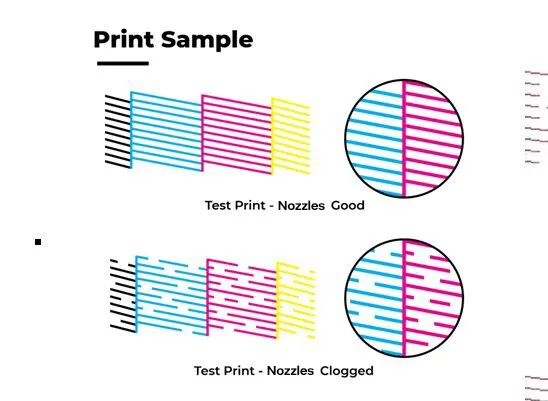
Even more challenging is pressure fluctuation, which can produce seemingly random nozzle dropout.
A useful troubleshooting approach is to compare the dropout pattern:
| Symptom | Possible Cause | What to Check |
| Same nozzles repeatedly missing | Clogged nozzle or contamination | Nozzle plate and printhead |
| Dropout position changes randomly | Ink supply or pressure issue | Negative pressure and pump |
| Dropout appears during high-speed printing | Insufficient ink supply | Flow rate and pressure |
| Temporary recovery after cleaning | Ink path or nozzle contamination | Filter and ink lines |
| White ink drops out more often | Sedimentation or insufficient circulation | Ink circulation system |
Before replacing an expensive printhead, it is often worth checking the entire ink delivery system.
Where Should Industrial Ink Filters Be Installed?
Filters provide an important final layer of protection for industrial printheads.
They help remove:
- Particles
- Sediment
- Aggregates
- Contaminants generated during ink storage or operation
However, a finer filter is not always a better filter.
Filter selection should consider:
Ink type + printhead channel design + system flow rate + pressure drop + printhead manufacturer's requirements
Industrial ink systems may use filtration around the 5 μm range, but the correct specification must be determined according to the actual ink and printer design.
An excessively fine filter can increase pressure drop.
As the filter becomes contaminated, flow resistance increases. This can affect the pressure at the printhead inlet and eventually cause ink starvation and nozzle dropout.
Why Should You Avoid an Oversized or Overly Fine Filter Near the Printhead?
The printhead needs a stable ink supply.
If a very fine filter is installed immediately before the printhead and becomes partially blocked, the resistance in the ink path can increase rapidly.
The result may be:
Filter restriction → Reduced flow → Insufficient ink supply → Nozzle dropout during high-speed printing
For this reason, industrial ink systems should use a properly designed filtration strategy rather than simply installing the finest possible filter.
Why Is Recirculation Useful for Difficult Industrial Inks?
One of the key advantages of RC-series printheads is their ability to address part of the ink-management challenge through internal recirculation.
A conventional ink supply path may look like:
Ink tank → Pump → Filter → Printhead
A recirculating system places greater emphasis on:
Ink supply → Printhead → Recirculation → Ink supply system
Continuous ink movement can reduce the risk of sedimentation caused by prolonged ink stagnation.
This can be especially useful for:
- Ceramic inks
- Textile inks
- White UV inks
- High-solid-content inks
- Certain functional inks
However, it is important to understand that:
A recirculating printhead does not completely replace filters, degassing systems, or negative-pressure control.
Recirculation helps manage ink conditions inside the printhead, while the rest of the ink delivery system still needs to be properly designed.
How to Build a Stable Ink Delivery System for Seiko Printheads
When designing an industrial printer around a Seiko printhead, several areas deserve special attention.
Maintain Ink Cleanliness
Ink should pass through appropriate filtration before reaching the printhead.
Filter selection should consider:
- Filtration rating
- Flow rate
- Pressure drop
- Filter area
- Filter media
- Chemical compatibility
- Replacement interval
Control Air and Microbubbles
Check the following components:
- Pump
- Ink-line connections
- Dampers
- Degassing module
- Filters
- Valves
- High points in the ink tubing
A small leak on the negative-pressure side can allow air to enter the ink path.
Maintain Stable Negative Pressure
Negative pressure should not only be checked after a dropout occurs.
A better approach is to monitor pressure continuously.
If pressure fluctuates significantly, inspect:
Pump → Tubing → Filter → Damper/Sub-tank → Valve → Printhead
rather than immediately assuming the printhead has failed.
Pay Special Attention to White and Sediment-Prone Inks
UV white ink, ceramic ink, and other sediment-prone formulations require effective circulation.
Possible measures include:
- Ink tank agitation
- Ink-line circulation
- Sub-tank circulation
- Printhead recirculation
- Regular filter maintenance
The goal is simple:
Do not allow difficult inks to remain stationary for too long.
The Future of Industrial Inkjet: System Performance Will Matter More
In the past, industrial inkjet discussions often focused on one question:
"Which printhead does the printer use?"
In the future, the more important question may become:
"Can the printhead, ink, ink delivery system, and control system work together reliably?"
As printhead performance continues to improve, the limitations of the overall ink delivery system become increasingly important.
Several trends are likely to shape industrial inkjet development.
Single-Pass Printing and Higher Resolution
Corrugated packaging, labels, publishing, and industrial decoration are driving the development of single-pass inkjet systems.
Printheads must deliver:
- Higher resolution
- Higher firing frequency
- Wider print coverage
- More stable continuous jetting
At the same time, ink systems must provide sufficient flow and stable pressure at high production speeds.
High-Viscosity and Functional Inks
Traditional CMYK printing focuses mainly on image reproduction.
Functional inkjet printing focuses more on the material being deposited.
Conductive materials, ceramic slurries, functional coatings, and other specialty materials can require more advanced jetting technology.
For these applications, recirculation, chemical resistance, filtration, and ink delivery stability may be more important than printing speed alone.
Smarter Ink Delivery Systems
Future industrial printers may move beyond manual pressure adjustment and scheduled filter replacement.
More intelligent ink systems could integrate:
- Real-time negative-pressure monitoring
- Flow monitoring
- Filter differential-pressure monitoring
- Degassing monitoring
- Ink temperature monitoring
- Automatic alarms
- Automatic pressure adjustment
The goal is to move from:
Repair after nozzle dropout
to:
Early warning before nozzle dropout.
Conclusion: Choosing a Printhead Also Means Choosing an Ink System
From the 508GS and 1024GS to the RC1536, Seiko printheads reflect the industry's growing demand for:
Higher speed, greater stability, broader ink compatibility, and longer continuous production.
But an industrial printhead never works alone.
A reliable inkjet system requires:
A suitable printhead + compatible ink + proper filtration + stable negative pressure + effective degassing + reliable pumps + appropriate ink circulation
If any one of these components is poorly matched, the final result may be nozzle dropout, deflection, unstable droplets, or even printhead damage.
Therefore, when selecting a Seiko printhead, it is important to look beyond the specifications of 508GS, 1024GS, RC1536, and other models.
The real key to long-term industrial inkjet reliability is not a single component but how well the printhead works together with the entire ink delivery system.