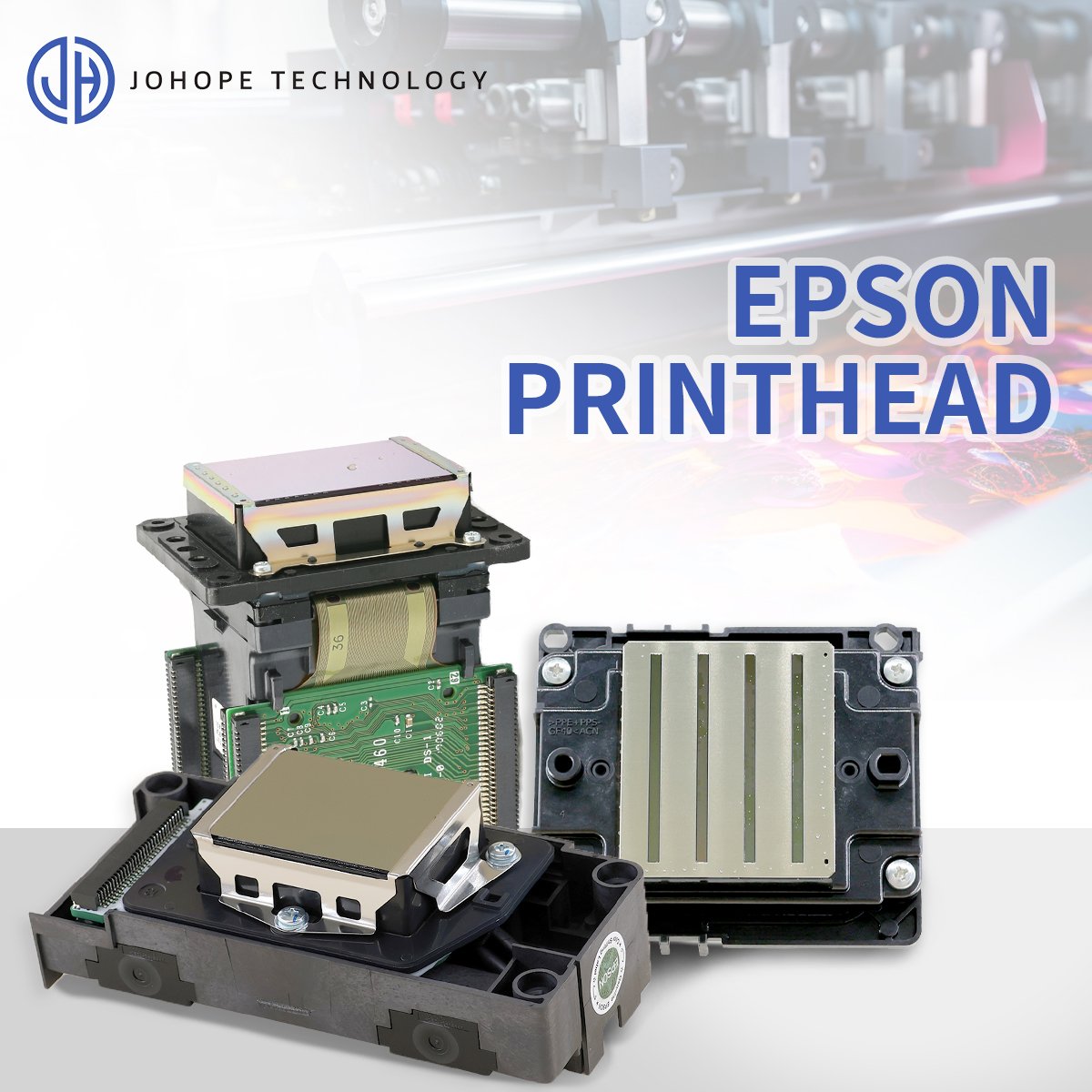
Introduction: Three Generations of Epson Piezo Printhead Technology
The development of Epson printheads can be divided into three major technology generations:
- First Generation: Single-Layer Piezoelectric Printheads (1978–1992)
The early commercial stage of piezo inkjet technology, establishing Epson’s cold printing foundation. - Second Generation: Multi-Layer Ceramic Micro Piezo Printheads (1993–2012)
The era that defined Epson’s core micro-piezo technology, improving print quality, ink compatibility, and durability. - Third Generation: Thin-Film Piezo Precision Core Printheads (2013–Present)
A new generation based on MEMS manufacturing technology, enabling higher nozzle density, faster printing, and industrial applications.
Alongside technological evolution, Epson developed three major product lines:
- Consumer desktop inkjet printers
- Wide-format photo and signage printers
- High-speed industrial inkjet printing systems
Together, these product families have driven Epson’s transition from office printing to industrial digital printing.
First Generation: Single-Layer Piezoelectric Printheads (1978–1992)
1978: Beginning of Piezo Inkjet Research
Based on its experience with piezoelectric ceramic technology used in dot matrix printers, Epson started research into on-demand piezoelectric inkjet printing.
Unlike thermal inkjet technology developed by companies such as Canon and HP, Epson selected a cold printing approach, which ejects ink through mechanical deformation rather than heating the ink.
This technology provided advantages in:
- Longer printhead lifetime
- Better ink compatibility
- Support for specialty inks
1982: Development of the IP-100 Inkjet Prototype
Epson successfully developed the IP-100 prototype, solving early challenges such as:
- Nozzle clogging
- Ink stability issues
- Compatibility with fast-drying inks
This proved the feasibility of piezoelectric drop-on-demand printing and created the foundation for commercial production.
1984: IP-130K / SQ-2000 — Epson’s First Commercial Piezo Inkjet Printer
In 1984, Epson launched the IP-130K (overseas model: SQ-2000), recognized as the company’s first commercially available piezo inkjet printer.
Key features:
- Single-layer-thick ceramic piezo printhead
- 24 nozzles
- Monochrome text printing
- Glass substrate structure
- Approximately 120 μm piezoelectric layer thickness
However, the first-generation printhead had limitations:
- High driving voltage requirements
- Limited piezo deformation
- Low nozzle density
- Restricted resolution
Despite these limitations, it marked Epson’s official entry into commercial piezo inkjet printing.
1988–1992: Development of MACH Multi-Layer Piezo Technology
To overcome the limitations of single-layer ceramic actuators, Epson shifted focus to multi-layer stacked piezoelectric structures.
The MACH (Multi-layer Actuator Head) technology used multiple ceramic layers, each approximately 20 μm thick, which significantly improved:
- Driving efficiency
- Piezo deformation
- Energy consumption
- Print stability
By 1992, MACH technology achieved stable mass production and became the foundation of the next-generation Micro Piezo printheads.
Second Generation: Micro Piezo Multi-Layer Ceramic Printheads (1993–2012)
1993: Stylus 800—Birth of Commercial Micro Piezo Technology
The launch of the Stylus 800 (Japan model MJ-500) marked a major milestone in inkjet printing history.
It was the first commercial printer equipped with Epson’s Micro Piezo multi-layer ceramic printhead.
Key improvements:
- Multi-layer ceramic piezo actuator
- Higher deformation efficiency compared with first-generation heads
- Variable-size droplet control
- Support for both dye and pigment inks
- Reusable long-life printhead design
Compared with thermal inkjet systems, micro-piezo technology offered better durability and broader ink compatibility.
1994: Color Micro Piezo Technology—Stylus Color Series
Epson introduced color Micro Piezo printheads with the Stylus Color series.
Main improvements:
- 720 dpi color printing
- Four-color independent nozzle arrays
- Variable Size Droplet Technology (VSDT)
The ability to combine different droplet sizes improved image smoothness and accelerated the adoption of home photo printing.
1996–2007: Expansion into Desktop and Industrial Printing
During this period, Epson continued improving Micro Piezo structures while expanding into professional printing markets.
Consumer Desktop Printing
Representative developments:
- Stylus Photo series
- Six-color Micro Piezo technology
- Up to 1440 dpi photo output
- Professional photo printing applications
- Early ink tank printer systems
- Reduced printing cost
- Improved long-term usability
Epson DX Series: The Era of Wide-Format Printing
Epson’s DX printheads became some of the most widely used printheads in the signage and advertising industry.
DX3 Printhead
The early generation is used in entry-level wide-format printers.
Characteristics:
- Lower nozzle count
- Moderate printing speed
- Mainly compatible with water-based and mild solvent applications
A transitional generation featuring:
- Single-color and dual-color versions
- Improved stability
- Adoption by Roland and Mimaki wide-format printers
DX5 Printhead (2004): The Industry Classic
The DX5 became one of the most influential Epson printheads in the aftermarket printing industry.
Key specifications:
- 1,440 nozzles (dual-channel)
- Support for water-based and mild solvent inks
- Strong durability and stability
It became a standard configuration for many:
- Eco-solvent printers
- Advertising printers
- Chinese wide-format printing machines
DX6 Printhead (2006): Professional Imaging Version
The DX6 was designed mainly for Epson’s professional photo printing systems.
Features:
- 8 independent color channels
- 720 nozzles per channel
- Total 5,760 nozzles
- Minimum droplet size: 3 pl
Unlike DX5, the DX6 was not designed for general advertising printers. It was mainly used for:
- Fine art reproduction
- Photography output
- Museum-quality printing
DX7 Printhead (2008)
The DX7 further improved Epson’s Micro Piezo technology.
Enhancements:
- Smaller ink droplets
- Better color transition
- Improved print longevity
It became a premium solution for high-quality wide-format printing.
2007: TFP Thin Film Piezo Technology Validation
Epson developed Thin Film Piezo (TFP) technology to overcome the physical limits of ceramic structures.
Major breakthroughs:
- Micron-level thin piezo layers
- MEMS-based manufacturing process
- Higher actuator efficiency
This technology became the foundation of the next-generation PrecisionCore platform.
Third Generation: PrecisionCore Thin Film Piezo Technology (2013–Present)
2013: PrecisionCore MicroTFP Commercial Launch
PrecisionCore represented a major technological shift.
By combining:
- Thin-film piezo technology
- MEMS semiconductor manufacturing
- High-density nozzle design
Epson created a new generation of industrial printheads.
Key advantages:
- Approximately 1 μm piezo-thin film structure
- High nozzle density
- Faster firing frequency
- Lower power consumption
- Improved jetting accuracy
- Broad ink compatibility
Supported applications include:
- Water-based pigment printing
- Eco-solvent printing
- UV printing
- Textile printing
- Specialty industrial inks
2014–2016: PrecisionCore Expansion into Consumer- and Small-Format Printing
Representative printheads:
Epson TX800 (F1770)
Applications:
- Photo printers
- Desktop printing equipment
- Small-format converted machines
Features:
- Compact design
- Low production cost
Epson XP600 (F1080)
Often called DX11 in the aftermarket market.
Improvements:
- Minimum droplet size around 3.5 pl
- Better precision
- Widely used in entry-level advertising printers
Epson 4720 / 5113 Printheads
Designed for higher-speed water-based printing.
Applications:
- Textile transfer printing
- Flag printing
- High-volume production
Compared with DX series printheads, PrecisionCore models achieved significantly higher nozzle density and productivity.
2017: PrecisionCore Linehead Technology for Industrial Printing
Epson introduced fixed PrecisionCore linehead systems.
Unlike scanning printheads, lineheads remain stationary while media moves continuously.
Applications:
- Labels
- Packaging
- Commercial printing
- High-speed digital production
These systems enabled inkjet technology to enter traditional industrial printing markets.
2018–2022: Modular Industrial PrecisionCore Printheads
Epson developed modular industrial printheads including:
Epson i1600
Features:
- 1,600 nozzles
- Compact industrial design
Epson i3200
Features:
- 3,200 nozzles
- Multiple ink-specific versions:
- A1: Water-based inks
- E1: Eco-solvent inks
- U1: UV inks
Applications:
- Advertising graphics
- Building materials
- Leather printing
- Industrial decoration
Multiple printheads can be combined to increase production capacity.
2023–2026: Next-Generation Industrial UV Printheads
Epson T3200-U3-2 (2026)
The upgraded T3200-U3-2 further improves industrial UV printing capability.
Key improvements:
- Ink temperature control up to 50°C
- Designed for high-viscosity UV inks
- Compatible with existing T3200-U3 systems
- Supports advanced industrial applications
Applications include:
- UV industrial coating
- 3D surface printing
- Special material decoration
Epson Printhead Technology Evolution Comparison
| Technology Generation | Period | Structure | Manufacturing | Representative Models | Key Features |
|---|---|---|---|---|---|
| First-Generation Piezo | 1984–1992 | Single-layer ceramic piezo | Ceramic processing | IP-130K / SQ-2000 | High voltage, low nozzle density, monochrome printing |
| Micro Piezo | 1993–2012 | Multi-layer ceramic MACH | Ceramic stacking technology | DX5, DX6, DX7 | Variable droplets, durable, wide ink compatibility |
| PrecisionCore MicroTFP | 2013–Present | Thin Film Piezo + MEMS | Semiconductor manufacturing | XP600, 4720, 13200, T3200 | High density, high speed, modular industrial printing |
Conclusion: Epson’s Long-Term Innovation in Piezo Inkjet Technology
Epson’s printhead evolution follows a clear technological path:
Single-layer ceramic piezo → Multi-layer micro piezo → Thin-film piezo precision core
The company has continuously improved:
- Droplet control
- Printing speed
- Ink compatibility
- Printhead durability
- Industrial scalability
By maintaining a long-term commitment to piezoelectric cold printing technology, Epson has built a strong foundation across consumer printing, wide-format graphics, textile printing, and industrial digital manufacturing.
From the early IP series to today’s PrecisionCore industrial platforms, Epson printheads remain one of the most influential technologies in the global inkjet printing industry.