
White ink is becoming an increasingly important part of digital corrugated packaging printing. It allows printers to create opaque backgrounds, improve color appearance on brown or colored corrugated board, and expand packaging design possibilities.
However, white ink is also one of the most challenging ink types to manage in industrial inkjet printing. Pigment sedimentation, nozzle clogging, unstable ink supply, slow drying, insufficient opacity, and poor color-layer compatibility can all affect production performance.
The results depend on more than the ink formulation alone. Printhead compatibility, pigment dispersion, ink circulation, pressure control, and maintenance must work together.
This guide compares four printhead platforms commonly discussed in corrugated digital printing—Epson i3200, Kyocera EX600, Fujifilm Dimatix SG1024, and Seiko 2536—and explains the key factors to consider when developing and operating a stable white ink system.
1. Why Is White Ink More Difficult to Print Than CMYK?
Most industrial white inks use titanium dioxide (TiO₂) as the primary white pigment. Its high density and solid-particle characteristics make sedimentation a major challenge during storage and printing.
If pigment particles settle unevenly, the ink may develop concentration differences throughout the supply system. This can lead to:
- Uneven white coverage and reduced opacity
- Filter loading and restricted ink flow
- Damper or nozzle blockage
- Unstable ink ejection
- Inconsistent results during long production runs
A reliable white ink system needs to address several factors simultaneously:
Pigment particle size and distribution: Particle size must be controlled to balance dispersion stability, opacity, and nozzle compatibility.
Dispersion system: Suitable dispersants help prevent particle aggregation and maintain a more uniform pigment distribution.
Viscosity: Ink viscosity must remain within the operating range supported by the selected printhead.
Ink circulation: Appropriate circulation or agitation helps reduce prolonged pigment settling in the ink supply path.
Resin and drying performance: The binder system must provide suitable adhesion, film formation, and drying behavior on corrugated board.
White ink performance is therefore a system-level engineering issue, not simply a matter of increasing pigment concentration.
2. Four Printhead Platforms for Corrugated White Ink Printing
Different printheads have different requirements for ink viscosity, particle characteristics, pressure conditions, waveform settings, and ink delivery. There is no universally best printhead for every white ink application.
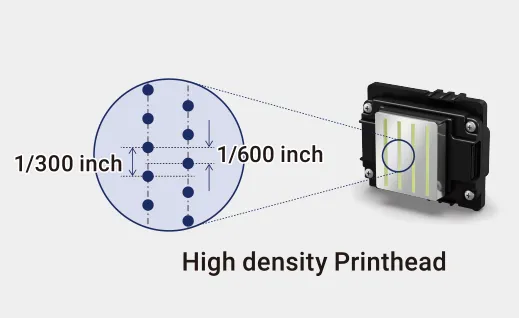
2.1 Epson i3200: A Cost-Effective Option for Production Flexibility
The Epson i3200 series is widely used in industrial inkjet equipment where print quality, productivity, and equipment investment must be balanced.
For corrugated printing, its suitability for white ink depends on the specific i3200 version, ink formulation, and ink supply design.
Key considerations:
- White ink must meet the printhead’s supported viscosity and material compatibility requirements.
- Pigment dispersion and filtration need to be carefully controlled.
- The ink supply system should prevent prolonged stagnation.
- Negative pressure and waveform settings must be matched to the actual ink characteristics.
- Automatic capping and appropriate idle-time maintenance help reduce nozzle drying.
Potential applications: Cost-conscious digital corrugated printers, short-run packaging, and applications with moderate white coverage requirements.
2.2 Kyocera EX600: An Option for Industrial Production
Kyocera industrial printhead technology is used in demanding production environments where stable ink delivery and consistent jetting performance are important.
For white ink applications, the key is to match the ink formulation and supply architecture to the specific EX600 configuration.
Key considerations:
- Stable waveform and jetting parameters
- Consistent ink viscosity and temperature
- Appropriate filtration and pressure management
- Continuous ink circulation where required by the system design
- Reliable performance during extended production runs
Potential applications: Industrial corrugated printing and production environments requiring consistent output at higher operating speeds.
2.3 Fujifilm Dimatix SG1024: For High-Deposit White Applications
The Fujifilm Dimatix SG1024 platform is used in industrial printing applications requiring robust inkjet performance.
For corrugated white printing, it may be considered for applications involving substantial white deposits, such as opaque backgrounds and white underlayers.
Key considerations:
- Ink formulation must match the specific printhead variant.
- Waveform settings should be optimized for the ink’s physical properties.
- Pigment dispersion and filtration are essential.
- Ink delivery must remain stable under the required production conditions.
Potential applications: High-coverage white printing, opaque underlayers, and selected corrugated pre-print applications.
2.4 Seiko 2536: An Industrial Platform for High-Coverage Applications
Seiko industrial printhead platforms are used in a range of demanding inkjet applications. The suitability of a particular 2536 configuration for white ink depends on its technical specifications and the machine’s ink delivery design.
Key considerations:
- Verify the supported ink chemistry and viscosity range.
- Evaluate particle-size compatibility and filtration requirements.
- Maintain stable pressure and ink flow.
- Confirm that the ink system can support the required white ink consumption.
- Optimize waveform and operating parameters through practical testing.
Potential applications: Corrugated packaging requiring substantial white coverage and industrial production performance, subject to configuration compatibility.
3. How to Match White Ink Systems with Different Printheads
Printhead selection should be based on the actual production requirements rather than brand reputation alone.
| Printhead platform | Main selection considerations | Potential application |
|---|---|---|
| Epson i3200 | Ink compatibility, viscosity, pressure stability and maintenance | Short-run and flexible production |
| Kyocera EX600 | Jetting stability, circulation and production consistency | Industrial corrugated printing |
| Fujifilm Dimatix SG1024 | Ink deposit, waveform and formulation compatibility | High-coverage white applications |
| Seiko 2536 | Ink flow, filtration and high-coverage requirements | Industrial packaging applications |
These are application-oriented considerations, not a universal performance ranking. Actual print speed, white opacity, and production stability depend on the complete printer configuration.
4. Eight Ways to Improve White Ink Stability and Printing Performance
The following measures provide a practical starting point for equipment manufacturers and printing factories.
1. Optimize Pigment Particle Size
Particle-size distribution affects sedimentation, dispersion stability, filtration, and nozzle compatibility.
A range around 200–250 nm may be investigated during formulation development, but it should not be treated as a universal specification. The suitable range depends on the pigment, dispersant, particle-size distribution, and printhead requirements.
2. Improve Dispersion Stability
A suitable combination of dispersants can help maintain pigment distribution and reduce particle aggregation.
Zeta potential can be used as one indicator when evaluating certain dispersion systems. However, a value above ±35 mV is not a universal requirement for every white ink. The measurement method, solvent environment, and steric stabilization mechanism must also be considered.
3. Control Ink Viscosity
White ink must maintain stable viscosity under actual operating temperatures.
Do not apply a general viscosity target such as 8–12 cP to every printhead. Different printhead models have different supported ink viscosity ranges, which should be confirmed before ink development and equipment adjustment.
4. Use an Appropriate Ink Circulation System
White ink circulation helps reduce prolonged stagnation and supports more consistent pigment distribution.
A properly designed system should consider:
- Main tank and secondary tank arrangement
- Pump flow rate
- Supply and return paths
- Filter position and rating
- Pressure stability
- Air bubble prevention
A true circulation loop should provide a defined return path. Simply returning excess ink to a tank does not necessarily guarantee effective circulation throughout the entire ink circuit.
For more information, see our guide to Secondary Ink Tanks: Functions & Selection.
5. Manage Temperature Carefully
Temperature affects ink viscosity, flow behavior, and drying performance.
Some systems may use printhead or ink temperature control to maintain consistent operating conditions. However, a fixed temperature of 35–40°C should not be applied to all printheads and white ink formulations.
The correct operating range must be established through ink supplier recommendations and printhead specifications.
6. Select a Suitable Resin System
The resin must provide sufficient adhesion and film formation on corrugated board.
Important factors include:
- Substrate absorption
- Surface energy
- Drying conditions
- Required white opacity
- Compatibility with overprinted CMYK layers
A suitable resin system helps reduce problems such as poor adhesion, uneven coverage, and color-layer separation.
7. Coordinate White and Color Ink Layers
When white ink is used as an underlayer, its compatibility with CMYK ink becomes especially important.
Differences in resin chemistry, surface tension, and drying behavior may lead to poor interlayer adhesion, uneven color appearance, or surface defects.
White and color ink systems should therefore be evaluated together under actual printing and drying conditions.
8. Improve Automatic Maintenance During Downtime
White ink printing requires particular attention during machine idle periods.
Recommended measures include:
- Appropriate white ink agitation or circulation
- Automatic capping
- Scheduled nozzle checks
- Automatic spitting where supported
- Regular inspection of filters and dampers
- Proper shutdown and restart procedures
The maintenance strategy should be designed around the ink formulation and printer architecture rather than relying on circulation alone.
For additional maintenance guidance, read our article on How to Extend the Service Life of an Epson I3200 U1 Printhead.
5. What Should Equipment Manufacturers and Printing Factories Evaluate?
Before selecting a white ink system for corrugated digital printing, it is useful to evaluate the entire production process.
| Evaluation area | What to check |
|---|---|
| Printhead | Ink compatibility, viscosity range and jetting stability |
| White ink | Opacity, dispersion stability, adhesion and drying |
| Ink supply | Circulation, filtration, pressure and temperature |
| Printing performance | Coverage, production speed and color consistency |
| Maintenance | Capping, agitation, nozzle checks and downtime procedures |
A white ink system should be tested under actual production conditions, including continuous printing, machine idle periods, restart procedures, and different corrugated board surfaces.
Conclusion
White ink is one of the most technically demanding parts of digital corrugated printing. Its performance depends on the interaction between pigment formulation, printhead characteristics, ink supply design, and maintenance procedures.
Epson i3200, Kyocera EX600, Fujifilm Dimatix SG1024, and Seiko 2536 offer different possibilities for industrial printing applications, but none should be selected based on printhead specifications alone.
Stable white ink printing requires the right combination of printhead compatibility, pigment dispersion, viscosity control, circulation, filtration, and maintenance.
For equipment manufacturers and printing factories, optimizing the entire ink delivery system is essential to achieving consistent white coverage, reducing nozzle-related interruptions, and improving production reliability.
Frequently Asked Questions
1. Why Does White Ink Sediment More Easily Than CMYK Ink?
White ink commonly uses titanium dioxide (TiO₂) as its main pigment. Its relatively high density makes sedimentation more likely, especially when ink remains stationary for extended periods. Proper dispersion, circulation, and regular maintenance help manage this issue.
2. Which Printhead Is Suitable for White Ink in Corrugated Digital Printing?
Epson i3200, Kyocera EX600, Fujifilm Dimatix SG1024, and Seiko 2536 are potential options for different industrial applications. The right choice depends on ink compatibility, viscosity requirements, production speed, white coverage, and ink supply system design.
3. Does White Ink Require a Circulation System?
Many pigment-based white ink systems benefit from circulation because it helps reduce prolonged pigment settling. However, the circulation design must match the ink formulation and printhead requirements. It should not introduce excessive pressure fluctuations or air bubbles.
4. How Can White Ink Clogging Be Reduced?
Maintain suitable pigment dispersion, use compatible filters, control ink viscosity, and prevent prolonged ink stagnation. Regular nozzle checks, appropriate capping, and proper circulation also help reduce clogging risks.
5. Why Is White Ink Coverage Sometimes Uneven on Corrugated Board?
Uneven coverage may result from pigment distribution problems, unstable ink supply, insufficient ink deposition, substrate absorption differences, or incorrect printing and drying parameters. Both the ink formulation and printer settings should be checked.