Why Timing Belt Selection Goes Wrong So Often
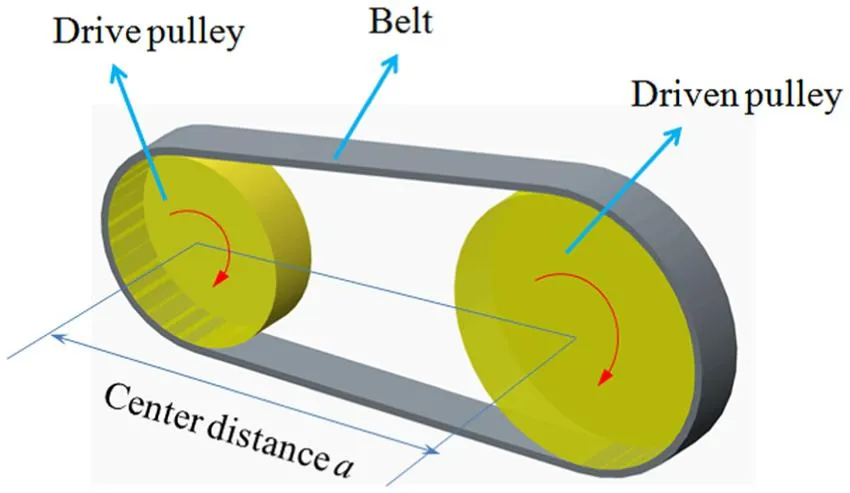
Every large-format printer relies on a handful of timing belts to keep motion precise: one drives the carriage back and forth across the print head, one feeds media through the machine, and often a third drives the cleaning or capping station. When any of these belts stretches, cracks, or loses teeth, the fix looks simple—order a replacement. In practice, it's one of the most commonly misordered parts in the industry.
The reason is twofold: the same physical belt can be labeled in several different ways depending on who applied the marking, and belts with an identical pitch can still be completely different products with different tooth shapes. This guide covers the naming logic, the full family of tooth profiles, how to read a part number correctly, and what to do when your old belt doesn't have a legible marking at all.
The Full Family of Timing Belt Tooth Profiles
Before getting into part numbers, it helps to see the bigger picture—timing belt tooth shapes go well beyond the handful of profiles most buyers have heard of (MXL, S2M). Grouped by tooth geometry:
| Category | Representative series | Tooth characteristics |
|---|---|---|
| Trapezoidal (Imperial) | MXL, XXL, XL, L, H, XH, XXH | Straight-sided trapezoidal tooth; the most widely used imperial family, spanning light to extra-heavy duty |
| T-type / AT-type (Special) | T2.5, T5, T10, T20; AT5, AT10, AT20 | T is a full trapezoidal tooth; AT has a curved tooth root, giving smoother engagement, less backlash, and lower noise |
| HTD full-curvilinear | HTD3M, HTD5M, HTD8M, HTD14M, HTD20M | Fully curved tooth profile — high transmission accuracy, low noise, widely used |
| STD/STS semi-curvilinear (high-torque) | S2M, S3M, S4.5M, S5M, S8M, S14M | Curved-root, high-torque design that balances precision and load capacity; typically priced higher |
| GT precision curvilinear | 1.5GT, 2GT, 3GT, 5GT | Gates' patented tooth geometry, mostly imported rather than domestically produced, used in high-precision automation |
| Specialty profiles | 8YU; RPP5M / RPP8M | 8YU is a high-speed, high-torque profile used in medical equipment; RPP ("rabbit-tooth") profile handles tight turns well and is common in robotic arms |
| Double-sided | Square-tooth DXL/DL/DH; curvilinear 3M-DL/5M-DL/8M-DL/14M-DL | Teeth on both faces, for bidirectional drive or driving multiple axes at once |
The Three Numbers That Define a Belt
Regardless of category, every timing belt is fully described by three physical measurements:
- Tooth profile—the specific profile code, such as S2M, 2GT, HTD3M, or MXL.
- Pitch—the fixed distance between tooth centers for a given profile. This is what defines the profile; it doesn't vary by belt length.
- Length, tooth count, and width—the three variables that differ from one belt to the next within the same profile.
Pitch is the anchor—but as the previous section makes clear, matching pitch alone narrows the range; it doesn't guarantee a unique answer.
Two Naming Systems: Metric vs. Imperial
Belt part numbers follow one of two conventions, and mixing them up is the single most common source of ordering errors.
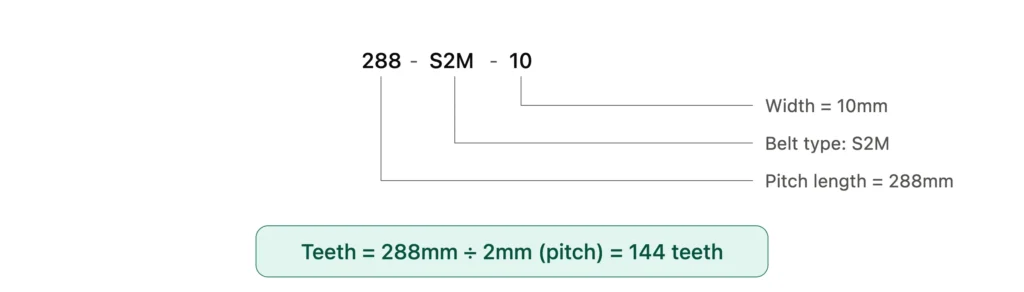
Metric profiles (S2M, S3M, S5M, 2GT, HTD3M, etc.) use a straightforward format:
[pitch length in mm] - [profile] - [width in mm]For example, it 288-S2M-10 is a belt with a 288 mm pitch length, S2M profile, and 10 mm width. Tooth count is simply pitch length divided by pitch: 288 ÷ 2 mm = 144 teeth.
Imperial profiles (MXL, XL, XXL) use a length-code format instead:
[pitch length code] [profile] - [width in mm]Here, the number is the pitch length in tenths of an inch, not millimeters. 144MXL-15mm means 14.4 inches—convert to mm (14.4 × 25.4 = 365.76 mm) and divide by the MXL pitch (2.032 mm) to get 180 teeth.
Some suppliers skip the length-code format entirely and print the tooth count directly, usually with a "B" prefix: B180MXL-15mm means exactly what it says—180 teeth, no conversion needed.
These two labels describe the same belt. 144MXL-15mm and B180MXL-15mm both work out to 180 teeth, a 365.76 mm circumference, and a 15 mm width. If a customer sends either code, they're describing the same part—the only difference is which naming convention their original supplier used.
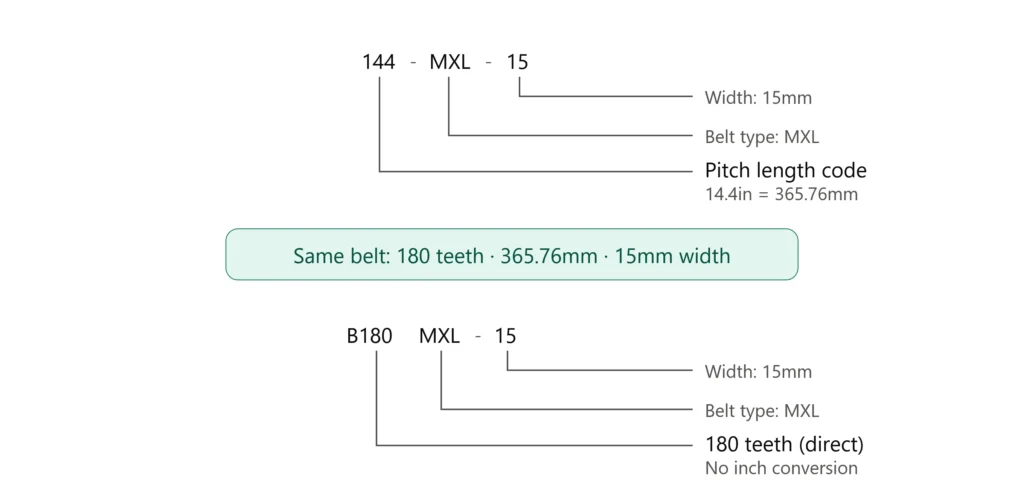
(Diagram: model-code breakdown, 144-MXL-15 alongside B180MXL-15, showing both calculation paths arriving at the same 180-tooth result.)
A useful sanity check when a code looks unusual: a belt can't have a fractional tooth. If converting a number through the length-code formula produces something like 91.2 or 183.75 teeth, that number was never meant to be read that way—it's almost certainly a direct tooth count instead. This single check resolves most ambiguous part numbers without needing to see the belt in person.
Same Pitch, Different Belt—It's Bigger Than Just S2M vs. 2GT
Once you factor in the full profile family from Section 2, "same pitch, different tooth shape" turns out to be more common than most buyers expect:
| Pitch | Profile families that share it | What's different |
|---|---|---|
| 2 mm | S2M (semi-curvilinear, high-torque), 2GT (Gates precision curvilinear) | Different tooth-root curvature and meshing precision; different price points and typical applications |
| 3 mm | S3M (semi-curvilinear), HTD3M (full curvilinear), 3GT (precision curvilinear) | Increasing degree of curvature—and increasing precision and cost—across the three |
| ~5 mm | XL (5.08 mm, imperial trapezoidal), S5M (5.00 mm, semi-curvilinear) | Close but not identical—not interchangeable |
So "I measured 2mm pitch" isn't a complete answer on its own—it could be S2M, could be 2GT, and in principle could match other less common profiles sharing that pitch. The deciding factor is the tooth's physical shape and curvature, which a pitch measurement alone can't tell you. A close-up photo settles it in seconds.
Reading Each Profile's Model Code
The metric-profile logic is consistent across the board—only the pitch value changes:
| Profile | Pitch | Example code | Reading it |
|---|---|---|---|
| S2M | 2.00mm | 288-S2M-10 | 288 mm length ÷ 2 mm = 144 teeth, 10 mm wide |
| S5M | 5.00mm | 375-S5M-15 | 375 mm length ÷ 5 mm = 75 teeth, 15 mm wide |
| 2GT | 2.00mm | 376-2GT-15 | 376 mm length ÷ 2 mm = 188 teeth, 15 mm wide |
| HTD3M | 3.00mm | 357-HTD3M-35 | 357 mm length ÷ 3 mm = 119 teeth, 35 mm wide |
For imperial profiles, the shortcut varies by pitch because the ratio between pitch and the 0.1-inch coding unit is different for each:
| Profile | Pitch | Shortcut formula | Example |
|---|---|---|---|
| MXL | 0.080" | number × 1.25 = teeth | 144MXL → 144 × 1.25 = 180 teeth |
| XXL | 0.125" | number × 0.8 = teeth | 142.5XXL → 142.5 × 0.8 = 114 teeth |
| XL | 0.200" | number ÷ 2 = teeth | 140XL → 140 ÷ 2 = 70 teeth |
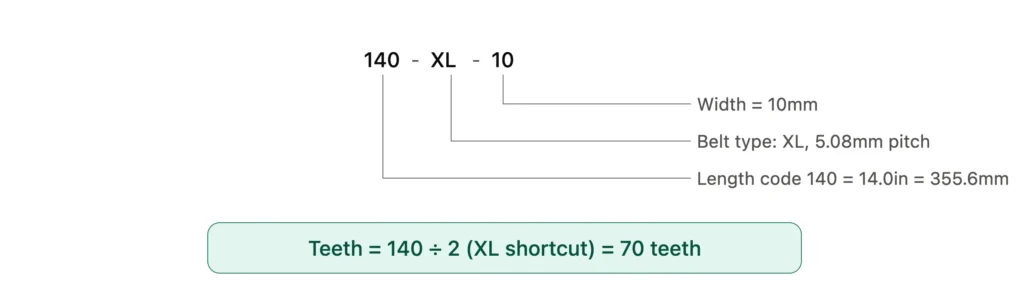
(Diagram: model-code breakdown for a representative example from each profile.)
No Legible Marking on Your Old Belt? Do This
Belt markings wear off with use, and some timing belts were never printed at all. When that happens, four measurements are enough to identify the replacement:
- Check the tooth shape category. Compare the belt against a reference—is it a straight-sided trapezoidal tooth (MXL-type), a curved-root profile (S2M-type), or a fully curved tooth (HTD/GT-type)?
- Count the teeth. Count how many complete teeth fall within any 10 cm section of the belt. Combined with the tooth shape, this narrows the pitch down to one or two likely profiles.
- Measure the pitch. The distance from the center of one tooth to the center of the next, in mm—this confirms the pitch directly.
- Measure the total length. Run a flexible tape along the inside of the belt for the full pitch circumference in mm.
(Diagram: four-step visual guide—check tooth shape, count teeth, measure pitch, measure circumference.)
Send these four data points along with a close-up photo of the tooth profile, and a correct match can be confirmed without ever having the old belt in hand—the photo matters most for the tooth-shape step, since written descriptions alone are easy to get wrong.
Matching Timing Belts to Printer Subsystems
Large-format printers use timing belts in several different roles, and the belt specification often differs by subsystem even within the same machine:
- Carriage drive—moves the print head across the width of the media. Typically a wider, higher-tooth-count belt since it covers the full print width and needs to resist stretch under repeated back-and-forth motion.
- Media feed—advances paper or vinyl through the machine. Often a shorter belt paired with a feed roller.
- Cleaning/capping station—moves the wiper or cap assembly to service the print head. Usually the shortest, narrowest belt on the machine, and the one most often mistaken for the carriage belt because it looks similar at a glance.
Because these are different belts on the same printer, knowing your printer's model alone isn't enough to order the correct part—the position matters as much as the model.
Common Ordering Mistakes We See
Reading a length code as a tooth count. A buyer sees "144MXL" and assumes 144 teeth, when the correct reading for that number is a length code that converts to 180 teeth. Ordering by the wrong tooth count means the belt won't reach around the pulleys correctly.
Matching on pitch alone. A buyer confirms "2mm pitch" and orders an S2M belt, when the original was a 2GT—same pitch, different tooth shape, doesn't mesh with the existing pulley.
Forcing a single classification label onto every profile. Calling S2M simply "trapezoidal" or simply "curvilinear" both oversimplify it—it's a curved-root, high-torque design that sits between the two, and the industry itself doesn't fully agree on the label. Don't rely on a single category name; confirm against the actual tooth profile or the manufacturer's CAD drawing.
Trusting an unverified reference chart. Even published parameter tables aren't immune to errors. We've seen a widely circulated XXL reference table where every row past the first was calculated using the wrong pitch value (5.08 mm instead of 3.175 mm)—the kind of copy-paste formula error that's easy to miss unless every row is independently checked. It's a good reminder to verify a supplier's numbers against the base formula before ordering in bulk, not just trust the table at face value.
Checklist Before You Order
- Tooth profile confirmed (not just pitch, and not just a loose "trapezoidal vs. curvilinear" label)
- Pitch length or tooth count confirmed
- Width confirmed
- Old belt marking or measurements on hand
- Photo of the tooth profile, if the marking is unclear
- Correct subsystem identified (carriage vs. feed vs. cleaning station)
Still Not Sure Which Timing Belts You Need?
Send us a photo of the belt's tooth profile along with your measurements—even a rough count and a tape-measure length are enough for our team to confirm the closest stock match or arrange a custom-length belt. We stock MXL, XL, XXL, S2M, S3M, S5M, 2GT, and HTD3M profiles across a wide range of lengths and widths for large format printer carriage, feed, and cleaning systems.
Contact our team → JOHOPE.