While inkjet printheads, inks, drying, and software all affect print quality, this article will focus on the evolution of printheads in delivering improved results as production inkjet printing expands into new areas.
When single-pass production inkjet technology became commercially viable, graphic arts applications were purely wishful thinking. Printheads must now offer higher resolution and accuracy to meet the demands of high-coverage, high-color applications. There are many challenges to achieving this combination, which we will discuss for different printhead technologies.
Printhead Technology for Graphic Arts Production
Inkjet printhead types used for graphic arts printing include piezoelectric, thermal, and continuous inkjet (CIJ). Piezoelectric and thermal printheads are known as drop-on-demand (DOD) technology because they are activated to eject a drop of ink only when needed, whereas CIJ printheads eject continuously.
The piezoelectric printhead delivers electrical pulses to the piezoelectric crystal, which causes the ink chambers in the nozzle to expand and contract, creating the pressure needed to propel the ink droplets.
Thermal inkjet printheads use heating elements in the nozzle (rather than piezoelectric crystals) to create pressure pulses that propel ink droplets.
CIJ printheads continuously circulate ink. As the ink exits the nozzle, the ink stream is separated into droplets for printing and those that need to be recycled.
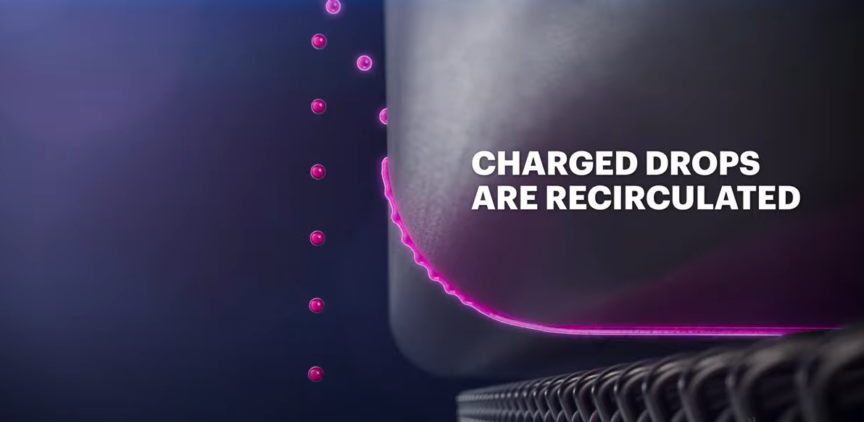
The CIJ printhead's unique continuous drop recycling feature is not to be confused with the ability to "recycle" DOD printheads. Circulating DOD printheads provide a constant flow of ink inside the printhead, helping to prevent nozzles from drying out and clogging, which can prevent jetting and other defects. Circulation also helps keep the ink temperature more stable, which is especially important for thermal printheads. This feature is a relatively new and sophisticated feature for DOD printheads but is inherent to CIJ printheads.
All of these printhead technologies have evolved over time, pursuing different quality metrics through different methods.
The Evolution of Print Quality
Fifteen years ago, the main application area for production inkjet printers was monochrome customer communications, where 300dpi resolution was sufficient for most needs. As inkjet printers have progressed in solving more challenging applications, the emphasis on different print quality metrics has also changed.
In the early days, inkjet printhead manufacturers focused on increasing native resolution. In order to increase the number of drops per inch (dpi), the drops themselves must become smaller. As the dpi upper limit increases from 300 to 600 to 1200 and beyond, droplet volume steadily decreases proportionally. However, smaller droplets are more susceptible to wind shear caused by the movement of the substrate beneath the printhead. When the long tail separates from the main drop, it breaks into "satellites" that hit the substrate after the main drop, causing blurring.
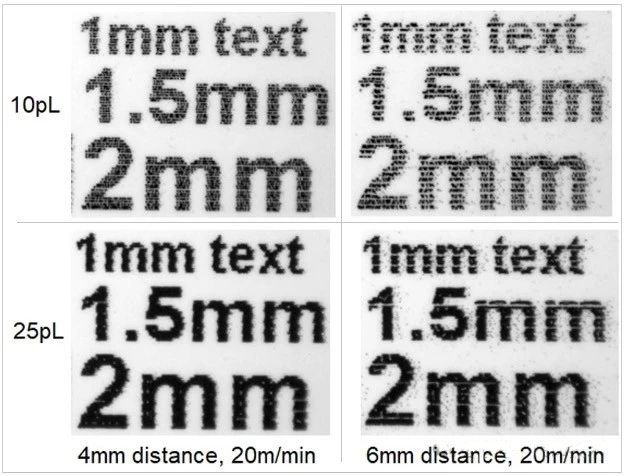
Example of piezoelectric printhead reducing spray accuracy and increasing satellite count at higher spray distances
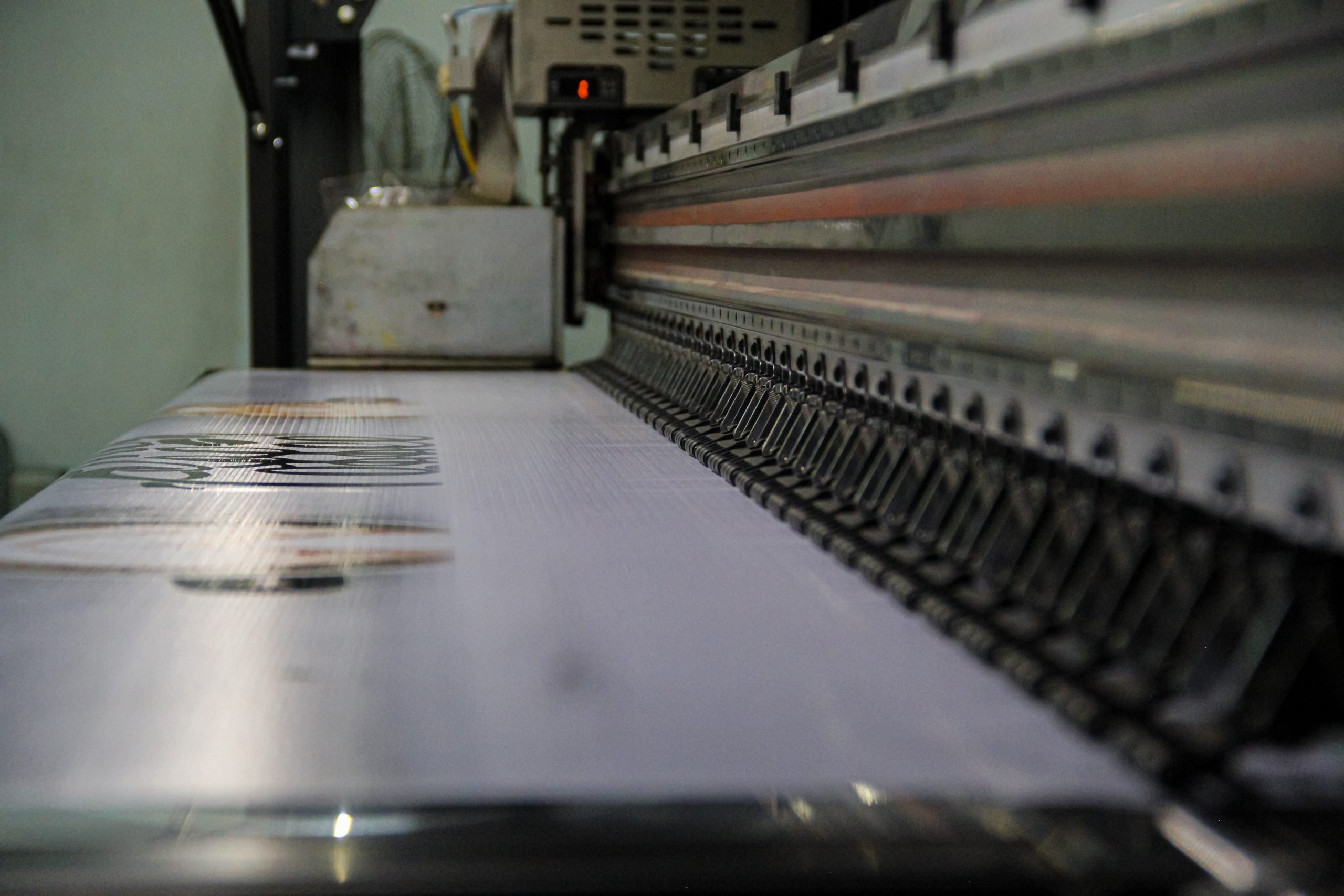
To avoid printing defects caused by air turbulence, the jet distance between the print head and the substrate must be reduced, or the jet speed must be increased. Pulsing is required to generate droplets, which limits the DOD printhead's ability to increase jet speed and therefore requires the printhead to be closer to the substrate than a CIJ printhead. This requires additional equipment to lift the print head to support automated functions such as uninterrupted winding and splicing to prevent damage to the print head.
While higher resolution is a primary consideration when evaluating text print quality, higher grayscale, or bits per dot, is critical for optimizing images, especially photographic images. The binary inkjet printheads change the position of fixed-size dots with the help of an error diffusion algorithm to match the density changes of the photographic image. With a single-point size, it is difficult to avoid visible "stepping" unless the points are very small. However, using multiple volumes produces a range of droplet sizes on the media, improving tonal range and edge definition.
Leading piezoelectric printhead manufacturers initially addressed this challenge by enabling “dynamic drop-on-demand” ejection of three or even four different drop sizes. However, using smaller droplets and multiple droplet sizes requires higher firing frequency, which can impact productivity. As a result, most of today's piezoelectric printheads for graphic arts only eject two different drop sizes. It is also possible to interleave high-drop-weight nozzles with low-drop-weight nozzles in the same printhead, as HP does with its HDNA thermal printheads. Excellent grayscale reproduction is achieved when all nozzles are used, but forming smaller droplets consistently at high speeds is challenging, resulting in a trade-off between speed and quality where the best is only achieved at lower speeds quality and vice versa. A third way to optimize image reproduction is by delivering small drop volumes and ejecting multiple droplets accurately to the same spot to create larger dots. This approach requires higher firing frequencies and drop velocities unique to CIJ printheads.
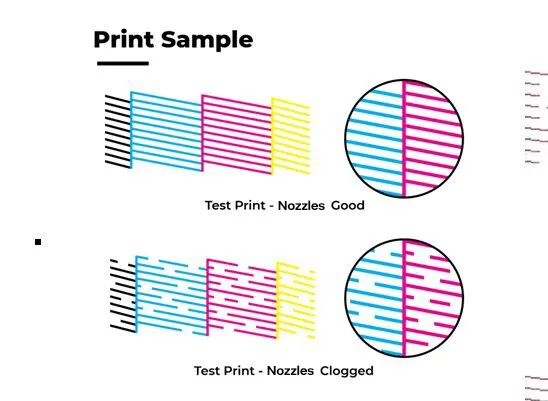
Print quality is also affected by the health of the inkjet printheads. Even the highest resolution printheads with precise drop formation can produce substandard results if the nozzles become clogged due to internal ink drying. Capping the printhead during downtime can help avoid this problem, but there are other causes of clogged nozzles. Printheads located close to the substrate can be negatively affected by dust and debris from the media moving underneath. Some press manufacturers have added in-line print quality systems to dynamically compensate for potential jetting using redundant nozzles. All of these important but expensive systems can be avoided by using the printhead farther from the substrate, jetting at higher speeds, and recirculating the ink to avoid clogging.