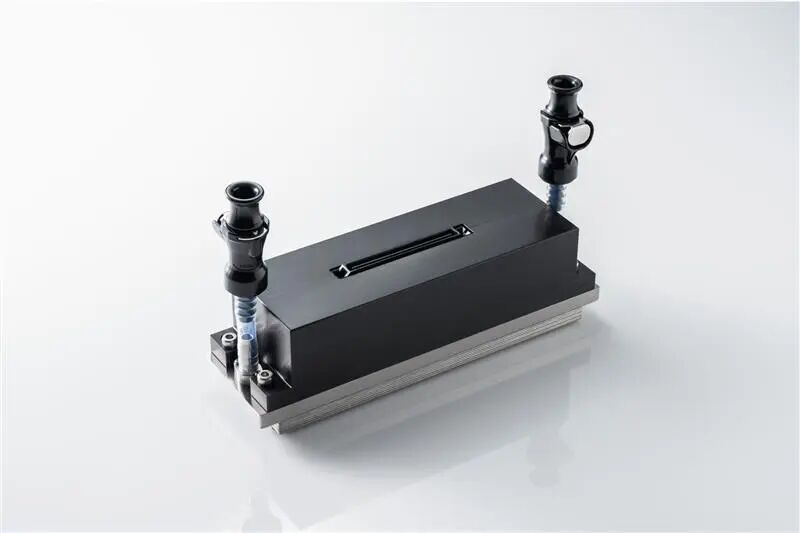
Industrial inkjet technology is rapidly evolving from graphic printing into advanced manufacturing. Recently, Kyocera announced a prototype inkjet printhead designed specifically for high-viscosity fluids—marking a significant step toward transforming inkjet into a true material deposition platform.
Although still in the prototype stage, the technology signals a major shift: enabling stable jetting of functional and industrial materials previously considered unsuitable for inkjet systems.
Why High-Viscosity Inkjet Matters
Traditional inkjet printheads are optimized for low-viscosity inks, typically in the 3–11 mPa·s range. While these fluids are easy to jet, they limit the range of materials that can be used.
As industries push toward digital manufacturing, demand for higher-viscosity materials is growing rapidly, including:
- Functional inks (conductive, dielectric, PCB inks)
- Automotive coatings
- Textile and packaging printing
- Additive manufacturing materials
- High-solids eco-friendly coatings
Historically, manufacturers relied on heating ink to reduce viscosity, but this approach introduces limitations:
- Temperature constraints for system safety
- Material instability at elevated temperatures
- Increased energy consumption and complexity
A printhead capable of jetting high-viscosity fluids at room temperature represents a major technological leap.
Core Technical Innovations
Kyocera’s development builds on its KJ4 printhead architecture and focuses on solving two fundamental challenges of high-viscosity jetting: fluid transport and jetting force.
1. Reinvented Piezo Actuator Design
Conventional piezo inkjet heads use bending-mode actuation, which struggles with thick fluids. Kyocera redesigned the actuator structure to significantly increase jetting force.
Key improvements include:
- Substantially stronger droplet ejection energy
- Larger droplet formation capability
- Expanded material compatibility
This innovation leverages Kyocera’s long-standing expertise in piezo ceramics, including multilayer ceramic and crack-controlled structures previously used in automotive and industrial components.
2. Optimized Internal Fluid Channels
High-viscosity fluids introduce major flow challenges:
- Higher resistance
- Increased stagnation risk
- Reduced recirculation stability
Using advanced fluid simulation, Kyocera redesigned the internal ink pathways to achieve:
- Smoother fluid transport
- Stable chamber pressure
- Improved continuous jetting reliability
This is critical for industrial production environments where uptime and consistency are essential.
Key Specifications
While still a prototype, the printhead demonstrates strong industrial positioning:
| Specification | Value |
|---|---|
| Nozzle Count | 1,584 |
| Print Width | 111.69 mm |
| Resolution | 360 × 360 dpi |
| Max Viscosity | 80 mPa·s (room temperature) |
| Drop Volume | ~280 pL |
These specs reflect a typical industrial trade-off:
Higher viscosity often prioritizes material performance over image resolution.
In applications like coatings and material deposition, 360 dpi is considered high resolution.
How It Compares to Industry Trends
Kyocera is not alone in exploring high-viscosity inkjet. For example:
- Xaar has developed printheads capable of handling ultra-high-viscosity fluids using recirculating architectures.
However, Kyocera’s approach stands out due to:
- High nozzle density (>1500 nozzles)
- Strong piezo-driven jetting force
- Focus on scalable industrial production
This positions the technology closer to mass-production platforms rather than niche experimental systems.
Potential Application Areas
High-viscosity jetting opens the door to a wide range of next-generation applications.
Advanced Manufacturing
- Printed electronics
- Semiconductor materials
- Functional coatings
Industrial Coatings
- Automotive digital painting
- High-solids eco coatings
- Precision surface deposition
Additive Manufacturing
- Material jetting 3D printing
- Multi-material deposition systems
Textile and Packaging
- Direct-to-fabric without heavy pre-treatment
- Durable industrial printing
Still a Prototype — But Strategically Important
Kyocera’s new printhead is currently:
- Unnamed
- Designed for test rigs and robotic systems
- Lacking standardized mounting hardware
This aligns with Kyocera’s typical strategy: release early prototypes, collaborate with industry partners, and refine designs before commercialization.
The path from prototype to full production could take several years.
What This Means for the Inkjet Industry
High-viscosity printheads signal a broader transformation:
Inkjet is evolving from a printing method into a digital material deposition technology.
Key industry implications include:
- Expansion into high-value industrial sectors
- Growth of functional material jetting
- Greater emphasis on material compatibility over pure resolution
Additionally, sustainability trends are accelerating adoption of high-viscosity water-based materials, further strengthening the market outlook.
Implications for Equipment and Components
For equipment manufacturers and inkjet component suppliers, high-viscosity systems introduce new technical demands:
Engineering Challenges
- Higher negative pressure stability
- Advanced ink delivery architectures
- Stronger sealing requirements
Emerging Component Opportunities
- High-pressure ink supply modules
- Advanced filtration systems
- High-viscosity cleaning and maintenance solutions
This shift may reshape the entire inkjet ecosystem, especially in industrial segments.
Conclusion
Kyocera’s high-viscosity inkjet printhead prototype represents a meaningful milestone in the evolution of industrial inkjet. By combining a redesigned piezo actuator with optimized fluid dynamics, the company is pushing the boundaries of what inkjet systems can handle.
As demand for functional materials and digital manufacturing continues to grow, high-viscosity inkjet technology is poised to play a central role in the next phase of industrial innovation.