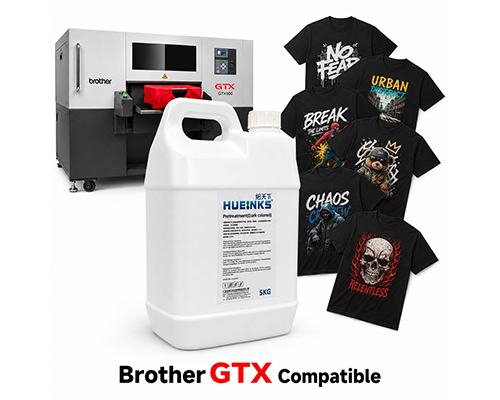
When discussing Direct-to-Garment (DTG) printing, most people focus on printers, printheads, inks, and RIP software. However, one critical factor is often overlooked—the DTG pretreatment solution.
No matter how advanced your DTG printer is, poor pretreatment can lead to dull colors, weak white ink coverage, poor wash durability, and inconsistent print quality. In many cases, the difference between an average print and a professional-grade result comes down to proper pretreatment.
In this guide, we'll explore what a DTG pretreatment solution is, why it matters, how it works, and the best practices for achieving consistently outstanding results.
What Is a DTG Pretreatment Solution?
A DTG pretreatment solution is a specially formulated liquid applied to garments before printing. It prepares the fabric surface to receive DTG inks and creates an optimal environment for ink bonding.
Think of pretreatment as a primer before painting a wall. Without it, the final finish may look uneven, faded, or lack durability.
Pretreatment solutions are particularly important when printing on dark-colored garments, where white ink is required as a base layer beneath the colored artwork.
Why Is Pretreatment So Important?
1. Improves Color Vibrancy
Fabric fibers naturally absorb ink. Without pretreatment, much of the ink penetrates deep into the garment instead of remaining on the surface where it can produce vivid colors.
A proper pretreatment layer helps:
- Increase color saturation
- Enhance image brightness
- Improve contrast
- Preserve fine details
The result is sharper, more vibrant artwork that better matches the original design.
2. Enhances White Ink Performance
White ink plays a critical role in DTG printing, especially on black and dark garments.
Without pretreatment, white ink can sink into the fabric, causing:
- Dull white underbases
- Reduced opacity
- Washed-out colors
- Poor image definition
Pretreatment creates a surface that allows white ink to sit closer to the fabric surface, resulting in brighter whites and improved color reproduction.
3. Increases Wash Durability
Customers expect printed garments to withstand repeated washing without fading or cracking.
Proper pretreatment helps establish a stronger bond between the ink and the fabric, improving:
- Wash fastness
- Scratch resistance
- Print longevity
- Overall durability
A well-pretreated garment can maintain its appearance through many wash cycles.
4. Improves Print Sharpness
Fabric surfaces contain tiny fibers and irregular textures that can cause ink spreading.
Pretreatment helps smooth and stabilize the printing area, resulting in:
- Cleaner edges
- Better small-text readability
- Sharper lines
- Improved image clarity
This is especially important for detailed graphics, logos, and high-resolution artwork.
How Does DTG Pretreatment Work?
Pretreatment solutions perform several important functions at the fabric level.
Filling Fabric Gaps
Textile fibers contain microscopic spaces that can absorb and disperse ink.
Pretreatment fills many of these gaps, creating a more uniform printing surface.
Creating an Ink-Bonding Layer
Special ingredients within the pretreatment solution react with DTG inks during printing and curing.
This interaction helps keep the ink on the fabric surface rather than allowing it to soak deep into the fibers.
Flattening Fabric Fibers
During the heat-press process, pretreatment helps flatten loose fibers and garment fuzz, creating a smoother surface for printing.
This leads to better ink placement and greater image precision.
Pretreatment Requirements for Different Fabrics
100% Cotton Garments
Cotton remains the preferred fabric for DTG printing because it:
- Absorbs pretreatment effectively
- Delivers excellent color vibrancy
- Produces consistent print quality
Most DTG pretreatment solutions are primarily designed for cotton-based fabrics.
Cotton-Polyester Blends
Blended fabrics can still produce good results but often require adjustments to:
- Pretreatment quantity
- Heat-press settings
- Curing conditions
The higher the polyester content, the more testing may be required to achieve optimal results.
Dark-Colored Garments
Dark garments typically require:
- Higher pretreatment coverage
- Uniform application
- Proper white ink underbases
Any inconsistency in pretreatment can become visible in the final print.
Light-Colored Garments
Although some light garments can be printed with little or no pretreatment, using pretreatment often improves:
- Color brightness
- Detail reproduction
- Wash durability
Best Practices for Applying DTG Pretreatment
Apply Evenly
Consistency is essential.
Pretreatment can be applied using:
- Hand-held spray bottles
- Electric spray guns
- Automatic pretreatment machines
For commercial production, automatic pretreatment systems typically provide the most consistent results.
Use the Correct Amount
Too little pretreatment can result in:
- Weak white ink coverage
- Dull colors
- Reduced durability
Too much pretreatment may cause:
- Visible staining
- Fabric stiffness
- Glossy patches
- Print cracking
Finding the optimal application level often requires testing based on garment type and design requirements.
Heat Press Properly
After application, pretreatment should be cured using a heat press.
Typical settings include:
- Temperature: approximately 320°F (160°C)
- Time: 30–45 seconds
- Medium pressure
This process removes moisture and activates the pretreatment layer.
Allow the Garment to Cool
Before printing, ensure the garment has cooled completely.
Residual heat or moisture may affect white ink performance and overall print quality.
Common Pretreatment Problems and Solutions
Dull or Faded Colors
Possible Cause:
Insufficient pretreatment.
Solution:
Increase pretreatment coverage and verify even application.
Poor White Ink Opacity
Possible Cause:
Uneven or inadequate pretreatment.
Solution:
Check spray patterns and pretreatment consistency.
Cracking Prints
Possible Cause:
Excessive pretreatment application.
Solution:
Reduce the amount applied and verify curing parameters.
Yellowing Around the Print Area
Possible Cause:
Excessive heat or over-curing.
Solution:
Lower heat-press temperature or reduce pressing time.
Poor Wash Resistance
Possible Cause:
Incomplete curing.
Solution:
Verify heat press and post-print curing settings.
Manual vs. Automatic Pretreatment Systems
Small businesses and startup shops often begin with manual spraying methods due to lower equipment costs.
However, as production volume increases, automatic pretreatment machines offer significant advantages:
- Greater consistency
- Reduced labor requirements
- Lower material waste
- Faster production speeds
- Improved repeatability
For businesses seeking professional and scalable DTG production, automated pretreatment systems are often a worthwhile investment.
The Future of DTG Pretreatment Technology
As the digital textile printing industry evolves, manufacturers continue developing technologies that simplify or reduce pretreatment requirements.
Emerging innovations include:
- Automated inline pretreatment systems
- Wet-on-wet printing processes
- Advanced pigment ink technologies
- Improved pretreatment chemistries
- Hybrid garment printing workflows
Despite these advancements, pretreatment remains one of the most important factors in achieving high-quality DTG prints today.
Conclusion
A DTG printer can only perform as well as the foundation it prints on. That foundation is the pretreatment layer.
Proper pretreatment improves color vibrancy, white ink opacity, image sharpness, wash durability, and overall production consistency. Whether you operate a small custom apparel shop or a large-scale garment printing facility, mastering pretreatment techniques is essential for achieving professional results.
If you're experiencing issues with DTG print quality, don't immediately blame the printer or the ink. In many cases, the solution starts with improving your pretreatment process.