The ink droplet size is the most well-known printhead parameter. Whether you are a novice or a veteran, you must understand the ink droplet size of the printhead when purchasing digital printing equipment. Generally, people think that the smaller the ink droplet, the better the printing effect, but if you consider it comprehensively, this is not the case. The printing effect is also related to some other factors.
Ink Drop Coverage
Ink drop coverage, in simple terms, refers to the coverage between ink droplets on the medium after the ink droplets fall.
There is a concept of dot gain in the industry. When the dot gain is too small, the printed image will have white spots (as shown in Figure 1); when the dot gain is too large, the ink dots will accumulate repeatedly, which not only wastes ink but also causes drawing and depth under certain ink characteristics (as shown in Figure 2); when the ink dot gain is at a suitable value, it can completely cover the medium, and the printed image will look even and full (as shown in Figure 3).
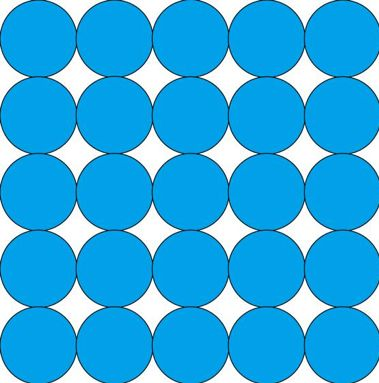
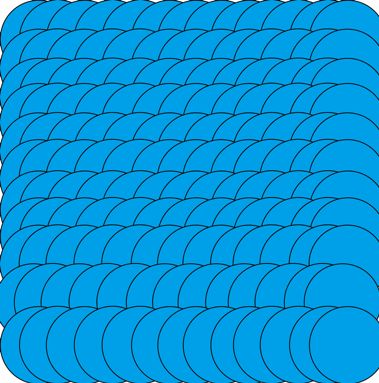
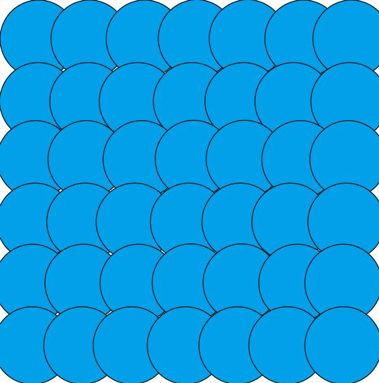
Of course, in some cases, repeated accumulation of ink droplets is required, such as printing in backlight mode. Only by repeatedly stacking ink droplets can the dark area be opaque. However, in most cases, choosing a suitable dot gain can save ink and maximize the production efficiency of the equipment under the same printhead configuration.
Relationship Between Ink Droplets and Media
After understanding the ink droplet coverage, we must understand the relationship between ink droplets and media. The surface tension between ink and media is different, and the capillary degree (surface density) of the material surface is also different, which causes the same volume of ink droplets to form ink droplets of different diameters on different media.
When ink droplets are printed on a medium with a smooth surface and high density, such as a car sticker, the ink droplet diffusion range is small (as shown in Figure 4); if the printing surface is rough, such as paper, the ink droplet diffusion range is large (as shown in Figure 5).
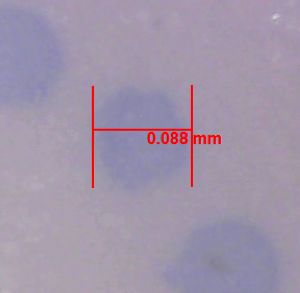
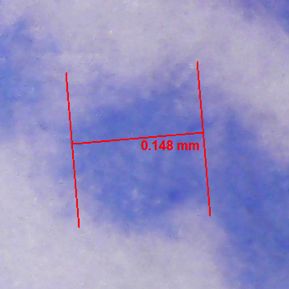
Only by understanding the relationship between ink droplets and media can we accurately calculate the coverage of ink droplets, rather than just using the nominal ink droplet size of the printhead to calculate directly.
Relationship Between Ink Droplets and Curing Methods
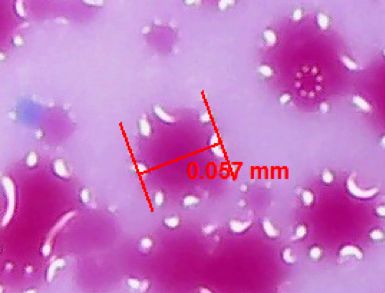
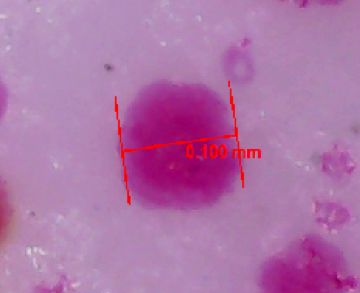
Different inks and their corresponding curing methods will also affect the size of ink droplets. For example, after UV ink is dried and cured, the ink droplets will be much smaller than those of solvent ink. Because UV ink is cured instantly with the help of UV light, the ink droplets hardly spread (Figure 6), while solvent ink is dried through water evaporation and an external drying system; the drying process is slow, and the ink droplets will spread (Figure 7).
Practical Application
After understanding the above knowledge, what aspects should we consider when selecting equipment?
Suppose we need a UV device to print plastic gussets, and three models are in front of us: one has a 5pL printhead, one has a 10pL printhead, and the other has a 20pL printhead. How should we choose?
As mentioned before, after UV ink is cured, the ink droplets have almost no diffusion phenomenon, and the ink droplets are much smaller than other inks. Plastic gussets are relatively smooth and have a higher surface density, so the ink droplets after printing will be better controlled than other materials with rough surfaces. With the above two conditions, we can conclude that the ink droplets diffuse less due to the medium and ink, and the actual ink droplet size after printing is better controlled.
Next is the coverage rate. According to the size of the ink droplet volume of the three devices, it can be concluded that the ink droplet coverage rate of the 5pL printhead device is half of the coverage rate of the 10pL printhead device and one quarter of the coverage rate of the 20pL printhead device. Simply put, the 5pL printhead needs to eject 1 time more ink droplets to achieve the coverage rate of the 10pL printhead device, and needs to eject 3 times more ink droplets to achieve the coverage rate of the 10pL printhead device.
To achieve the same printing effect, under the condition of the same number of nozzles, the printing time of the 5pL printhead is 1 time more than that of the 10pL printhead and 3 times more than that of the 20pL printhead.
Finally, we concluded that ink drop size is not the only answer to printing accuracy. We also need to consider the accuracy requirements of users for printed products in the actual use of plastic gussets. Of course, there are too many factors related to the effect of ink drop size, such as equipment accuracy, ink characteristics, and the waveform of controlling ink droplet injection, which will affect the final printing effect. According to experience, when observing a 10pL ink drop size screen from a distance of 1 meter away, basically no ink dots can be observed, while 5pL nozzle printing can achieve photo-level effects. If it is observed from a distance of 3 meters away, the 20pL effect will not feel rough. If you choose a 5pL printing device, the printing effect will naturally be the best, but the efficiency of choosing a 20pL printhead is 4 times that of yours.