Direct-to-film printing depends on more than printheads, ink, PET film, adhesive powder, and curing equipment. Behind every stable DTF printing process is an ink delivery system that must keep pigment ink flowing at the correct pressure and consistency.
This is especially important for white DTF ink. Because white ink contains a relatively high concentration of pigment particles, it is more likely to separate or settle when it remains stationary. Poor ink movement can lead to blocked dampers, clogged nozzles, uneven white coverage, color variation, wasted ink, and unexpected production downtime.
To reduce these risks, DTF printers generally use either an active ink circulation system or a passive ink circulation system. Although both systems deliver ink to the printhead, they differ significantly in how they manage ink movement, sedimentation, maintenance, cost, and long-term production stability.
What Is the Main Difference Between Active and Passive Ink Circulation?
An active ink circulation system uses pumps, motors, valves, or controlled pressure to continuously or periodically move ink through a circulation loop.
A passive ink circulation system does not use a dedicated powered circulation loop. Instead, it relies mainly on gravity, pressure differences, dampers, negative-pressure control, and ink consumption at the printhead.
In practical terms, active circulation provides better protection against pigment sedimentation, while passive circulation offers a simpler and less expensive ink delivery structure.
Active vs Passive Ink Circulation at a Glance
| Comparison Factor | Active Ink Circulation | Passive Ink Circulation |
|---|---|---|
| Ink movement | Driven by pumps or controlled circulation components | Driven mainly by gravity, pressure difference, and printhead demand |
| Circulation loop | Usually includes a return path | Usually one-way ink delivery |
| White ink stability | Better during printing and idle periods | More dependent on manual agitation and maintenance |
| Pigment sedimentation risk | Lower | Higher |
| System complexity | Higher | Lower |
| Initial equipment cost | Usually higher | Usually lower |
| Power consumption | Slightly higher | Lower |
| Mechanical maintenance | Pumps, valves and sensors may require servicing | Fewer powered components to maintain |
| Print startup after idle time | Usually faster | May require agitation, priming or cleaning |
| Best suited for | Commercial and high-volume DTF production | Entry-level, low-volume or budget-focused operation |
The table provides a general comparison. Actual performance also depends on circulation-loop design, ink quality, printer configuration, ambient temperature, pressure control, maintenance procedures, and how long the printer remains idle.
Why Does Ink Circulation Matter in DTF Printing?
DTF ink is a water-based pigment ink formulated to print onto coated PET film. After printing, hot-melt adhesive powder is applied to the wet design, cured, and then transferred onto a garment or textile using a heat press.
Unlike dye-based inks, pigment inks contain solid particles suspended in a liquid carrier. These particles can gradually settle when ink remains motionless.
The issue is most noticeable with white ink because white formulations contain a heavy pigment load needed to create an opaque underbase on dark and colored garments.
An effective DTF ink circulation system helps:
- Keep pigment particles evenly suspended
- Maintain consistent white ink density
- Reduce sediment inside ink tanks and tubes
- Stabilize ink supply to the dampers
- Prevent air from entering the ink lines
- Reduce nozzle dropout and interrupted output
- Improve white underbase uniformity
- Shorten preparation time after idle periods
- Reduce unnecessary cleaning cycles
- Protect the printhead from unstable ink delivery
Ink circulation does not replace regular maintenance, but it can make the complete ink system more stable and easier to manage.
Why Is White Ink Circulation More Important Than Color Ink Circulation?
White DTF ink contains titanium dioxide or similar opaque pigment materials. These particles are heavier than the pigments commonly used in CMYK inks and therefore settle more easily.
If white ink remains stationary for too long, pigment may accumulate in:
- The bottom of the main ink tank
- Ink supply tubes
- Sub-tanks
- Filters
- Dampers
- Manifolds
- Printhead ink channels
This can cause the first part of a print run to appear weak or inconsistent. In more serious cases, concentrated pigment deposits may restrict ink flow and create permanent nozzle problems.
For this reason, many DTF printers use active circulation specifically for the white ink channel while relying on a simpler delivery system for CMYK inks. A printer advertised as having “white ink circulation” does not necessarily circulate every ink color.
What Is an Active Ink Circulation System?
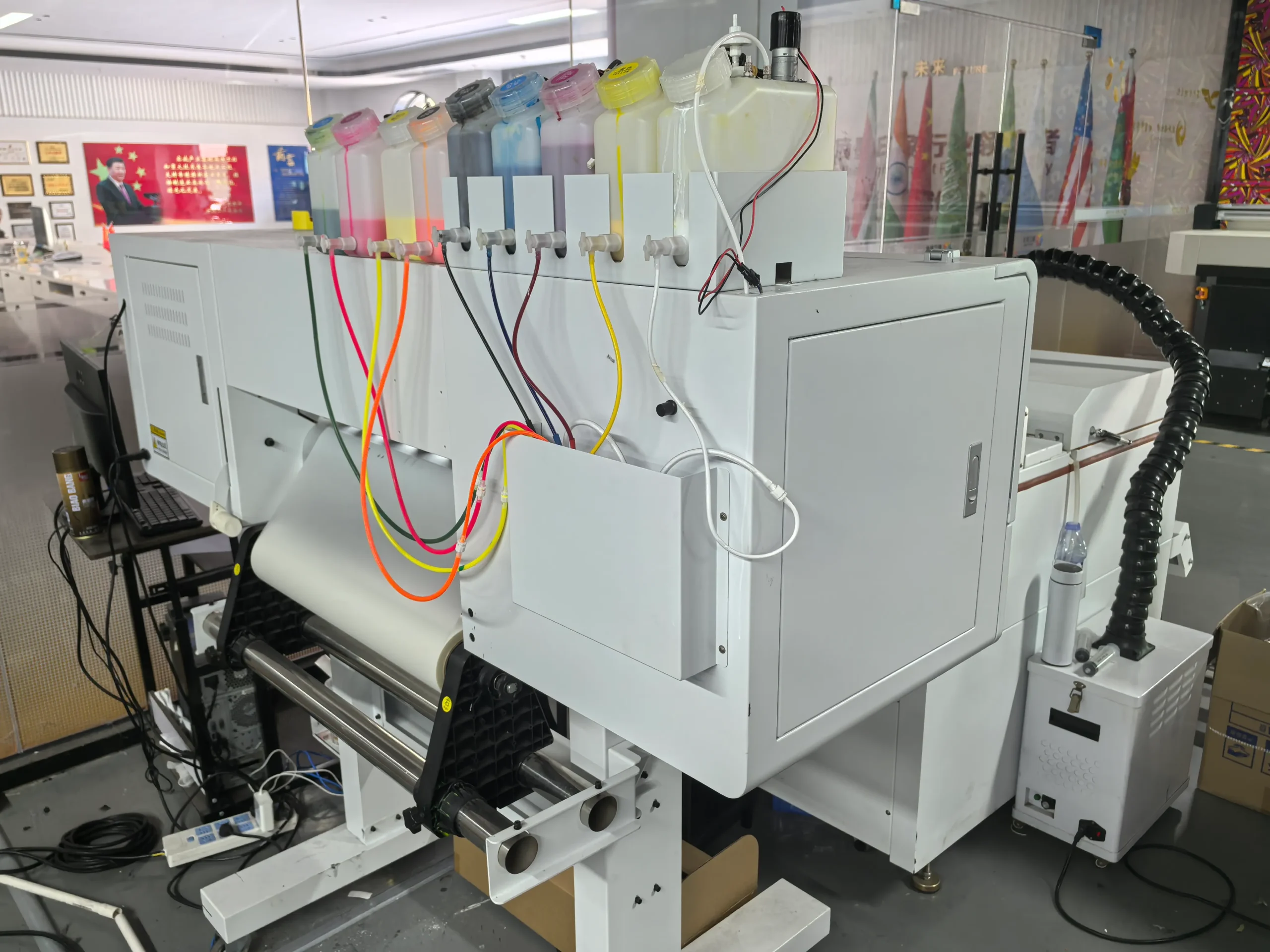
An active ink circulation system uses powered components to move ink through a controlled path. Depending on the printer design, the system may circulate ink continuously, at scheduled intervals, during startup, or only when certain operating conditions are detected.
Typical active circulation components include:
- Main ink tanks
- Ink circulation pumps
- Agitation motors
- Sub-tanks
- Filters
- Solenoid valves
- Return tubes
- Negative-pressure controllers
- Ink-level sensors
- Pressure sensors
- Printer control software
The exact structure varies between desktop DTF printers, 30 cm machines, 60 cm production printers, and industrial multi-head systems.
How Does Active Ink Circulation Work?
A typical active ink circulation process follows these steps:
- Ink is drawn from the main tank by a circulation or supply pump.
- The ink travels through filters and ink tubes toward the sub-tank, damper, or printhead manifold.
- Controlled pressure keeps the ink supply stable near the printhead.
- Excess ink or continuously circulated ink travels through a return line.
- The ink returns to the reservoir and repeats the circulation cycle.
Some systems circulate ink through the complete printhead pathway. Others circulate ink only between the main tank and sub-tank or around the damper manifold.
This distinction is important. A printer may be marketed as having active circulation even though the ink does not circulate directly through every internal printhead channel.
Advantages of Active Ink Circulation in DTF Printing
Better Protection Against White Ink Sedimentation
Regular ink movement helps prevent pigment particles from collecting in one area. This produces a more uniform white ink concentration throughout the supply system.
More Consistent White Underbase
A stable white ink concentration creates more even opacity beneath the CMYK layer. This can improve color brightness, edge definition, and consistency across longer production runs.
Reduced Nozzle Clogging Risk
Active circulation minimizes stagnant areas where concentrated pigment deposits may develop. It does not completely prevent clogging, but it reduces one of the major causes of white ink flow problems.
Faster Recovery After Idle Periods
When ink has been circulated periodically, the operator may need less manual shaking, priming, and cleaning before starting production.
The actual startup time still depends on how long the printer was idle and whether the printhead was properly capped.
Greater Suitability for High-Volume Printing
Commercial DTF businesses often run long jobs where white ink density must remain stable from the first meter to the last. Active circulation is generally better suited to this type of continuous production.
More Stable Ink Pressure
Well-designed active systems can work with negative-pressure control to maintain a steady supply at the printhead. Stable pressure helps prevent both ink starvation and excessive ink dripping.
Reduced Manual Intervention
Automated circulation and agitation reduce the need for operators to shake tanks or manually move ink several times during the working day.
Limitations of Active Ink Circulation Systems
Active circulation also introduces additional components and potential failure points.
Higher Initial Cost
Pumps, sensors, sub-tanks, valves, and control systems increase the manufacturing cost of the DTF printer.
More Complex Troubleshooting
When ink flow becomes unstable, the operator may need to inspect the pump, return line, filter, valve, sensor, pressure system, and circulation settings rather than only the ink tube and damper.
Pump and Valve Wear
Circulation pumps and solenoid valves are consumable mechanical components. Their performance may decline after prolonged use, especially if they are exposed to sedimented ink or operated without sufficient liquid.
Possible Air Bubbles
An incorrectly installed or overly aggressive circulation system can introduce air into the ink line. Air bubbles may cause missing nozzles, interrupted ink flow or inconsistent printing.
Additional Power Consumption and Noise
Small pumps and agitation motors consume electricity and may generate low mechanical noise. In most commercial environments, the difference is minor, but it may matter in quiet home studios.
Risk of Excessive Circulation
More circulation is not always better. Excessive flow can create foam, introduce air, disturb pressure balance or increase wear on pumps and filters.
A reliable active system must control both circulation speed and ink pressure.
What Is a Passive Ink Circulation System?
A passive ink circulation system has no dedicated powered loop continuously returning ink to the reservoir. Ink reaches the printhead through natural pressure differences, gravity-assisted delivery, dampers, sub-tanks or negative-pressure regulation.
Ink mainly moves when:
- The printhead consumes ink during printing
- The printer performs a cleaning cycle
- The operator primes the ink lines
- A pressure difference draws ink toward the damper
- The operator manually agitates or mixes the ink
Passive does not always mean that the printer has no pump anywhere. A machine may use a pump for ink loading or cleaning while still being considered passive because it lacks continuous or scheduled circulation during normal operation.
Advantages of Passive Ink Circulation
1. Simpler Ink Delivery Structure
Passive systems use fewer circulation components, making the ink path easier to understand and troubleshoot.
2. Lower Printer Cost
The reduced number of pumps, valves, return tubes, and sensors makes passive-system printers more affordable.
3. Fewer Powered Components to Replace
Fewer circulation-related mechanical parts can wear out or fail.
4. Lower Power Consumption
Passive ink delivery requires little or no additional energy beyond the printer’s normal operation.
5. Quiet Operation
Without a continuously operating circulation pump, the ink system produces minimal mechanical noise.
6. Suitable for Light Production
A properly maintained passive system can work adequately for sampling, occasional orders and low daily output, particularly when the printer is used regularly and the white ink is manually agitated.
Limitations of Passive Ink Circulation
Higher Risk of Pigment Separation
Ink that remains inside tanks and tubes for extended periods can gradually separate. White ink is especially sensitive to this problem.
More Manual Maintenance
Operators may need to shake the white ink tank, stir the ink, perform nozzle checks, prime dampers or run cleaning cycles more frequently.
Longer Startup After Downtime
A printer that has been inactive may require more preparation before stable white ink reaches the printhead.
Inconsistent White Density
If pigment settles unevenly, the white underbase may appear weaker at the beginning of a job or change during longer production.
Greater Dependence on Operator Discipline
Passive systems can perform reliably, but only when maintenance routines are followed consistently. Missing a daily agitation or cleaning procedure may create problems that are difficult to reverse.
Less Suitable for Long Ink Paths
Large-format and multi-head printers often have longer tubes and more complicated ink paths. A passive system may struggle to maintain uniform ink movement throughout these areas.
The Most Important Differences Are Not Always Visible
When comparing DTF printers, buyers often ask only whether the machine has white ink circulation. That question is not detailed enough.
A better evaluation should include the following points.
Where Does the Ink Circulate?
Ink may circulate:
- Inside the main tank only
- Between the main tank and sub-tank
- Between the sub-tank and damper
- Around the printhead manifold
- Through a complete supply-and-return loop
A tank stirrer can prevent sediment inside the reservoir but cannot prevent ink from settling inside long tubes or dampers.
Is the Circulation Continuous or Intermittent?
Continuous circulation provides regular movement but creates more pump wear.
Intermittent circulation may run every few minutes or during scheduled periods. This can reduce energy use and component wear while still limiting pigment settlement.
Is Pressure Controlled Independently?
Circulation and printhead pressure are related but not identical.
A printer can circulate ink effectively while still having poor negative-pressure control. This may lead to dripping, ink starvation or inconsistent nozzle output.
Does Circulation Continue During Idle Periods?
Some printers circulate ink only while the machine is powered on. Others have scheduled standby circulation.
Operators should understand whether the printer must remain powered on to protect the white ink system.
Is There Separate Agitation in the Main Tank?
Circulation moves ink through tubes, while agitation mixes ink inside the reservoir. The most stable systems often combine both functions.
Are Filters Easy to Access?
Circulation cannot solve a blocked-filter problem. Easily accessible filters, dampers, and ink tubes make preventive maintenance faster and less expensive.
Active vs. Passive Ink Circulation: Which Is Better?
Neither design is automatically suitable for every DTF business.
An active system is generally better when:
- The printer runs every day
- Production volume is high
- White ink consumption is significant
- Long print runs are common
- Multiple printheads are installed
- The ink path is relatively long
- Consistent white opacity is critical
- Downtime is expensive
- The business expects to scale production
A passive system may be sufficient when:
- Production volume is low
- The printer is used for sampling or occasional orders
- The available budget is limited
- The ink path is short
- The operator can perform daily maintenance
- Replacement parts and technical support are readily available
- Simplicity is more important than automation
For most professional 60 cm and industrial DTF printing operations, an active white ink circulation system usually offers better long-term production stability.
For entry-level users, a well-maintained passive system may reduce initial investment, but the buyer should consider the additional labor and maintenance required over time.
How Production Patterns Affect the Decision
Home-Based or Startup DTF Business
A passive system may keep the initial equipment investment low. However, the owner must establish a strict routine for white ink agitation, nozzle checks, and printhead capping.
A compact printer with a poorly maintained passive system can become more expensive than an active system if it repeatedly consumes dampers, ink, cleaning fluid, and printheads.
Small Commercial Print Shop
A controlled active white ink circulation system is usually a practical choice. It reduces daily preparation and provides more reliable output when customer orders arrive unpredictably.
High-Volume DTF Factory
An industrial active system with tank agitation, return circulation, filtration, and pressure monitoring is preferable. The cost of production interruption is usually much greater than the additional cost of the circulation hardware.
Seasonal or Intermittent Production
An active system can reduce sedimentation during short idle periods, but it cannot protect a printer that is abandoned for weeks without proper shutdown procedures.
Businesses with seasonal production should evaluate storage, flushing, and long-term idle maintenance requirements in addition to circulation type.
Does Active Ink Circulation Eliminate DTF Printer Maintenance?
No. Active circulation reduces pigment sedimentation but does not eliminate maintenance.
Even an advanced circulation system cannot prevent problems caused by:
- Expired or low-quality ink
- Ink and cleaning-fluid incompatibility
- Contaminated ink tanks
- Blocked filters
- Damaged dampers
- Air leaks
- Incorrect negative pressure
- Dried ink on the capping station
- Dirty wiper blades
- High or low operating temperature
- Excessive humidity changes
- Long-term printer shutdown
Operators must still perform nozzle checks, clean the capping station, inspect dampers and filters, maintain the correct environment, and follow the ink supplier’s storage instructions.
Common Misconceptions About DTF Ink Circulation
Misconception 1: Every Active System Circulates Ink Through the Printhead
Some systems circulate ink only between the main tank and sub-tank. Buyers should ask for an ink-path diagram rather than relying on the phrase “white ink circulation.”
Misconception 2: Passive Systems Cannot Produce Good Prints
A properly configured and maintained passive system can produce high-quality output. Its main disadvantage is greater sensitivity to idle time and operator maintenance.
Misconception 3: Stronger Pumps Always Provide Better Circulation
Excessive pump pressure may create air bubbles, leakage, foam, or unstable meniscus pressure at the printhead.
Controlled flow is more important than maximum flow.
Misconception 4: Circulation Solves Every White Ink Problem
White ink stability also depends on ink formulation, filtration, temperature, humidity, printhead condition, and cleaning procedures.
Misconception 5: The Cheapest Printer Has the Lowest Production Cost
A low-cost passive system may require more labor, cleaning fluid, wasted ink, and replacement components. Buyers should compare total operating cost rather than purchase price alone.
How to Evaluate a DTF Printer’s Ink Circulation System
Before purchasing a DTF printer, ask the supplier the following questions:
- Which ink channels are actively circulated?
- Does the system circulate ink through the printhead manifold or only the tank?
- Is there a return line to the main reservoir?
- Is the circulation continuous, intermittent or software-controlled?
- Does circulation operate when the printer is idle?
- Is the main white ink tank separately agitated?
- How is negative pressure controlled?
- What happens if the circulation pump fails?
- Are filters, pumps and valves easy to replace?
- What daily maintenance is still required?
- Which ink formulations have been tested with the system?
- Can the supplier provide a diagram or video showing the complete ink path?
A transparent supplier should be able to explain how ink travels from the main tank to the printhead and back through the system.
Maintenance Tips for Active Ink Circulation Systems
To keep an active system reliable:
- Inspect pumps for abnormal noise or weak flow
- Check return tubes for blockages
- Replace filters according to the maintenance schedule
- Prevent the pump from running dry
- Remove air from the ink lines after maintenance
- Keep ink tanks clean and covered
- Confirm that circulation settings match the ink formulation
- Avoid mixing different ink brands without flushing the system
- Check negative pressure after replacing dampers or tubes
- Continue normal capping-station and printhead maintenance
Maintenance Tips for Passive Ink Circulation Systems
For passive systems:
- Agitate white ink according to the ink supplier’s instructions
- Perform a nozzle check before production
- Avoid leaving pigment ink motionless for long periods
- Check ink-tank height and pressure balance
- Inspect tubes for sediment or restricted flow
- Replace clogged filters and dampers promptly
- Keep the printhead properly capped when idle
- Follow the correct shutdown procedure
- Maintain stable temperature and humidity
- Print regularly when possible
Manual agitation should be controlled rather than aggressive. Excessive shaking can create foam and air bubbles that later enter the ink supply lines.
Essential DTF Printer Parts for Ink System Maintenance
Maintaining a DTF printer requires regular inspection and replacement of key components of the ink system. Common maintenance parts include:
- DTF ink pumps for stable ink circulation
- Ink dampers for controlling ink supply to the printhead
- Ink filters for removing contaminants
- Ink tubes and connectors for preventing air leakage
- Capping and cleaning components for printhead protection
Using compatible and reliable DTF printer parts helps improve machine uptime, reduce maintenance costs, and maintain consistent print quality.
Future Development of DTF Ink Circulation Technology
DTF printer manufacturers are gradually moving toward more automated and sensor-based ink management.
Future and emerging systems may include:
- Variable-speed circulation pumps
- Scheduled standby circulation
- Independent circulation for each white ink channel
- Pressure and flow monitoring
- Ink-temperature monitoring
- Automatic sediment detection
- Pump-failure warnings
- Predictive maintenance notifications
- Integrated tank agitation and return circulation
- Software-controlled cleaning based on nozzle condition
The goal is not simply to circulate ink faster. The objective is to maintain stable pigment distribution, correct pressure, and reliable printhead supply while reducing ink waste and component wear.
Final Recommendation
The difference between active and passive ink circulation is not simply whether a printer has a pump.
A reliable DTF ink delivery system must manage three connected factors:
- Pigment suspension
- Ink movement
- Printhead pressure
Active ink circulation offers stronger protection against white pigment sedimentation and is generally better suited to commercial production, frequent operation, and long print runs. Passive circulation provides a simpler, quieter, and more affordable solution for lower-volume users who are prepared to perform regular manual maintenance.
Before choosing a DTF printer, examine the complete ink path, not just the product specification sheet. Ask where the ink circulates, how pressure is controlled, whether the white ink tank is agitated, and what happens during idle periods.
The right system is the one that matches your production volume, maintenance capability, and expected operating schedule while delivering stable white ink density and dependable printhead performance.