
What Are Toshiba Printheads Used for?
Toshiba printheads are widely used in UV flatbed printers, cylindrical printers, irregular-object printing systems, label and packaging equipment, white ink printers, and certain single-pass industrial inkjet production lines.
In the industrial inkjet market, Toshiba printheads are mainly known for:
High print precision, grayscale droplet control, high-gap printing, and internal ink circulation.
Compared with Ricoh printheads, which are often selected for durability and industrial stability, Konica Minolta printheads, which are commonly used for high-speed mass production, and Epson printheads, which are popular in cost-sensitive high-resolution systems, Toshiba printheads are particularly suitable for applications that require accurate ink placement, curved-surface printing, white ink circulation, and compatibility with complex materials.
The main applications of each model are:
- CE4M: UV flatbed printing
- CF3: Cylindrical, irregular-shape, high-gap, and white ink printing
- CF1 series: Label, packaging, and single-pass printing
- CA5: Fine-detail, small-droplet printing
- CK1 series: Large-droplet and high-coverage applications
Main Toshiba Industrial Printhead Models
Toshiba printheads use piezoelectric drop-on-demand inkjet technology. Different models vary significantly in nozzle configuration, droplet size, firing frequency, ink circulation, and target application.
Toshiba Printhead Model Comparison
| Model | Nozzles | Droplet Range | Firing Frequency | Main Applications |
|---|---|---|---|---|
| CE4M | 636, arranged as 2 × 318 | 5–35 pL, 8-level grayscale | Up to approximately 28 kHz | UV flatbed printing, building materials, signs |
| CF1 | 636 | 6–42 pL | Approximately 5.7 kHz | Labels, packaging, single-pass printing |
| CF1L | 636 | Large-droplet output | Approximately 5.7 kHz | High-coverage packaging and industrial printing |
| CF1XL | 636 | Up to approximately 180 pL | Approximately 5.7 kHz | Thick ink layers and functional-fluid deposition |
| CF3 | 636, single-row 300 npi | Minimum approximately 3.4 pL | Depends on waveform configuration | Cylindrical, irregular-shape, high-gap, and white ink printing |
| CA5 | 318 | Minimum approximately 3 pL | Approximately 17.9 kHz | High-resolution, small-droplet printing |
| CK1 | 636 | 6–42 pL | Approximately 4.8–5 kHz | General industrial printing and higher ink volume |
| CK1L | 636 | 51–90 pL | Approximately 4.8–5 kHz | High-opacity and large-droplet industrial printing |
What Features Do Toshiba Printheads Share?
Most Toshiba printheads share several common characteristics:
- Effective print width of approximately 53.7 mm per printhead
- Physical resolution of approximately 300 dpi
- Support for multi-head stitching to increase print width
- Compatibility with UV, oil-based, and solvent inks
- Certain models can be configured for water-based inks
- Integrated water channels for temperature control
- Variable grayscale droplet technology
- Internal ink circulation on selected CF-series models
However, ink compatibility should never be determined only by whether an ink is described as UV, solvent, or water-based.
The following factors must also be checked:
- Ink viscosity
- Surface tension
- Pigment particle size
- Operating temperature
- Chemical compatibility
- Drive waveform
Toshiba CE4M: A Mainstream Choice for UV Flatbed Printers
What Printers Use the Toshiba CE4M?
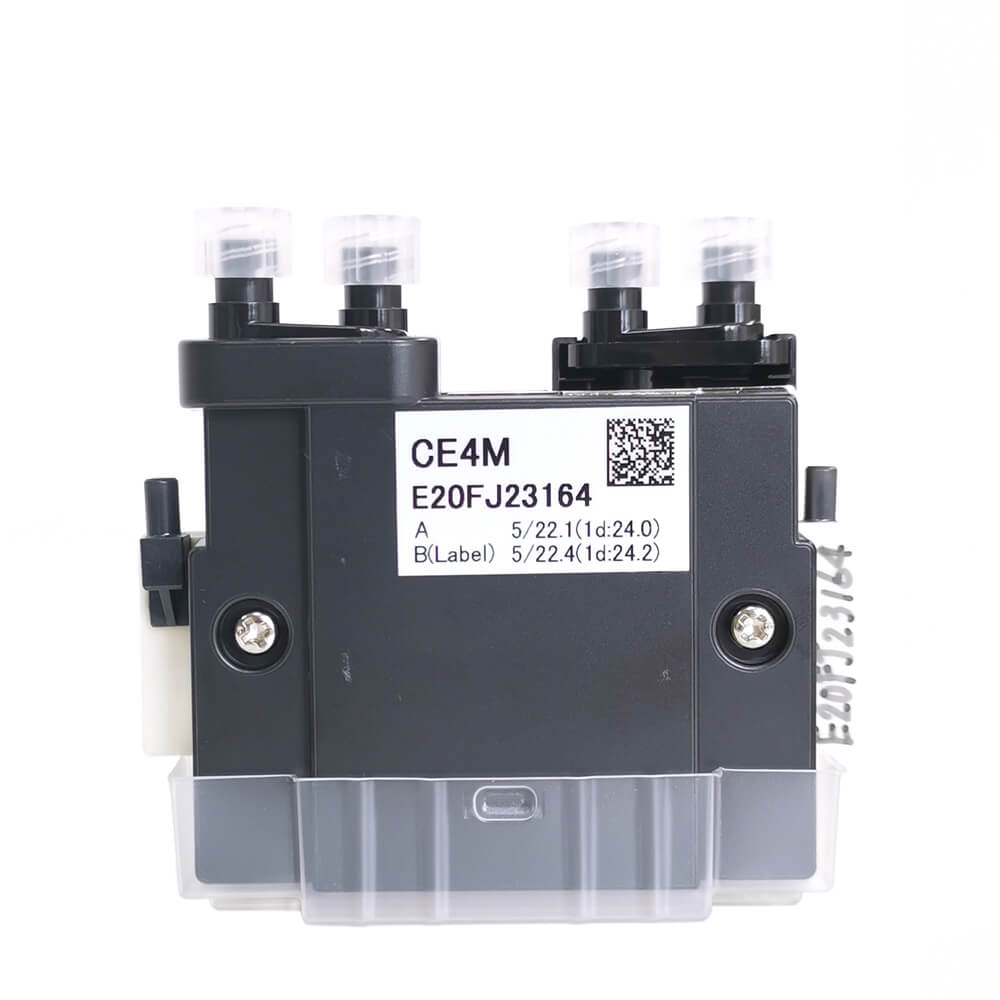
The Toshiba CE4M is one of the most established Toshiba printheads used in industrial UV flatbed printing.
It is commonly installed in medium- and large-format UV2030, UV2513, and UV3220 flatbed printers. These machines often use four to eight CE4M printheads to print on:
- Glass doors
- Ceramic tiles
- Acrylic sheets
- PVC boards
- Metal signs
- Wooden panels
- Phone cases
- Furniture decoration panels
- Advertising display materials
The CE4M has 636 nozzles arranged in two rows of 318. Its effective print width is approximately 53.7 mm.
Multiple heads can be stitched together to create wider color, white, or varnish printing channels.
What Are the Main Advantages of the CE4M?
1. Variable Grayscale Droplet Control
The CE4M offers an approximate droplet range of 5–35 pL and supports multi-level grayscale printing.
Smaller droplets can be used for highlights, gradients, and fine details, while larger droplets can be used for dark areas and high-coverage sections.
This helps to:
- Improve gradients
- Reduce visible grain
- Increase dark-color density
- Balance print quality and speed
- Reduce unnecessary ink consumption
2. Suitable for Medium- and Large-Format UV Flatbeds
The CE4M has a relatively wide print swath, allowing manufacturers to build wide printing channels with fewer printheads.
This makes it suitable for UV2513, UV2030, UV3220, and similar industrial platforms.
Some dual-row printhead systems may reach production speeds of approximately 32 square meters per hour. However, actual speed depends on:
- Number of printheads
- Print resolution
- Number of passes
- Ink configuration
- Machine structure
- RIP settings
3. Proven for Building Materials and Signage
The CE4M has been widely used for printing glass, tiles, acrylic, metal, and decorative panels.
For users mainly printing flat materials and looking for a balance between image quality, production capability, and machine cost, the CE4M remains a practical industrial UV solution.
Toshiba CF3: Designed for High-Gap and Irregular-Object Printing
Why Is the Toshiba CF3 Suitable for Cylindrical and Irregular Products?
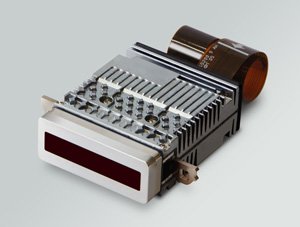
The CF3 is one of Toshiba’s most differentiated industrial printheads.
Its main characteristics include:
- Minimum droplet size of approximately 3.4 pL
- Single-row 300 npi nozzle arrangement
- Ink circulation close to the nozzles
- Accurate droplet placement
- Compatibility with white and high-viscosity UV inks
- Suitability for high-gap printer development
The CF3 is commonly used for printing:
- Tumblers
- Wine bottles
- Cosmetic bottles
- Cylindrical containers
- Toys
- Irregular plastic parts
- Embossed decorative products
- Deep-relief objects
- White ink specialty products
What Is High-Gap Printing?
High-gap printing refers to printing when there is a larger-than-normal distance between the printhead and the material surface, or when the product has significant height variations, curves, or recessed areas.
In standard flatbed printing, the printhead is positioned as close as possible to the substrate to maintain accurate droplet placement.
However, when printing bottles, tumblers, curved surfaces, or embossed objects, the distance between different parts of the product and the printhead can vary significantly.
Some CF3-based machines can operate with gaps of approximately 10–20 mm. Specially optimized systems may achieve larger distances.
However, high-gap performance is not determined by the printhead alone. It also depends on:
- Droplet velocity
- Droplet size
- Drive waveform
- Ink viscosity
- Printhead installation angle
- Product curvature
- Carriage speed
- Mechanical precision
The CF3 is therefore well suited to developing high-gap and irregular-object printing equipment, but the actual maximum gap should always be confirmed through machine testing.
What Is the Advantage of the CF3 Single-Row Nozzle Structure?
Many industrial printheads use multiple nozzle rows, while the CF3 uses a single-row 300 npi nozzle configuration.
This structure may provide several advantages:
- More direct physical nozzle alignment
- Reduced registration error between nozzle rows
- Improved color-channel alignment
- More consistent droplet placement on curved surfaces
- Better suitability for irregular and high-gap applications
When the distance between the printhead and the product increases, even small installation-angle or nozzle-position errors become more noticeable.
For this reason, nozzle arrangement is especially important in high-gap printing.
Why Is the CF3 Suitable for White Ink?
White UV ink contains a relatively high concentration of pigment. If the ink remains stationary for long periods, the pigment may settle.
The CF3 uses internal ink circulation close to the nozzles. Continuous ink movement can help:
- Reduce white pigment settling
- Lower the risk of nozzle blockage
- Remove some air bubbles
- Stabilize ink temperature
- Improve consistency during long print runs
- Improve nozzle recovery after downtime
However, internal printhead circulation does not replace the machine’s complete white ink circulation system.
A properly designed white ink printer should still include:
- Main ink tank agitation
- Ink supply circulation
- Return ink lines
- Secondary ink tanks
- Ink filters
- Degassing system
- Stable negative-pressure control
Toshiba CF1, CF1L, and CF1XL for Label and Packaging Printing
What Equipment Uses the CF1 Series?
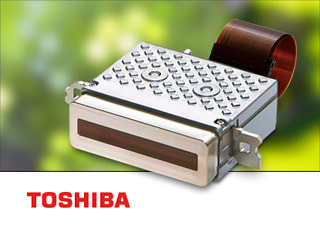
The CF1 series is mainly used in label, packaging, paper, film, and single-pass industrial inkjet equipment.
Its common characteristics include:
- 636 nozzles
- Approximately 53.7 mm print width
- Internal ink circulation
- Compatibility with UV and industrial pigment inks
- Suitability for continuous production
- Different droplet ranges for different ink-volume requirements
What Is the Difference Between CF1, CF1L, and CF1XL?
CF1: General Label and Packaging Printing
The CF1 offers a droplet range of approximately 6–42 pL.
It is suitable for applications that require a balance between image detail and ink coverage, including:
- Labels
- Packaging graphics
- Paper printing
- Plastic film
- Industrial markings
- Single-pass color printing
CF1L: Higher Ink-Volume Output
The CF1L is designed for larger droplets and higher ink coverage.
It is more suitable for packaging and industrial applications that require thicker ink deposition.
CF1XL: Extra-Large Droplets and Functional Fluids
The CF1XL can produce droplets up to approximately 180 pL.
It is better suited to:
- Thick ink-layer printing
- High-opacity coating
- Functional-fluid jetting
- Special material deposition
- Industrial coatings
- High-viscosity or particle-containing fluids
The CF1 series is therefore not limited to photo-quality graphics. Its different droplet ranges allow it to support applications ranging from packaging graphics to functional material deposition.
Toshiba CA5 for High-Resolution Small-Droplet Printing
The Toshiba CA5 has 318 nozzles, a minimum droplet size of approximately 3 pL, and a firing frequency of approximately 17.9 kHz.
It is mainly used in industrial applications that require fine text, sharp edges, and detailed images, including:
- Small-format high-resolution UV printing
- Electronic product housings
- Fine-detail signs
- Crafts and promotional products
- Small packaging graphics
- Fine text and QR codes
The main advantage of the CA5 is its small droplet size, which supports more detailed image reproduction.
However, because it has fewer nozzles than the CE4M and CF-series printheads, a high-production machine may require more heads or lower print resolution.
The CA5 is therefore more suitable for applications that prioritize precision over maximum output.
Toshiba CK1 and CK1L for Large-Droplet Printing
The CK1 series also has 636 nozzles, but its positioning is more focused on larger droplets and higher industrial ink coverage.
What Is the CK1 Used For?
The CK1 offers an approximate droplet range of 6–42 pL.
Typical applications include:
- General UV industrial printing
- Packaging graphics
- Marking and coding
- Medium-volume ink deposition
- Industrial surface decoration
What Is the CK1L Used For?
The CK1L offers an approximate droplet range of 51–90 pL.
It is better suited to:
- Large-droplet printing
- High-opacity graphics
- Thick ink-layer effects
- White ink or primer applications
- Functional-fluid deposition
- Industrial printing where fine detail is less important
When choosing between CK1 and CK1L, users should determine whether they require fine image detail or higher ink deposition.
For detailed full-color graphics, the CE4M, CF3, or CA5 may be more suitable. For higher opacity and thicker ink layers, the CK1L may offer greater advantages.
Toshiba vs Ricoh G6 vs Konica 1024i vs Epson I3200
Selecting an industrial printhead involves more than comparing price or nozzle count.
The machine structure, ink chemistry, production requirements, maintenance capability, and local technical support must all be considered.
Industrial Printhead Comparison
| Comparison Factor | Toshiba CE4M / CF3 | Ricoh G6 | Konica 1024i | Epson I3200 |
| Image quality | Good; CF3 minimum droplet approximately 3.4 pL | Good; approximately 5 pL | More focused on industrial production | Strong small-droplet performance |
| High-gap capability | Strong advantage with CF3 | Mainly standard-gap applications | Depends on machine structure | Better suited to short print distances |
| Ink circulation | Available on CF3 and CF1 series | Depends on model and ink system | Depends on system configuration | Usually no internal printhead circulation |
| Continuous production | Requires careful ink and maintenance control | Strong industrial tolerance | Suitable for high-volume production | More common in small and medium systems |
| Equipment cost | Medium | Relatively high | High | Lower |
| Typical applications | UV flatbed, irregular objects, white ink | Industrial UV, solvent, and aqueous printing | Roll-to-roll, packaging, mass production | DTF, UV, signage, textile |
| Maintenance difficulty | Medium to high | Medium | Medium | Relatively high |
| Main advantage | Precision, high-gap printing, circulation | Stability and high frequency | Speed and batch production | Cost and nozzle density |
When Should You Choose the Toshiba CE4M?
The CE4M is suitable for:
- UV flatbed building-material printing
- Glass and ceramic tiles
- Acrylic and metal signs
- Medium production volumes
- Grayscale image requirements
- Users with an established CE4M machine platform
When Should You Choose the Toshiba CF3?
The CF3 is suitable for:
- Cylindrical products
- Irregular crafts
- Recessed or embossed materials
- High-gap printing
- White ink equipment
- Multi-SKU, small- and medium-batch production
- Businesses that frequently change materials
When Should You Choose the Ricoh G6?
The Ricoh G6 is suitable for:
- Large UV flatbed printers
- Continuous industrial production
- Higher output requirements
- Applications requiring greater machine tolerance
- Users looking for a mature industrial platform
When Should You Choose the Konica 1024i?
The Konica 1024i is suitable for:
- Roll-to-roll advertising printing
- High-volume production
- Single-pass industrial lines
- Packaging and industrial graphics
- Applications where speed is more important than very small droplets
When Should You Choose the Epson I3200?
The Epson I3200 is suitable for:
- Limited equipment budgets
- Small- and medium-batch orders
- DTF and DTG printing
- Compact UV printers
- Signage and photo printing
- Users sensitive to machine size and initial investment
Why Is Toshiba Printhead Maintenance So Important?
The precision of a Toshiba printhead depends on stable ink supply, negative pressure, filtration, temperature control, and drive waveform.
If these systems are not properly maintained, the printer may experience:
- Missing nozzles
- Deflected jets
- Nozzle blockage
- Color inconsistency
- Ink dripping
- Ink mist
- Ink buildup on the nozzle plate
- Ink starvation during longer print runs
Use the Correct Ink Filtration System
The CF3 and CF1 series are sensitive to the condition of the ink filtration system.
Industrial ink systems may use filters in the 1–5 μm range, but finer filtration is not always better.
A filter that is too restrictive can cause:
- Insufficient ink flow
- Unstable negative pressure
- Ink starvation
- Nozzle dropout during high-speed printing
Filter selection should be based on:
- Ink particle size
- Ink viscosity
- Pump flow
- Circulation rate
- Printhead requirements
- Machine manufacturer recommendations
Check Printhead Condition Every Day
Before printing, inspect:
- Main ink tank level
- Ink circulation
- Negative-pressure status
- Ink filters
- Secondary ink tanks
- Nozzle test pattern
- Ink buildup on the printhead surface
Before shutting down, make sure:
- The carriage returns to the home position
- The capping station seals the printhead correctly
- The nozzles remain moist
- White ink circulation runs according to the machine settings
Avoid Excessively High Drive Voltage
Increasing drive voltage may temporarily increase jetting force, but continuous operation at excessive voltage may place additional stress on the piezoelectric elements.
Potential problems include:
- Deflected jets
- Satellite droplets
- Ink mist
- Printhead overheating
- Unstable nozzle performance
- Reduced printhead life
CF3 high-gap printing should rely on a correctly optimized waveform rather than simply increasing voltage.
Control the Printing Environment
Recommended operating conditions include:
- Temperature: 20–28°C
- Relative humidity: 40%–60%
- Avoid direct airflow toward the printheads
- Reduce dust and airborne fibers
- Prevent direct sunlight on ink lines
- Keep the platform and encoder system clean
In high-gap printing, airflow and static electricity can have a greater effect on droplet trajectory, making environmental control especially important.
Protect the Printhead During Long Shutdowns
If the printer will be inactive for more than three days, follow the machine manufacturer’s cleaning and moisturizing procedure.
This may include:
- Circulating compatible cleaning fluid
- Cleaning the nozzle plate
- Sealing the printhead
- Keeping the capping station moist
- Running the machine periodically
- Preventing white pigment settling
Do not leave the printhead exposed to air without ink or cleaning fluid protection.
Do Not Change Ink Brands Without Testing
Even when two UV inks are designed for the same application, they may differ in:
- Viscosity
- Surface tension
- Chemical composition
- Pigment particle size
- Curing behavior
- Waveform requirements
Mixing incompatible inks may cause:
- Ink coagulation
- Filter blockage
- Damage to internal adhesives
- Color abnormalities
- Unstable jetting
Before changing ink, clean the complete ink system and confirm that the new ink has passed compatibility testing.
How to Choose the Right Toshiba Printheads
The appropriate model can be selected according to the application.
For UV Flatbed Building Materials and Signs
Recommended model:
Toshiba CE4M
Suitable for glass, tiles, acrylic, metal, wood, and other flat materials.
For Cylindrical, Irregular, and High-Gap Products
Recommended model:
Toshiba CF3
Suitable for tumblers, bottles, toys, embossed crafts, and products with uneven surfaces.
For Labels and Packaging
Recommended models:
Toshiba CF1 or CF1L
Suitable for paper, film, packaging graphics, and single-pass systems.
For Thick Ink Layers or Functional Materials
Recommended models:
Toshiba CF1XL or CK1L
Suitable for high-coverage printing, large droplets, and functional-fluid deposition.
For Fine Small-Format Graphics
Recommended model:
Toshiba CA5
Suitable for fine text, QR codes, electronic product housings, and small crafts.
Conclusion
Toshiba printheads are not designed only for maximum production speed.
Their main strengths are grayscale droplet control, high-gap printing capability, and internal ink circulation on selected models.
The key models can be summarized as follows:
- CE4M: A mature solution for UV flatbed printing
- CF3: A strong option for cylindrical, irregular, high-gap, and white ink printing
- CF1, CF1L, and CF1XL: Suitable for labels, packaging, and different ink-volume requirements
- CA5: Suitable for high-resolution, small-droplet printing
- CK1 and CK1L: Suitable for large-droplet, high-opacity, and functional-material applications
For equipment manufacturers, the CE4M is suitable for developing established UV flatbed systems, while the CF3 can support more differentiated, higher-value printing equipment.
For end users, the following questions should be answered before selecting a printhead:
- What products and materials will be printed?
- What daily production capacity is required?
- Is white ink circulation necessary?
- Is cylindrical, irregular-shape, or high-gap printing required?
- Is reliable local technical support and spare-parts supply available?
A correctly selected printhead can improve print quality, production stability, and application range.
If the printhead does not match the ink, machine design, or production requirements, maintenance costs and machine downtime may increase significantly.
JOHOPE supplies industrial printer printheads and related spare parts. Customers can provide the printer model, original printhead label, connector photos, ink type, and printing application. Our team can help identify compatible Toshiba printheads, printhead cables, ink filters, ink pumps, dampers, and other ink supply components.
Frequently Asked Questions
The CE4M is mainly used in UV flatbed printers such as UV2513, UV2030, and UV3220 machines. It can print glass, ceramic tiles, acrylic, metal, PVC, and wood.
The CF3 is used for cylindrical products, irregular objects, embossed materials, white ink applications, and high-gap UV printing, including tumblers, bottles, toys, and decorative crafts.
The CF3 has internal ink circulation close to the nozzles, which helps reduce pigment settling inside the printhead. However, the printer still requires main-tank agitation and complete ink circulation.
The CE4M is better suited to conventional UV flatbed and building-material printing. The CF3 offers smaller droplets and internal ink circulation, making it more suitable for white ink, irregular objects, and high-gap printing.
Certain models or customized systems may be configured for water-based ink. However, ink compatibility, corrosion resistance, and waveform testing must be completed before use.
Printhead life depends on ink compatibility, filtration, negative pressure, temperature, waveform, operating hours, and cleaning procedures.
A CE4M may operate for several years under suitable conditions, but a fixed service life should not be applied to every machine.
The two printheads are designed for different priorities.
The Ricoh G6 is often preferred for continuous industrial production and large-format systems. The Toshiba CF3 has stronger advantages in white ink circulation, irregular objects, and high-gap printing.
High-pressure flushing is not recommended. Excessive pressure may damage the nozzle plate or internal channels.
Ink condition, negative pressure, filters, and air bubbles should be checked first. Cleaning should follow the machine manufacturer’s approved pressure and procedure.