In UV inkjet printing, output quality is not determined by resolution alone. The real foundation of print performance lies in ink droplet control.
Droplet size, placement accuracy, consistency, and coverage collectively define image sharpness, color density, and overall stability. Understanding these factors is essential for achieving high-quality and reliable printing results.
1. Droplet Size: Balancing Detail and Color Density
Droplet size directly influences how an image looks:
- Small droplets
Deliver finer details, smoother gradients, and sharper edges—ideal for high-resolution graphics and small text.
- Large droplets
Provide stronger ink coverage and richer colors, especially for solid areas and dark backgrounds.
- Grayscale printing (variable droplet sizes)
Combines multiple droplet volumes to balance detail and saturation, now widely used in advanced UV printing systems.
The key is not “smaller is better,” but choosing the right droplet size for the application.
2. Droplet Placement Accuracy: The Key to Sharp Edges
Even with optimal droplet size, poor placement accuracy can ruin print quality:
- Jagged or blurry edges
- Broken or inconsistent lines
- White gaps in solid areas
Accurate droplet positioning ensures:
- Clean outlines
- Sharp text
- Well-defined image structure
3. Droplet Consistency: Ensuring Uniform Color Output
If droplet volume fluctuates, visible defects will appear:
- Uneven color density
- Patchy gradients
- Grainy textures
Stable droplet formation means:
- Uniform droplet size
- Consistent firing frequency
- No abnormal misting or missing dots
This is critical for maintaining consistent print quality across the entire image.
4. Droplet Coverage: Not Too Little, Not Too Much
Proper coverage determines final appearance
- Insufficient coverage
→ Substrate shows through
→ Weak, faded colors
- Excessive coverage
→ Ink accumulation
→ Loss of detail, potential curing issues
The goal is:
A uniform ink layer that fully covers the substrate without overloading it
5. Key Factors That Influence Droplet Performance
Droplet behavior is affected by multiple factors beyond the printhead:
1) Substrate Properties
Different materials affect ink spread:
- Smooth surfaces (vinyl, acrylic) → minimal spread, sharper dots
- Porous materials (fabric) → more spread, reduced sharpness
Adjust ink volume and settings accordingly
2) Printhead Technology
Printhead design determines droplet quality:
- Small-droplet heads → higher precision
- Industrial heads → better durability and stability
Choosing the right printhead requires balancing precision and lifespan.
3) Controlling Ink Mist (Overspray)
“Misting” or “flying ink” leads to blurred prints:
Common causes:
- Excessive head-to-media distance
- Static interference
- Aging printhead or improper waveform
Optimization tips:
- Maintain head height at 1–2 mm
- Ensure proper grounding
- Control humidity to reduce static
4) ICC Profiles & Print Curves
Even with a perfect image file, incorrect settings can result in:
- Dull colors
- Poor contrast
- Loss of detail
Proper ICC profiles ensure accurate color reproduction.
6. How to Evaluate Droplet Uniformity
You can assess droplet performance using these methods:
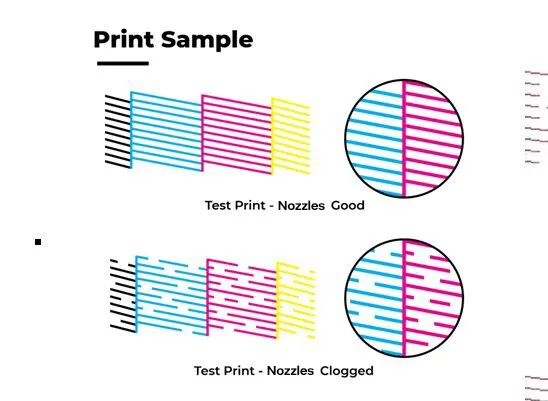
1) Test Pattern Evaluation
- Check line continuity
- Observe edge sharpness
- Inspect solid fill uniformity
Reflects placement accuracy and consistency
2) Micro Text Testing
- Print text smaller than 1 mm
- Check clarity and edge definition
Reflects precision and droplet control
3) Instrument Analysis
Using microscopes or imaging software:
- Measure droplet diameter variation
- Analyze positional deviation
- Count stray droplets
Provides quantitative performance data
7. Maintaining Stable Droplet Performance
Consistent droplet quality requires proper maintenance:
Ink Stability
- Use high-quality UV ink
- Prevent sedimentation
- Maintain temperature: 18–30°C
- Maintain humidity: 30%–70%
Printhead Maintenance
- Regular cleaning to avoid clogging
- Monitor negative pressure system
- Ensure stable ink supply
Substrate Matching
- Adjust parameters based on material
- Control ink spread and absorption
8. Conclusion
Small droplets, big impact.
In UV inkjet printing, droplet control defines:
- Image clarity
- Color richness
- Production consistency
The best results come from balancing:
- Droplet size and grayscale usage
- Placement accuracy
- Consistency and coverage
- Material and process settings
Extended Solution: Stable Ink Delivery System
Reliable droplet performance depends not only on the printhead, but also on the entire ink delivery system:
- Ink dampers (stable ink supply, anti-backflow)
- Filters (prevent contamination)
- Ink pumps (continuous ink flow)
- Capping stations (maintain nozzle condition)
We provide complete UV printer component solutions to help you:
- Improve print consistency
- Reduce printhead failure rates
- Achieve long-term stable production
For bulk orders or customized solutions, feel free to contact us.