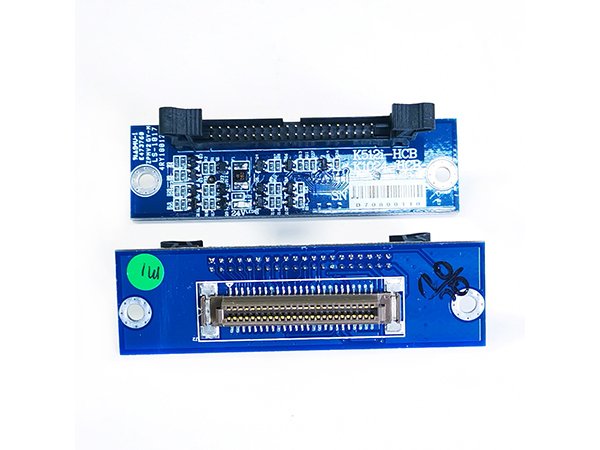
In modern digital inkjet printers, the printhead handles precise ink output while the mainboard sends control commands. Between them lies a small but crucial component—the printer adapter board. Acting as a signal bridge, it ensures smooth communication and stable operation between different mainboards and printheads.
The adapter board converts signals, matches interfaces, and regulates voltage, enabling components from different brands or models to work reliably together. It is especially important when upgrading printheads, replacing the mainboard, or adding new functionalities.
Key Functions of a Printer Adapter Board
1. Signal Conversion and Transmission
Different printhead manufacturers (e.g., Epson, Ricoh, Konica, Xaar) use unique communication protocols and interface standards. The adapter board translates mainboard signals into a format the printhead can recognize, including waveform control, voltage triggers, heating signals, and temperature feedback.
2. Interface Compatibility
Mainboard outputs may be FPC ribbon cables or pin headers, while printheads often require FFC, FPC, or flip-FPC connections. Adapter boards bridge these interfaces seamlessly, eliminating the need for hardware modifications and improving system flexibility.
3. Voltage Regulation and Protection
Printheads are sensitive to voltage fluctuations. Adapter boards include voltage regulators, filters, and capacitors to maintain stable voltage, protecting the printhead and prolonging its lifespan.
4. Multi-Printhead Expansion
In multi-head or multi-channel systems, adapter boards allow independent signal control for each printhead. For example, in dual DX7 or quad XP600 configurations, each printhead connects to the mainboard through a dedicated adapter board, ensuring stable operation without interference.
5. Upgrade and Replacement Support
When upgrading or replacing printheads (e.g., DX5 to i3200), adapter boards act as middleware to make new printheads compatible with existing mainboards, reducing costs and improving flexibility.
Structural Features
Precise Pin Mapping: Ensures correct signal transmission between the mainboard and the printhead.
Voltage Compatibility & Stabilization: Supports 24V and 33V inputs with integrated filtering and regulation.
High-Quality Connectors: Gold-plated pins and precision connectors reduce resistance and interference.
Industrial PCB Material: Multi-layer, high-density PCB resists heat and aging for continuous printing environments.
Compact Design: Fits behind the printhead or carriage board; a modular layout allows easy replacement and maintenance.
Printer Adapter Board Applications
Adapter boards are widely used in various printing equipment:
UV Printers (Flatbed / Roll-to-Roll): Connect UV printheads to the mainboard for waveform transmission and voltage regulation, supporting KM1024i, GH2220, i3200, XAAR, and other printheads.
Large Format Printers / Dye Sublimation / Photo Printers: Enable compatibility between domestic mainboards and EPSON DX5, DX7, XP600, TX800, etc.
Custom & Multi-Printhead Systems: Ensure stable signal distribution in multi-head, multi-interface, multi-voltage setups.
High-Speed Wide-Format Printers: Maintain precise control and stable drive signals for solvent or eco-solvent printing.
Printhead Upgrades & Replacement: Allow new printheads to run on existing systems without replacing the mainboard.
Maintenance Tips
Check Cables and Connectors: Inspect for loose or damaged cables and oxidized or burned connectors.
Anti-Static Handling: Use anti-static wristbands when installing or servicing to prevent electronic damage.
Environmental Protection: Keep the printer interior clean and dry to avoid dust or ink mist interference.
Regular Function Test: Verify signal transmission before printing to ensure accurate printhead control.
Conclusion
Though small, the adapter board is an essential signal bridge in printer systems. It ensures precise communication between the mainboard and printhead, provides voltage stabilization and interface conversion, and supports upgrades. For operators seeking long-term reliability and consistent print quality, using high-quality, compatible adapter boards and performing regular maintenance is key.