In garment printing, choosing between cartridge-based and bulk ink supply systems is not just a technical decision—it directly impacts your production efficiency, operating cost, and print consistency.
Whether you run a DTG (Direct-to-Garment) or DTF (Direct-to-Film) printer, the right ink delivery system should align with your production volume, workflow, and maintenance capability.
This guide breaks down the real differences—beyond surface-level comparisons—so you can make a smarter investment.
Understanding the Two Ink Supply Systems
1. Cartridge-Based Ink System
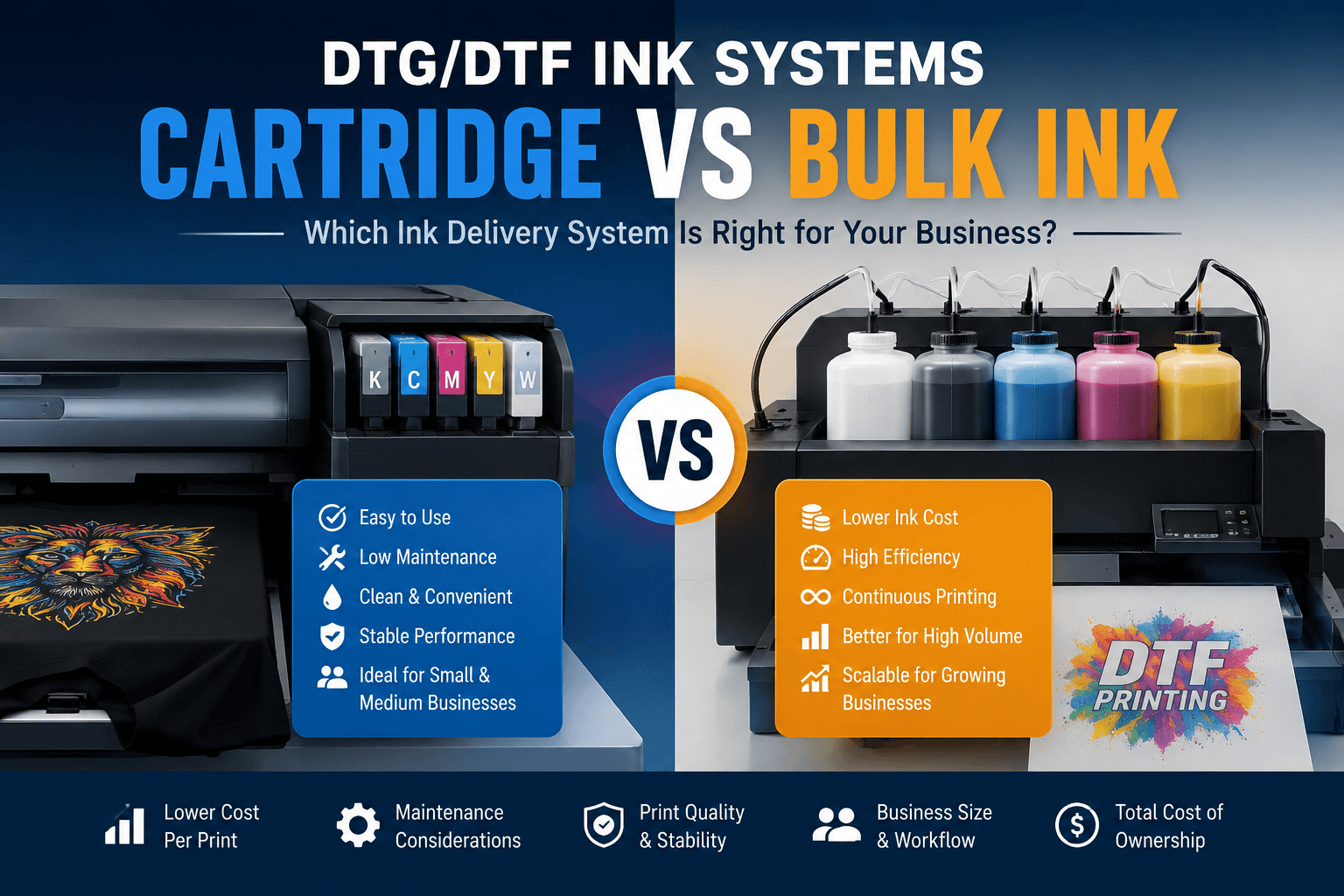
A cartridge system uses sealed, pre-filled ink cartridges designed for plug-and-play operation.
Key Advantages
- High Stability: Sealed ink reduces contamination and air exposure, helping maintain consistent print quality.
- Low Maintenance: No manual refilling required. Easy replacement minimizes downtime.
- User-Friendly: Ideal for beginners or businesses without dedicated technicians.
- Better Ink Protection: Prevents oxidation and pigment settling—especially critical for white ink.
Limitations
- Higher Cost per ml: Due to packaging, engineering, and chip integration.
- Frequent Replacement: Not ideal for continuous or high-volume production.
- Limited Scalability: Costs increase significantly as production grows.
2. Bulk Ink Supply System
Bulk systems use refillable tanks or continuous ink supply systems (CISS), allowing larger volumes of ink to be stored and delivered.
Key Advantages
- Lower Ink Cost: Typically 60–80% cheaper per ml compared to cartridges.
- Continuous Production: Fewer interruptions due to less frequent refilling.
- Scalable for Growth: Suitable for industrial-level or high-output environments.
- Reduced Waste: Less reliance on disposable cartridges.
Limitations
- Higher Maintenance Requirements: Requires regular cleaning, monitoring, and ink management.
- Risk of Contamination: Open or semi-open systems are more exposed to dust and air.
- Operator Dependency: Performance depends heavily on staff skills and consistency.
- White Ink Challenges: Sedimentation and clogging risks increase without proper stirring and circulation.
Keep Bulk Ink Systems Running Smoothly
Bulk ink systems rely on more than just large-capacity ink tanks. DTF printer parts and DTG printer parts such as white ink circulation pumps, stirring systems, dampers, filters, ink tubes, and sub-tanks help maintain consistent ink flow and reduce the risk of sedimentation or pressure fluctuations.
Replacing worn ink system parts before they fail can significantly reduce downtime and improve production stability in both DTG and DTF printing.
DTG vs DTF: Why Ink System Choice Matters More Than You Think
While both technologies use similar ink delivery principles, DTF printing places higher demands on the ink system, especially for white ink.
| Factor | DTG Printing | DTF Printing |
|---|---|---|
| White Ink Usage | Moderate | High |
| Maintenance Frequency | Lower | Higher |
| Risk of Clogging | Medium | High |
| Ink System Sensitivity | Moderate | Critical |
Key Insight:
DTF workflows benefit more from stable ink flow and proper circulation—making system choice even more important.
How to Choose the Right System (Practical Guide)
Instead of asking “Which is better?”, ask:
1. What is your daily production volume?
- Low volume → Cartridge
- High volume → Bulk ink
2. Do you have skilled technicians?
- No → Cartridge is safer
- Yes → Bulk system is viable
3. Is your production stable or fluctuating?
- Unstable → Cartridge reduces risk
- Stable → Bulk improves efficiency
4. Can you control your working environment?
- Limited control → Cartridge
- Controlled environment → Bulk
Cost Reality: It’s Not Just About Ink Price
Many businesses focus only on ink cost per liter, but the real decision should consider:
- Downtime and production interruptions
- Labor and maintenance costs
- Ink waste and cleaning cycles
- Printhead lifespan
- Output consistency
In some cases, cartridge systems actually deliver lower total cost of ownership despite higher ink prices.
Recommended Growth Path for Printing Businesses
A practical approach many successful print shops follow:
Stage 1: Start with cartridge systems (low risk, easy setup)
Stage 2: Transition to hybrid or partial bulk systems
Stage 3: Move to full bulk systems for large-scale production
This allows you to scale without compromising stability.
Final Thoughts
Choosing between cartridge and bulk ink systems is not about finding a “better” option—it’s about finding the right fit for your operation.
- Cartridge systems offer simplicity, stability, and low risk
- Bulk systems deliver cost efficiency and scalability—but require discipline
Your decision should reflect your production goals, team capability, and long-term growth plan.