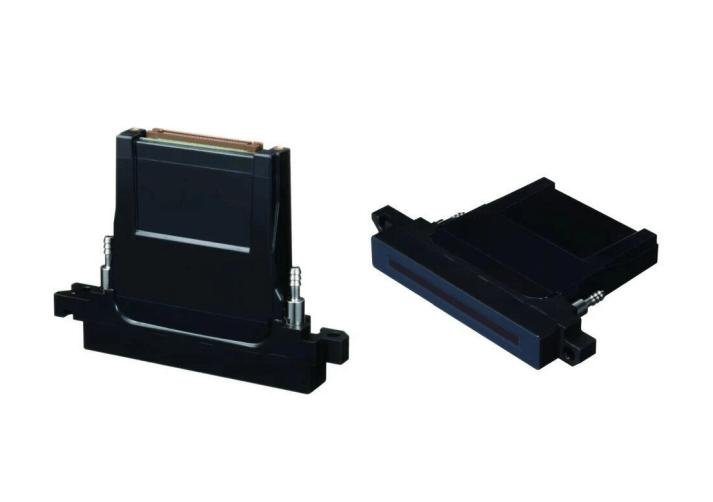
In industrial inkjet systems, the printhead plays a critical role not only in print resolution but also in ink compatibility, production speed, and long-term system stability.
Konica Minolta’s KM1024i series is widely adopted across UV printing, solvent-based printing, and functional material jetting thanks to its proven reliability and extensive industrial application experience.
Among this series, KM1024iSHE-HM and KM1024iSHE-HM-LV are two models that are often confused due to their similar appearance and shared platform—yet they are designed for very different application requirements.
This article provides a structured comparison from the perspectives of key parameters, application logic, and selection strategy, helping you choose the most suitable printhead for your project.
1. KM1024i SHE-HM Overview (High-Viscosity Version)
The KM1024iSHE-HM is an industrial printhead designed for medium- to high-viscosity inks, with a strong focus on speed, throughput, and broad industrial compatibility.
Key Specifications
| Parameter | KM1024iSHE-HM |
|---|---|
| Core Feature | High-viscosity compatibility, solvent resistant |
| Ink Viscosity Range | 7–12 mPa·s |
| Drop Volume | 6 pl |
| Maximum Firing Frequency | 56 kHz |
| Nozzle Count | 1,024 |
| Print Width | 72 mm |
| Native Resolution | 360 npi |
| Grayscale Levels | 8 levels |
| Built-in Heater | Yes |
| Compatible Ink Types | UV inks, solvent-based inks |
| Typical Applications | UV flatbed printers, roll-to-roll systems, industrial graphics |
Technical Insight
Thanks to its higher firing frequency, the HM version performs exceptionally well in high-speed scanning and high-output production systems, such as commercial graphics printers, industrial signage equipment, UV flatbed printers, and roll-to-roll machines.
The smaller 6-pl drop size also helps maintain sharp edges and fine details while delivering high productivity.
2. KM1024i SHE-HM-LV Overview (Low-Viscosity Version)
The “LV” (Low Viscosity) designation clearly indicates that KM1024iSHE-HM-LV is purpose-built for low-viscosity fluids, targeting functional materials and emerging manufacturing technologies.
Key Specifications
| Parameter | KM1024iSHE-HM-LV |
|---|---|
| Core Feature | Low-viscosity compatibility, solvent resistant |
| Ink Viscosity Range | 3–5 mPa·s |
| Drop Volume | 7.5 pl |
| Maximum Firing Frequency | 44 kHz |
| Nozzle Count | 1,024 |
| Print Width | 72 mm |
| Native Resolution | 360 npi |
| Grayscale Levels | 8 levels |
| Built-in Heater | Yes |
| Compatible Ink Types | UV inks, solvent-based inks |
| Typical Applications | Printed electronics, functional materials, coating and specialty inkjet |
Technical Insight
The HM-LV is not a lower-performance version but a printhead optimized for a different material behavior.
It's slightly larger drop volume improves jetting stability with low-viscosity liquids, reducing misting, satellite drops, and jet breakup. While it sacrifices some firing speed, it significantly enhances control and reliability for sensitive or functional fluids.
3. Core Parameter Differences Explained
Although both printheads share the same KM1024i platform and mechanical structure, they are clearly differentiated by jetting logic and material adaptability. Understanding what these parameters mean in practice is more important than simply comparing numbers.
3.1 Core Positioning: Viscosity Defines the Application Boundary
- KM1024iSHE-HM is optimized for medium-to-high viscosity inks, prioritizing industrial versatility and production efficiency.
- KM1024iSHE-HM-LV is optimized for low-viscosity materials, with structural and driving adjustments aimed at stable functional material jetting.
They are not “better” or “worse” versions—each solves a different jetting challenge.
3.2 Ink Viscosity Range: The Most Critical Selection Factor
- HM: 7–12 mPa·s
- HM-LV: 3–5 mPa·s
Ink viscosity should always be the first parameter to verify.
Using a printhead outside its recommended viscosity range can cause unstable jetting, ink misting, nozzle dropouts, and accelerated wear—even if all other specifications match.
3.3 Drop Volume: Precision vs. Stability
- HM: 6 pl
- HM-LV: 7.5 pl
The HM’s smaller droplets offer an advantage in ultra-fine image detail and edge definition.
The HM-LV’s larger droplets improve jet stability for low-viscosity fluids, reducing breakage and atomization during flight.
3.4 Firing Frequency: Direct Impact on Productivity
- HM: 56 kHz
- HM-LV: 44 kHz
A higher firing frequency enables higher theoretical printing speeds, making the HM more suitable for throughput-driven production lines.
The HM-LV intentionally lowers firing frequency to maintain consistent jetting behavior with low-viscosity materials.
3.5 Shared Specifications: A Stable High-Performance Foundation
Both models share identical core performance parameters:
- 1,024 nozzles
- 72 mm print width
- 360 npi native resolution
- 8-level grayscale
These shared specifications ensure high precision, uniform output, and industrial-grade reliability, regardless of the selected model.
3.6 Built-in Heater and Ink Compatibility
Both printheads feature a built-in heater, allowing fine viscosity adjustment through temperature control to maintain stable jetting under varying operating conditions.
They also offer strong solvent resistance and support both UV and solvent-based inks, covering most mainstream industrial inkjet applications.
4. How to Choose the Right Printhead
Choose KM1024iSHE-HM if:
- High printing speed and throughput are the priority
- Ink viscosity falls within 7–12 mPa·s
- Applications include graphics, signage, and industrial image printing
- Production efficiency is more important than material sensitivity
Choose KM1024iSHE-HM-LV if:
- Using low-viscosity functional fluids (3–5 mPa·s)
- Applications involve display manufacturing, printed electronics, functional coatings, or perovskite solar cells
- Jetting stability and material compatibility are more critical than maximum speed
- Reliable material deposition is the primary goal
5. Shared Technical Advantages of the KM1024i Platform
Despite their different positioning, both printheads benefit from Konica Minolta’s mature KM1024i architecture:
- Independent Drive for All 1,024 Nozzles
Enables all nozzles to operate simultaneously, avoiding the speed limitations of traditional multi-cycle drive methods.
- High-Performance Integrated Heating System
Stabilizes ink properties and minimizes viscosity fluctuations for consistent jetting.
- Industrial-Grade Reliability
Designed for long-term continuous operation with a wide range of industrial inks.
These shared strengths ensure long-term stability and predictable performance in demanding industrial environments.
Conclusion
There is no “higher-end” or “lower-end” choice between KM1024iSHE-HM and KM1024iSHE-HM-LV—they are engineered to meet different inkjet requirements.
The real selection question is simple:
What ink are you using, and do you prioritize speed or jetting stability?
If you are evaluating a specific application or need help confirming ink, system, and printhead compatibility, feel free to reach out for a more detailed discussion.