In digital inkjet printing systems, stable and precise fluid control is essential for achieving consistent print quality. Beyond printheads and ink supply systems, one critical yet often overlooked component is the printer solenoid valve.
A solenoid valve uses electromagnetic force to control the flow of liquids or gases—such as ink, cleaning fluid, or hot air—enabling accurate ink delivery, drying control, automated cleaning, and system integration. It is a vital part of modern, high-efficiency printing equipment.
What Is a Printer Solenoid Valve?
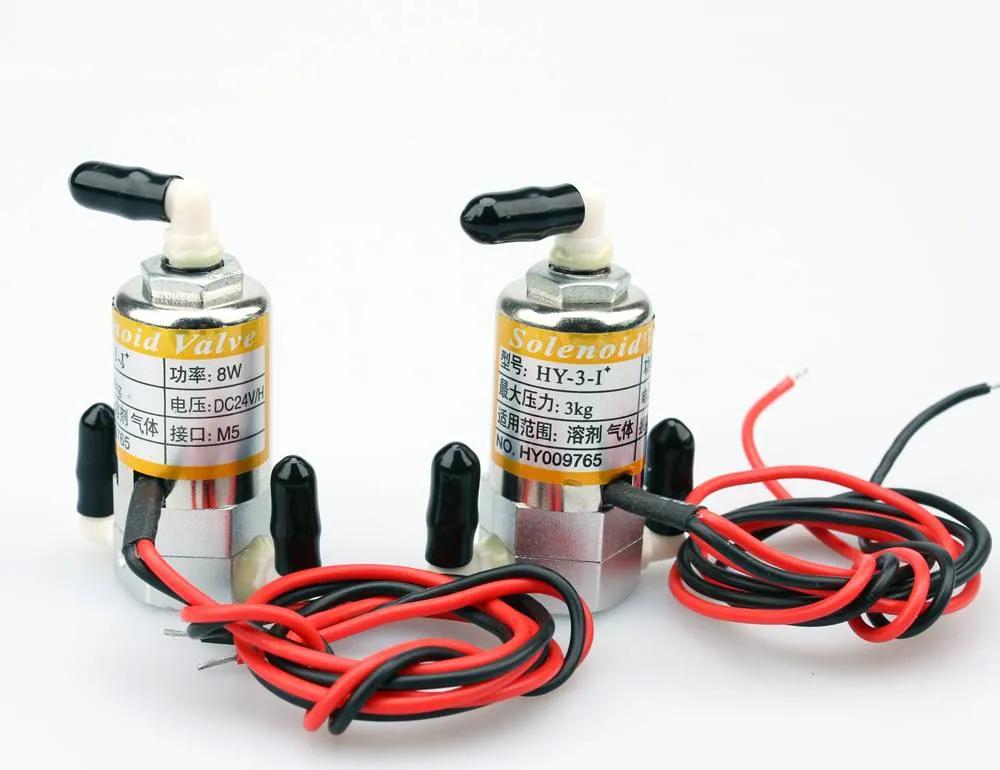
A solenoid valve is an electrically controlled device used to regulate fluid flow. Its core components include:
- Coil (electromagnetic coil)
- Plunger (movable core)
- Valve body
When the coil is energized, it generates a magnetic field that moves the plunger, opening or closing the valve. When power is off, a spring returns the plunger to its original position.
In printers, solenoid valves are typically integrated into ink supply systems, carriage boards, and cleaning units, forming the foundation of automated control.
Structure, Working Principle, and Key Features
The working principle of a solenoid valve can be summarized as: energize to actuate, de-energize to reset.
Process:
- Power on → magnetic field is generated
- Magnetic force moves the plunger
- Fluid channel opens or closes
- Power off → spring resets the plunger
Common Types by Structure
Depending on internal flow design, solenoid valves are typically divided into:
- 2-way solenoid valve
Used for simple ON/OFF control. Ideal for basic ink or airflow switching applications.
- 3-way solenoid valve
Used for flow direction switching. Commonly applied in systems requiring transitions between ink supply, return flow, or cleaning paths.
Different structures are suitable for different ink system designs. In complex printing systems, multiple valve types are often used together for flexible and efficient control.
Key Features of Printer Solenoid Valve
- Compact design
Small size allows installation in limited spaces such as carriage boards or ink modules.
- Fast response
Electrically driven switching ensures quick reaction, ideal for high-frequency printing operations.
- Configurable states
Available in normally closed (NC) or normally open (NO) configurations for different system requirements.
- High precision control
Enables accurate regulation of flow rate and pressure, critical for high-quality printing.
- Long service life
High-quality valves can withstand millions of switching cycles, meeting industrial demands.
Main Functions in Printing Systems
1. Precise Ink Supply and Pressure Control
Solenoid valves regulate the flow between main ink tanks, sub-tanks, and printheads. By controlling flow timing and pressure, they help prevent:
- Ink starvation
- Ink overflow
- Color inconsistency
This is especially important for high-resolution printing applications.
2. Control of Hot Air and UV Curing Systems
In UV printers, solenoid valves also control airflow and curing-related systems, such as:
- UV lamps
- Heating units
- Airflow systems
This ensures proper drying, better ink adhesion, and fewer issues like wrinkling or peeling.
3. Automated Cleaning System Control
During printhead or ink line cleaning, solenoid valves direct cleaning fluid through specific channels. Multi-valve setups can:
- Enable multi-channel cleaning
- Automate flushing cycles
- Improve cleaning efficiency
4. System Integration and Automation
Solenoid valves can be integrated with PLCs, sensors, and control systems to enable:
- Automatic ink supply
- Scheduled cleaning cycles
- Temperature and airflow control
- Unattended operation
This significantly enhances productivity and automation in industrial printing.
Printer Solenoid Valve Applications
Solenoid valves are widely used across various printing systems:
- Wide-format printers (eco-solvent / solvent)
- UV flatbed and roll-to-roll printers
- DTF and DTG textile printers
- Label printing and industrial inkjet systems
In multi-head and multi-channel systems, they are essential for ensuring consistent ink delivery and color accuracy.
Printer Solenoid Valve Selection Guidelines
When choosing a solenoid valve, consider the following:
- Voltage compatibility (e.g., 12V / 24V)
- Material resistance (especially for UV or solvent inks)
- Response speed
- Sealing performance
- Durability and lifespan
Selecting the right valve ensures stable operation and reduces maintenance issues.
Maintenance Tips
To ensure long-term performance:
- Keep clean and dry
Prevent ink or cleaning fluid from contacting the coil.
- Test regularly
Avoid plunger sticking due to long inactivity.
- Ensure stable voltage
Prevent coil damage caused by voltage fluctuations.
- Replace when necessary
If you notice slow response, leakage, or malfunction, replace promptly to avoid damage to other components.
Conclusion
Although small in size, the solenoid valve plays a critical role in fluid control and system automation in inkjet printers. It directly affects ink flow stability, print quality, and overall machine efficiency.
For printing businesses, choosing high-quality solenoid valves and maintaining them properly is essential for reliable operation, reduced downtime, and improved productivity.