Printer Ink Supply Part
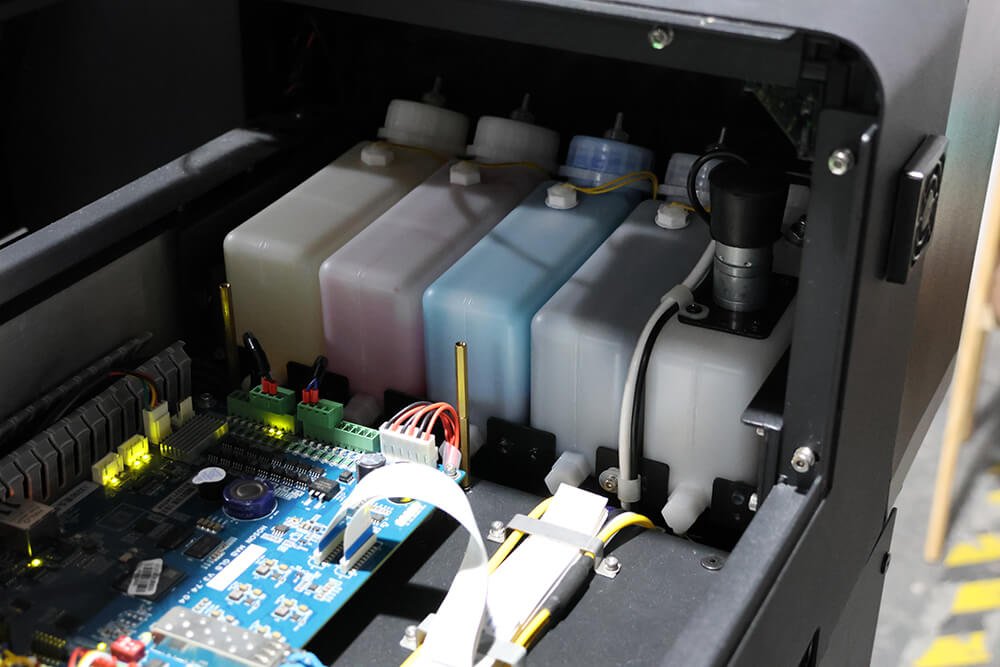
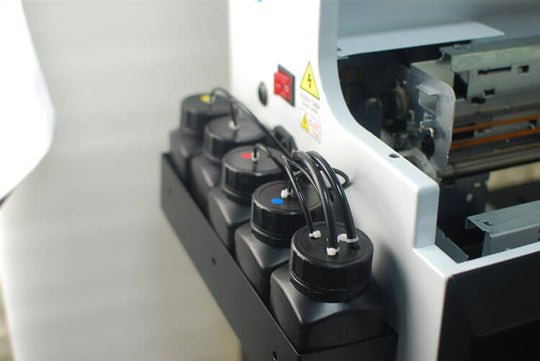
Ink cartridges or ink tanks: UV inkjet printers store ink in ink cartridges or ink tanks. The Ink cartridges are mainly used in small inkjet printers and usually hold a few hundred milliliters to a few liters of ink. Ink tanks, on the other hand, are designed for large-format printers. They have much larger capacities and can store up to dozens of liters of ink. Both cartridges and tanks help maintain a steady ink supply during printing. Most of them are equipped with level sensors that alert the operator when the ink is running low. This ensures timely refilling and prevents interruptions during printing.
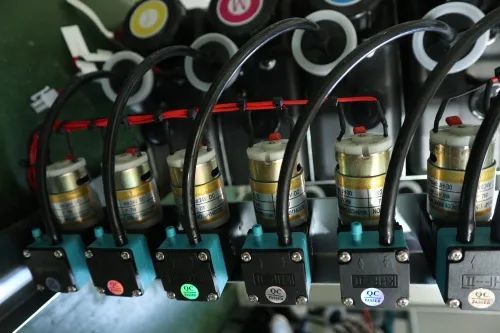
Printer ink supply pump: The ink pump is an essential part of the printing system. It transfers ink from the cartridge or tank to the printhead by creating a pressure difference. This pressure allows the ink to overcome resistance in the tubing and printhead, ensuring smooth flow. The working principle of the ink supply pump is similar to that of a small water pump.
There are many types of ink supply pumps, such as gear pumps and peristaltic pumps. The ink supply of the gear pump is relatively stable and can provide higher pressure. This type of pump is ideal for situations where ink needs to be transported over long distances or when the printhead requires stable, high pressure. A peristaltic pump offers excellent sealing and high precision. It can accurately control the ink flow and cause minimal damage to the ink. These features make it well-suited for high-precision inkjet printing tasks. It helps ensure consistent output and reliable performance.
Ink Filtration and Voltage Stabilization
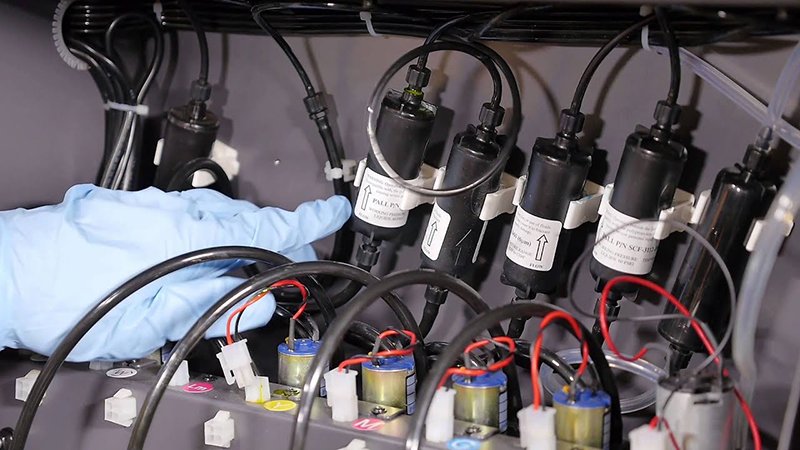
Ink Filter: In the process of ink flowing from the supply part to the printhead, it must pass through the filter. The main function of the filter is to remove impurities in the ink, such as dust, pigment particle agglomerates, etc. If these impurities enter the printhead, they may clog the nozzle and affect the quality of printing. The accuracy of the filter is generally between 1 and 50 microns. The appropriate accuracy is selected according to the requirements of the printhead and the properties of the ink. For example, for a high-precision printhead, a filter with an accuracy of 1-5 microns may be required to ensure the purity of the ink.
Pressure stabilizing device: To ensure that the printhead can spray ink stably, a pressure stabilizing device is also provided in the printer ink supply system. It can buffer the pressure fluctuations generated by the ink pump so that the ink is supplied to the printhead at a constant pressure. The pressure-stabilizing device typically takes the form of a pressure tank or an electronic pressure regulator. The pressure tank uses an internal airbag or piston to help regulate ink pressure. When the pressure is too high, it stores some of the ink; when the pressure drops, it releases ink to maintain stability. This helps keep the printing process smooth and consistent. In contrast, an electronic pressure regulator uses sensors and control circuits to monitor and adjust the ink pressure in real time. It provides more precise control over pressure changes for high-performance printing systems.
Ink Supply Inside the Printhead
Internal channels of the printhead: When the ink enters the printhead, it passes through a series of complex internal channels. These channels distribute the ink to the vicinity of each nozzle. The internal design of a printhead is extremely precise, with channel sizes typically ranging from tens to hundreds of microns. This ensures that ink flows accurately to the nozzle for consistent printing. Different brands and models have varying internal layouts and channel structures. However, their common goal is to distribute ink evenly and enable efficient ejection. This precision is key to achieving high-quality printing results.
Ink drive and injection: There is a special ink drive mechanism inside the printhead. For piezoelectric printheads, ink is ejected from the nozzle by squeezing the ink cavity through the deformation of a piezoelectric crystal. When a voltage is applied, the crystal deforms. This deformation creates pressure changes inside the ink cavity. As a result, the ink is pushed out through the nozzle for printing. The thermal foaming printhead works by heating the ink to create bubbles, which then expand and force the ink out through the nozzle. This process relies on precise temperature control to generate the bubbles quickly and efficiently. During operation, the printhead’s control circuit accurately manages the firing frequency and droplet size of each nozzle. This ensures consistent ink flow and delivers high-quality printing results.
Ink recovery and circulation part (available on some models)
Ink recovery system: Some high-end UV inkjet printers are equipped with an ink recovery system. When abnormal spraying occurs during printhead cleaning, initialization, or printing, the excess ink will be recovered. The recovered ink returns to the ink cartridge or a special recovery container through an ink tube. The recovery system typically comprises components such as recovery pipes, recovery pumps, and filters, ensuring that the recovered ink can be reused.
Ink circulation system: The ink circulation system allows the ink to circulate between the printhead and the ink cartridge. This helps maintain the uniformity of the ink and prevents the ink from settling or drying in the printhead. Through circulation, the ink can continuously pass through the filter to further remove possible impurities. The circulation system helps maintain a more uniform temperature inside the printhead, promoting stable ink injection. This improves overall printing consistency and quality. However, adding an ink circulation system increases the complexity and cost of the ink setup. Therefore, not all UV inkjet printers include this feature.