Epson 5113, 4720, and i3200 printheads represent three different stages of digital printing development. They differ in stability, ink compatibility, system requirements, and overall production capability.
To understand them clearly, it is important to look at their positioning, evolution, compatibility, and upgrade limitations.
Epson 5113 Printhead — Stable Water-Based Printing Base
The Epson 5113 printhead was introduced in 2015 and quickly became a standard choice for water-based digital printing systems.
Positioning:
The 5113 is mainly positioned as a stable, entry-to-mid-level water-based printing solution.
Key Features:
- Designed primarily for water-based inks
- High stability in long-running jobs
- Widely used in:
- Textile printing
- DTG (Direct-to-Garment) printing
- Sublimation printing
- Paper-based printing
Strengths:
- Very stable with water-based ink
- Mature waveform and system compatibility
- Reliable for continuous production
Limitations:
- Limited ink compatibility
- Not suitable for UV or solvent inks
- Lower flexibility for modern multi-material printing
In short: 5113 = stability-first water-based solution
Epson 4720 Printhead — Cost-Effective Multi-Ink Upgrade
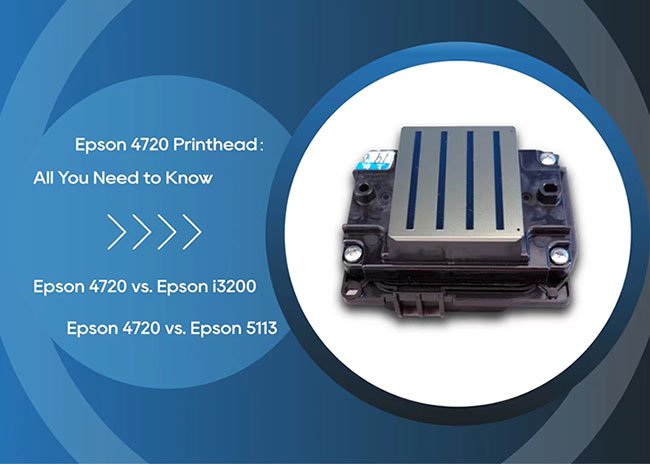
The Epson 4720 (also called the EPS3200) is developed based on the 5113 structure but with improved compatibility and broader applications.
Positioning:
The 4720 is positioned as a cost-effective, multi-ink, flexible production solution.
Key Features:
- 3200 nozzles for higher output efficiency
- Supports multiple ink types:
- UV ink
- Solvent ink
- Oil-based ink
- Water-based ink
- Corrosion-resistant design
- External ink damper support
- Lower cost compared to i3200
Strengths:
- High versatility across different ink systems
- Lower replacement cost
- Widely used in the advertising and UV printing industries
Limitations:
- Requires a decryption card in many systems
- Water-based stability is weaker than 5113
- System tuning is more sensitive (waveform + ink adjustment required)
In short: 4720 = flexible and economical multi-purpose printhead
Epson i3200 Printhead — Why It Is Becoming the Mainstream Choice
The Epson i3200 is a newer-generation industrial printhead designed for higher precision, stability, and production efficiency.
To understand the current I3200-A1, I3200-E1, and I3200-U1 options, read our Epson I3200 selection guide.
Positioning:
The i3200 is positioned as a mid-to-high-end industrial printhead for stable mass production.
Why is it becoming mainstream:
1. Better Stability
- Improved internal structure
- More balanced ink pressure
- Stronger consistency in long-term printing
2. No Decryption Card Required
- Simplifies installation
- Reduces system dependency and failure points
3. Higher Performance
- Around 30% faster than 4720
- More vivid color output
- Better droplet control
4. Longer Service Life
- Designed for industrial continuous operation
- Lower long-term maintenance risk
In short: i3200 = stable + fast + industrial-grade reliability
Epson 5113 vs 4720 vs i3200 Printhead Comparison
| Feature | Epson 5113 | Epson 4720 | Epson i3200 |
|---|---|---|---|
| Nozzle Count | 3200 | 3200 | 3200 |
| Ink Compatibility | Water-based only | Multi-ink (UV, solvent, water-based) | Multi-ink optimized |
| Stability (Water Ink) | High | Medium | High |
| UV / Solvent Support | No | High | Very high |
| Printing Speed | Medium | Fast | Very fast |
| Color Performance | Good | Good | Excellent |
| Service Life | Medium | Medium | Long |
| Cost | Medium | Low | High |
| Decryption Card Required | Yes | Yes | No |
Contact us today for pricing, technical support, and bulk order inquiries.
Can Old Machines Directly Upgrade to i3200?
In most cases: NO, not directly.
Upgrading from 4720 or 5113 to i3200 is not a simple plug-and-play replacement.
Why not directly compatible?
Because the system architecture is different:
- The mechanical structure may not match
- The electrical interface differs
- Firmware requirements are different
- Ink system pressure requirements change
Even if the printhead fits physically, it does NOT guarantee stable operation.
Compatibility Issues You Must Check Before Upgrading
Control Board Compatibility
The control board is critical.
You must check:
- Whether the board supports the i3200 drive signals
- Whether firmware includes the i3200 waveform
- Whether the voltage output is stable for i3200
Many 4720/5113 boards cannot directly support i3200.
Ink System Compatibility (Ink Path)
Upgrading may require changes in:
- Ink pump pressure
- Dampers (ink cushions)
- Ink tubing diameter
- Filtration system
The i3200 requires a more stable and balanced ink flow.
Software & Waveform Settings
Software must support:
- i3200 waveform data
- Firing frequency adjustment
- Ink limit curves
- ICC color profiles (optional but recommended)
Without a correct waveform, print quality will drop significantly.
Mechanical Structure Compatibility
You should verify:
- Carriage height
- Printhead mounting plate
- Alignment accuracy
- Vibration control
The i3200 is more sensitive to mechanical instability.
What Should Be Considered When Upgrading Old Machines?
Before upgrading from 5113 or 4720 to i3200, check the following:
Cost vs Upgrade Value
Sometimes, upgrading costs are close to buying a new machine.
System Rebuild Requirement
You may need to upgrade:
- Mainboard
- Firmware system
- Ink delivery system
- Mechanical carriage
Production Goal
Ask yourself:
- Do you need a higher speed?
- Do you need better stability?
- Or just lower operating cost?
Operator Skill Level
i3200 systems require:
- Better calibration ability
- More precise maintenance
- More stable production environment
Final Summary: Clear Positioning of Each Printhead
Epson 5113 → Stability-focused water-based printing
Epson 4720 → Cost-effective multi-ink flexible solution
Epson i3200 → Modern industrial mainstream standard