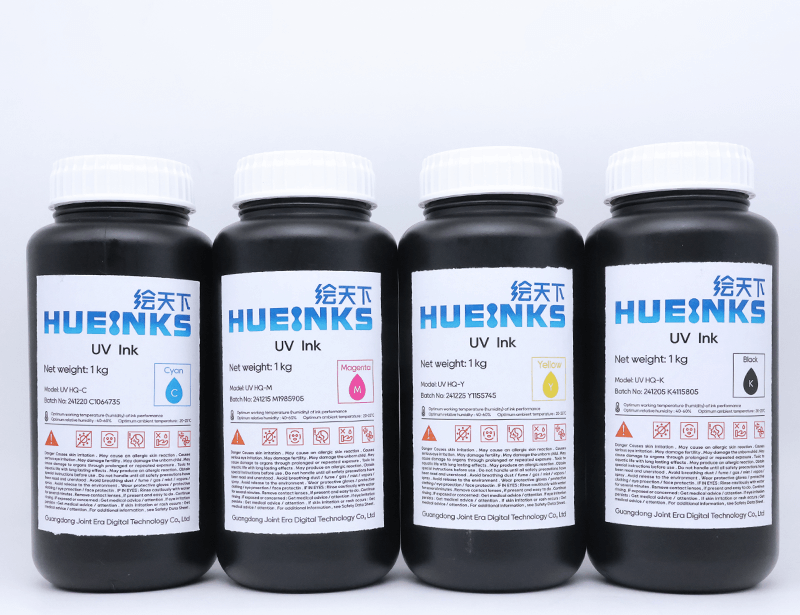
In UV printing, selecting the right UV ink comes down to three core factors: printhead compatibility, application suitability, and long-term stability. At the same time, proper storage management—including light protection, sealing, temperature control, and FIFO inventory rotation—is essential to maintaining ink performance and ensuring stable equipment operation.
For B2B procurement teams and equipment managers, UV ink is not just a consumable. It directly impacts print quality, printhead lifespan, maintenance costs, and delivery reliability. Therefore, scientific ink selection and standardized storage management are equally important.
In advertising production, industrial labeling, packaging customization, and decorative applications, UV ink has become a key variable influencing both production efficiency and product quality. For systems equipped with industrial printheads from Epson, Ricoh, or Konica Minolta, ink selection is a technical decision—not merely a purchasing action.
This article covers:
1. How to scientifically choose UV ink
2. How to properly store UV ink to extend its service life
Part I: Key Factors in Choosing UV Ink
1. Lightfastness and UV Resistance
UV-printed products, especially outdoor signage and advertising displays, are often exposed to sunlight for extended periods. Ink durability under UV exposure is therefore critical.
- Lightfastness determines whether colors remain vibrant over time
- UV resistance prevents fading or discoloration caused by sunlight
High-quality UV ink significantly slows color degradation and extends outdoor durability.
2. Ink Type and Application Matching
UV ink selection must be based on both material properties and the final application environment. UV inks are generally categorized into hard ink and flexible ink, each designed for different substrates.
Ink Type Comparison
| Ink Type | Suitable Materials | Core Features | Typical Applications |
|---|---|---|---|
| Hard Ink | Glass, metal, wood, acrylic, rigid boards | Hard surface finish, strong scratch resistance, high adhesion, durable | Nameplates, decorative panels, rigid signage |
| Flexible Ink | Soft film, plastics, leather, flexible materials | Excellent elasticity, bendable, resistant to cracking and peeling | Lightbox films, leather decoration, flexible packaging |
Incorrect matching may result in cracking, adhesion failure, or large-area peeling.
Application-Based Performance Requirements
| Application Type | Key Performance Requirements | Selection Recommendation |
|---|---|---|
| Advertising Boards (KT board, PVC, acrylic) | High adhesion, weather resistance, UV resistance | Choose weather-resistant formulations; evaluate outdoor lifespan |
| Metal / Glass | Strong adhesion, scratch resistance | Use high-adhesion hard ink; consider surface pretreatment |
| Soft Film/Leather | Flexibility, crack resistance | Select flexible UV ink formulations |
| Industrial Labels | Chemical resistance, weather resistance, oxidation resistance | Use industrial-grade, corrosion-resistant ink |
Core Selection Questions
- Is the substrate rigid or flexible?
- Will the product be exposed to outdoor environments long-term?
- Will it encounter chemicals or mechanical friction?
- Is high scratch resistance required?
Only by evaluating substrate characteristics and end-use conditions can long-term performance and reduced after-sales risk be ensured.
3. Printhead and Equipment Compatibility
This is one of the most critical technical considerations in procurement decisions.
Key parameters include:
- Viscosity range (typically 6–12 mPa·s, depending on printhead)
- Surface tension compatibility
- Pigment particle size
- Platform validation testing
Insufficient compatibility may lead to:
- Nozzle clogging
- Ink misting or deflection
- Ink path contamination
- Reduced printhead lifespan
Small-batch testing is strongly recommended before large-scale purchasing.
4. Curing Speed and Production Efficiency
UV ink cures under ultraviolet light, and curing performance directly impacts production flow.
- Instant curing increases productivity
- Insufficient curing causes tackiness or weak adhesion
- Excessively fast curing may affect layer bonding
Different substrates and processes require tailored curing speeds.
5. Color Performance and Coverage
For high-end graphic output, color quality is essential.
Key indicators include:
- Color saturation
- Color gamut
- White ink opacity
- Transparency clarity
Coverage and color stability are especially important when printing on transparent or dark substrates.
6. Adhesion and Abrasion Resistance
For high-contact or industrial applications:
- Strong adhesion is mandatory
- Surface durability must withstand friction
- Cross-cut and scratch testing should be conducted
In packaging and industrial components, abrasion and chemical resistance are particularly critical.
7. Environmental Compliance and Safety Standards
Environmental requirements are increasingly important in global markets.
Confirm compliance with:
- Low VOC emission standards
- REACH regulations
- Industry-specific safety requirements (e.g., food-contact safety)
Environmental performance is not only regulatory but also brand-sensitive.
8. Cost vs. Long-Term Stability
Although high-quality UV ink may have a higher unit price, it often provides:
- Lower clogging rates
- Reduced downtime
- Longer outdoor durability
True cost evaluation should consider total operational cost, not just initial price.
Part II: How to Properly Store UV Ink
UV ink contains photoinitiators and reactive components, making it sensitive to storage conditions. Improper storage may cause premature aging, viscosity changes, or curing failure.
1. Store Away from Light
UV ink must be protected from UV exposure.
- Store in a cool, shaded environment
- Keep original opaque packaging
- Avoid direct sunlight
Light exposure can trigger partial curing and affect flow performance.
2. Seal Properly
Always tightly close containers after use:
- Prevent oxidation
- Prevent dust contamination
- Avoid viscosity changes due to evaporation
Unsealed ink increases the risk of nozzle clogging.
3. Control Temperature and Humidity
Ideal storage conditions:
- Temperature: 16°C–28°C
- Humidity: 55%–65%
Avoid:
- High temperatures (accelerated aging)
- Low temperatures (sedimentation or thickening)
Ensure proper warehouse ventilation.
4. Safety Management
- Keep away from heat and fire sources
- Store by category
- Maintain spacing between containers
- Assign a dedicated warehouse management
5. Follow FIFO (First-In, First-Out)
- Use older batches first
- Monitor inventory turnover
- Conduct regular expiration checks
Typical shelf life: 6–12 months. Opened ink should be used as soon as possible.
6. Mix Thoroughly Before Use
Pigment-based UV inks may settle during storage.
Recommended practice:
- Gently shake before use
- Roll-mix at low speed
- Avoid vigorous shaking that creates bubbles
7. Evaluating Expired Ink
If the ink:
- Appears uniform in color
- Shows no visible clumping
- Maintains normal viscosity
It may be tested on a small scale. However, it is not recommended for high-value production jobs.
Selection and Management Are Equally Important
UV ink is more than a consumable—it is a critical factor influencing equipment stability and brand delivery quality.
Scientific selection helps:
- Improve print quality
- Extend printhead lifespan
- Reduce maintenance costs
Proper storage ensures:
- Stable ink performance
- Consistent output
- Lower production risks
For B2B procurement and equipment management teams, true competitiveness lies in stability and controllability. Choosing the right ink—and managing it properly—ensures reliable, high-efficiency printing every time.