Printer ink filters play a vital role in maintaining print quality and protecting printheads in inkjet printing systems. Learn about their functions, common types, applications, and maintenance best practices.
Why Do Ink Filters Matter in Inkjet Printing?
Ink filters are essential components in the ink supply system, responsible for removing impurities and air bubbles to ensure stable ink flow, protect printheads, and maintain high-quality output.
Whether used in photo printers, UV flatbed machines, coding printers, or textile direct-to-fabric printers, filters are critical to achieving consistent and reliable printing performance.
Core Functions of Printer Ink Filters
1. Filtering Impurities to Protect the Printhead
During the production, transportation, and storage of ink, fine particles or sediment can form.
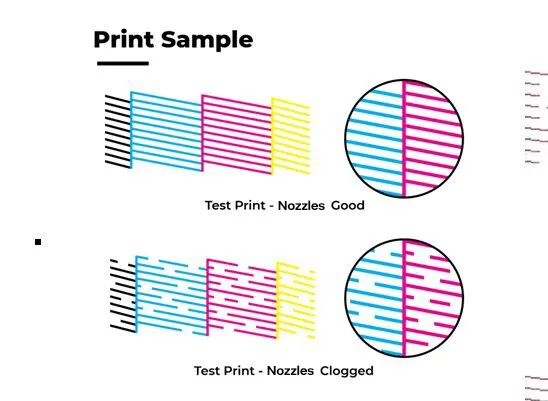
Filters prevent these impurities from entering the printhead’s microscopic nozzles—typically only tens of microns wide—avoiding clogging, misfiring, and costly printhead damage.
2. Ensuring Stable Ink Flow
Ink flowing through pipelines may carry tiny particles or deposits, which can affect smoothness.
A printer ink filter stabilizes ink pressure and flow, ensuring continuous, uniform printing without banding or interruptions.
3. Removing Air Bubbles
Air bubbles formed during ink agitation or circulation can lead to intermittent ink flow or inconsistent droplet ejection.
Certain capsule-type or degassing filters effectively remove bubbles, maintaining smooth inkjet performance and precise line definition.
4. Extending Equipment Lifespan
Unfiltered ink can accelerate wear on ink pumps, tubing, and printheads.
Regular filtration minimizes system wear, reduces maintenance frequency, and extends the lifespan of key components.
5. Enhancing Print Quality
By ensuring that only clean and uniform ink particles reach the printhead, printer ink filter contribute to consistent color and finer detail reproduction, while also preventing issues such as streaking or nozzle dropout.
Common Types of Printer Ink Filters
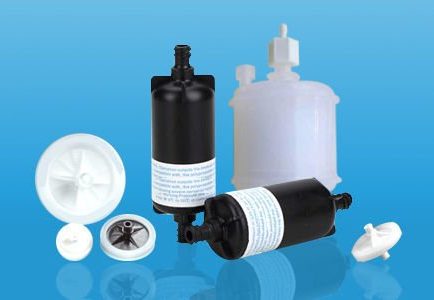
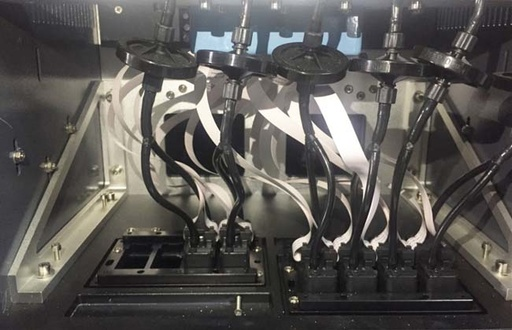
1. Butterfly Filter
Structure: Flat, compact shape with in/outlet ports and a thin filter membrane or mesh.
Function: Designed for removing particles and debris, protecting the printhead from clogging.
Application: Commonly used in photo printers and UV printers where compact size and ease of installation are essential.
2. Column (Cylindrical) Filter
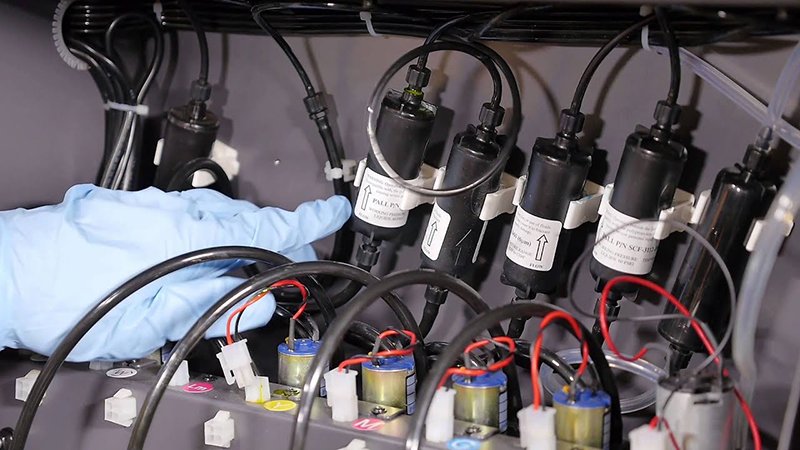
Structure: Cylindrical body with straight-through inlet/outlet; larger filter surface area; made from PP, nylon, or stainless steel mesh.
Function: Provides higher filtration capacity and pressure resistance, suitable for long-term continuous use.
Application: Ideal for industrial large-format printers, UV flatbed machines, and main ink supply systems.
3. Capsule Filter
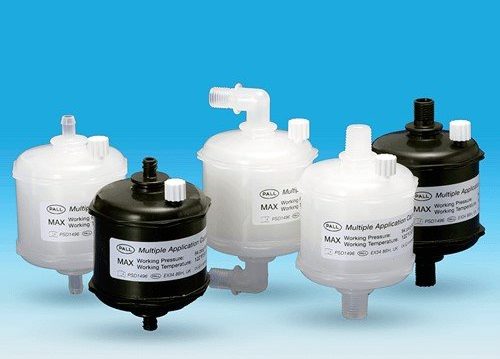
Structure: One-piece sealed capsule containing a microporous membrane (e.g., PP or PTFE) with filtration precision down to 0.2 μm.
Function: Removes ultra-fine particles and air bubbles; typically disposable.
Application: Used in high-end UV printers, industrial coding systems, and lab-grade precision printing.
Applications Across Printing Systems
Eco-solvent / Photo Printers: Prevents nozzle clogging during long-term printing.
UV Flatbed & Roll-to-Roll Printers: Filters white ink sediment, ensuring stable circulation and print uniformity.
Industrial Coding Printers: Maintains ink purity and droplet accuracy for high-speed, high-precision marking.
Textile & DTF Printers: Removes coagulated pigment and sediment to protect printheads and ensure continuous production.
Usage Tips and Maintenance
Replace filters every 3–6 months, depending on ink type and usage frequency.
If you experience unstable pressure or frequent nozzle drops, inspect for filter blockage.
For high-end printers, select filters that are heat-resistant, corrosion-proof, and ink-compatible.
Always check the flow direction during installation—incorrect orientation may cause ink flow issues.
For industrial inkjet systems, filter selection involves more than choosing a filtration rating or replacing the filter at a fixed interval. Flow rate, pressure drop, filtration area, material compatibility, installation position, and printhead requirements should also be considered. See our industrial inkjet filter selection and installation guide for a more detailed explanation of how filtration affects ink delivery and printhead protection.
Conclusion
Ink filters may be small, but they are indispensable for maintaining the health and performance of any inkjet printing system.
Choosing the right filter and replacing it regularly not only reduces downtime but also saves significant costs on printhead maintenance.
Contact us today to explore a wide range of butterfly, cylindrical, and capsule filters designed for UV, solvent, and textile printing applications.