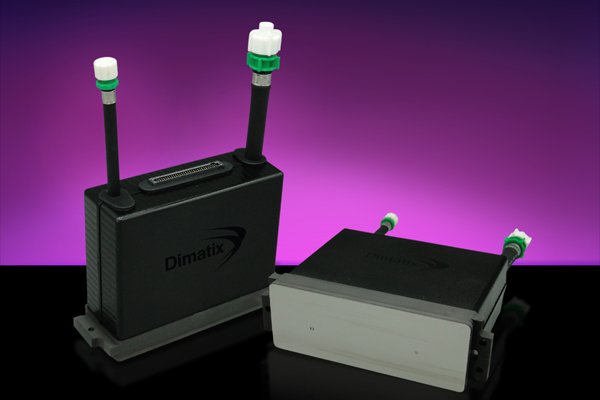
The StarFire® SG1024 printhead launched by Fujifilm Dimatix is an epoch-making printhead. This is due to its internal circulation ink supply technology, variable ink drop technology, detachable repair structure, and high-density nozzle design. All these can almost meet various high-standard industrial inkjet printing.
This article mainly introduces questions about the grayscale printing mode of the StarFire® SG1024 printhead.
A: What is grayscale?
B: Why do most driver boards of the SG1024 Starfire printhead only support binary printing (non-grayscale printing)?
C: What is the easiest way to achieve grayscale printing using the SG1024 Starfire?
Three printing methods in terms of the size of the ink droplets produced
1. Binary Printing:
Also known as "Native," 1 bit of data per second (1 bpp). Each prompt dot is 0 or 1 ink drop. All nozzles on the printhead will eject the same size ink droplet each time it is fired.
2. Adjustable Binary Printing:
Also known as "Binary Multi Pulse." 1 bit of data per offset dot (1 bpp), resulting in a transition of 0 or 1. Multiple ink droplets will follow the user's desired ink droplet during the ejection process. The adjustable binary printing mode allows the user to select the appropriate amount of ink in a single-pass printer without changing the type of printhead used.
3. Grayscale Printing:
Also known as "Multi Bits." 2 bits of data per dot 2bpp or 3 bits of data per dot 3bpp. By controlling each nozzle to eject a certain number of ink droplets and coalesce into a single droplet, each firing of each nozzle within an image can produce different sizes of ink droplets as needed.
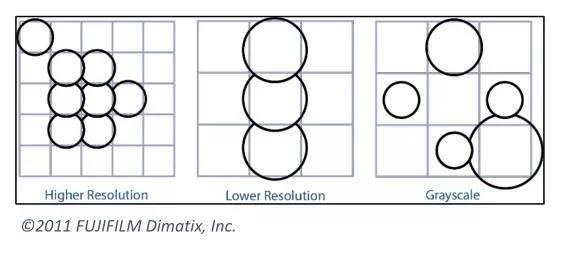
In binary printing, each nozzle can only generate a fixed size of ink droplets, and the final "point" printed on the media has only two conditions: "with ink droplets" and "without ink droplets." Grayscale printing can produce different sizes and has more advantages in printing effects, such as clearer text, sharper edges, and color matching using inkjet inks. And most importantly, single-pass printers; there is no need to sacrifice estimated printing yields.
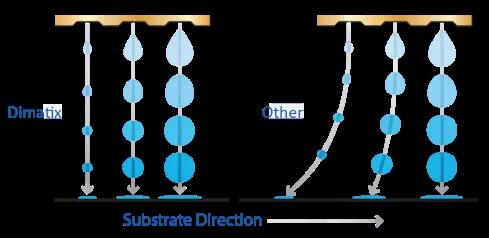
With VersaDrop, a fixed amount of fluid is injected to displace the ink droplets before separation from the nozzle. This feature is used to produce variable-sized ink drops. Coalescing the ink drops close to the nozzle will provide superior drop placement accuracy than coalescing the ink drops close to the print media.
The Fujifilm Dimatix SG1024 Starfire printhead supports one print mode (two-state, adjustable two-state, and grayscale). It is a 2 bpp printhead that supports up to 4 grayscale levels (0, 1, 2, or 3). The ink drops are produced by non-resonant excitation of the piezoelectric element with a precisely timed waveform with variable amplitude.
Two-state printing: The printhead requires a single, optimized trapezoidal pulse to generate the base drop size that matches the printhead design.
Adjustable two-state printing: The printhead uses incremental continuous trapezoidal pulses to generate droplets 1.5 to 3 times the base drop size. Each firing nozzle can only be turned on or off, in which case all pulses in the waveform will be used, so it is not possible to select the drop size based on different indication points within the same image. In this mode, a multi-pulse amplifier is required.
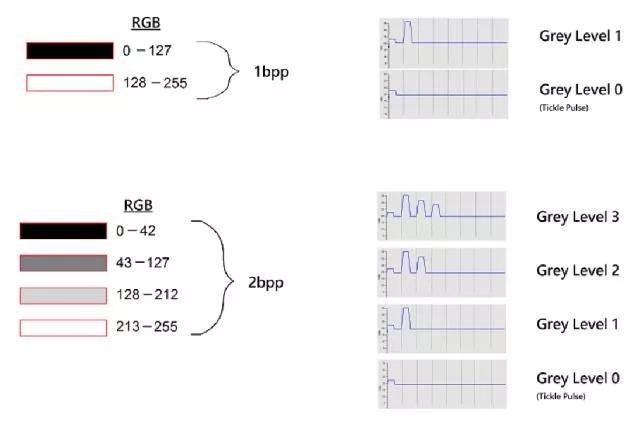
Grayscale printing: In any firing pulse cycle, the nozzle on the print head can be controlled to eject a small, medium, or large ink drop. Small, medium, and large ink dots are generated according to the needs of the image. In this mode, a multi-pulse amplifier and multi-bit data encoding and decoding functions are required.
Driver Board of StarFire® SG1024 Printhead
The design of the printhead driver board is a complex task that requires technology and experience. In order to realize the grayscale function of the StarFire® SG1024 printhead, Dimatix describes in detail the important functions required by the pulse generation circuit and the data path circuit. The drive system must be able to generate a suitable high-voltage waveform containing trapezoidal pulses over a certain range of jet loads. The drive system must support several trapezoidal pulses of different amplitudes within the waveform, and these waveforms must have maximum values so that the waveform structure can be optimized for different applications or inks. Finally, the data path circuit must update the switch state in the driver chip in a timely manner just before each pulse occurs within the waveform.
To ensure that all ink droplets are the correct size and ejection speed, very precise waveform shapes must be generated in the drive circuit. When generating these waveforms, several complex factors must be taken into account:
- If a pulse drives a droplet at the beginning of a waveform, then this droplet will also appear from the nozzle earlier
- Small ink droplets fly in the air longer than large ink droplets (and the print media is constantly moving)
- Due to different waveform pulse sizes, some ink droplets are faster than others
- Ink droplets may collide with and combine with other ink droplets during flight
- The distance between the nozzle surface on the printhead and the surface of the print media is variable
- Different types of ink require different waveforms
Ideally, the driver board would have a power amplifier for each nozzle row, allowing each row of nozzles to apply a different waveform to account for the differences between each nozzle row. Each waveform pulse that generates a sub-droplet should have a different pulse shape for the best results. For example, the first droplet ejected is more likely to be smaller than the second droplet ejected. This means that ideally, the hardware that generates the voltage waveform should be able to support analog pulses of different shapes. Unsophisticated driver boards try to skip these complex requirements and just generate waveform pulses by simply switching between two adjacent ones.
By independently timing each pulse and being able to match any pulse segment to a specific droplet-size waveform, more powerful control can be achieved on top of simple multi-pulse operations.
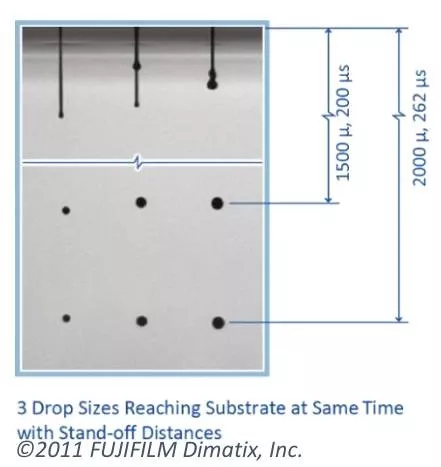
Application-specific tuning is essential for accurate drop placement and high-speed drop ejection.
Summary: SG1024 STARFIRE Grayscale Specifications
Obtaining grayscale capabilities for the SG1024 Starfire printhead requires the following additional items:
· Image file in tif format with a grayscale depth of 2 bits per digit (2bpp)
· Printhead driver board and software capable of processing 2bpp grayscale data input, converting the values, and sending multiple blocks of data to the printhead simultaneously
· Printhead driver board and software capable of generating digitally defined multi-pulse complex waveforms that are then used by the printhead to generate timed droplets of varying sizes that land at precise locations on the moving media.