In wide-format solvent and UV inkjet printing, printhead reliability is often the deciding factor between stable production and costly downtime.
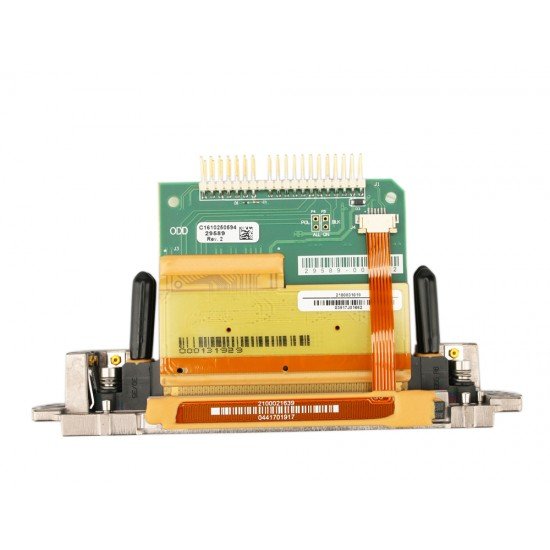
The Spectra Polaris printheads, originally developed by Spectra (USA) and later integrated into Fujifilm’s industrial inkjet portfolio, was designed specifically for demanding industrial environments where speed, durability, and ink compatibility matter.
Since its launch in 2009, Polaris has become a recognized solution for high-duty printing systems, positioned to compete directly with legacy industrial heads such as the Konica Minolta KM512 series.
From Office Printing to Industrial Inkjet
Spectra began as a manufacturer of thermal inkjet printheads for office and commercial applications. As industrial inkjet technologies evolved, the company shifted its focus to piezoelectric printheads, targeting wide-format and production-level printing systems.
The Spectra Polaris series marked this transition—combining industrial-grade materials, modular construction, and high-frequency firing capability to meet the requirements of solvent-based and UV curing inks.
Core Model Overview: Spectra Polaris PQ-512 Series
Among the Polaris lineup, the PQ-512 series remains the most widely adopted configuration.
Key Specifications (Spectra Polaris 512/15PL as reference)
Nozzle count: 512 individually controlled nozzles
Print width: 64.77 mm
Drop size:
- Native: 15 pl
- Variable (VersaDrop™): up to 30 pl
- Optional versions: 35 pl, 85 pl
Maximum resolution: up to 1000 DPI
Firing frequency: Up to 45 kHz (15 pl version)
Ink compatibility:
- UV-curable inks
- Solvent-based inks
Certification: CE compliant
The dual-row, dual-color architecture allows flexible single- or dual-color operation, balancing productivity and image quality in industrial workflows.
Modular Structure and Industrial Design
Dual-Module Architecture
The Spectra Polaris printhead is constructed from two identical modules, each featuring:
- Two ink inlets per module
- Two nozzle rows per module
In total, the printhead includes:
- 4 ink inlets
- 4 nozzle rows
- 128 nozzles per row
This configuration ensures stable ink distribution while supporting high-speed operation.
Materials Built for Harsh Environments
To withstand continuous industrial use, Spectra Polaris printheads incorporate:
- FR4 high-temperature PCB (rated up to 120 °C)
- Reinforced metal frame for mechanical stability
- Stainless-steel components compatible with aggressive ink chemistries
This structure significantly improves durability under thermal stress and long production cycles.
Thermal Control and Ink Management
Spectra Polaris printheads integrate advanced ink handling features:
1) Built-in heaters and temperature sensors
2) Ink temperature maintained below 60 °C
3) Dual-fluid interface design:
- Supports mono-color and dual-color configurations
- Automatic nozzle spacing adjustment
4) Dual ink ports simplify circulation and maintenance
An integrated mounting plate further reduces alignment time during installation and replacement.
Performance Advantages in Production Printing
Spectra Polaris printheads are designed for high-frequency continuous operation, making them well-suited for industrial printing lines.
Key benefits include:
- Stable high-speed jetting (up to ~8 m/s)
- Broad ink compatibility without mandatory ink supplier certification
- 256-channel modular replacement, reducing service costs
- Simplified calibration through integrated mechanical alignment features
These characteristics make Spectra Polaris a practical choice for manufacturers prioritizing uptime and flexibility.
Common Maintenance Considerations
Ink Starvation During High-Speed Printing
One of the most common field issues is intermittent ink dropout during fast or high-coverage printing.
Typical symptoms include:
- Test patterns appear normal, but image printing shows sudden dropouts
- Printing resumes temporarily after manual priming
- Air bubbles visible at the nozzle plate during priming
- Dark or high-density images show more severe banding
Root cause:
Contamination or blockage of the internal ink filter restricts ink flow, leading to insufficient supply during high-speed operation.
Recommended actions:
- Minor blockage: professional cleaning may restore performance
- Severe blockage: replacing the internal filter is the most effective solution
Nozzle Defects and Jetting Errors
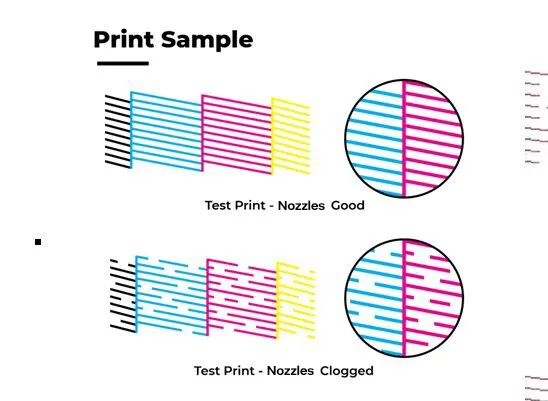
Issues such as nozzle clogging, misdirection, satellite droplets, or missing lines are typically linked to nozzle blockage.
- If flushing fluid does not flow smoothly → blockage is likely repairable
- If flushing is smooth but jetting remains unstable → piezo element aging may be the cause, and replacement is recommended
Compared to some earlier Spectra models, Spectra Polaris printheads may require more careful priming during initial ink filling.
Typical Applications
Spectra Polaris printheads are commonly used in:
- Solvent and UV wide-format printers
- Roll-to-roll and hybrid printing systems
- High-duty production environments requiring long continuous runs
With proper ink filtration, stable ink supply systems, and routine maintenance, the Spectra Polaris series continues to deliver reliable industrial-grade performance.