The growing industrial demand for high-efficiency, high-precision, and low-maintenance printing has led to the widespread adoption of single-pass printing in the industrial inkjet industry. This high-speed, continuous production model presents a key challenge: ensuring stable output of functional inks. This requires the printhead system to be both highly reliable and consistent while also being able to withstand challenging operating conditions such as air bubbles, sedimentation, and clogging.
To address these challenges, the recirculating printhead, with its structural advantages, has emerged as a mainstream solution for industrial inkjet systems. Today, it is not only the research and development focus of major printhead manufacturers, but they have also demonstrated the following key advantages in practice:
Key Advantages of Recirculating Printheads:
1. Prevents Ink Settling
Principle: Continuously circulates ink to prevent pigment or particles from settling in the nozzles.
Benefit: Significantly reduces the risk of clogging and extends printhead life. Ink flows through the circulation channel, eliminating sediment accumulation at the bottom of the nozzles.
2. Eliminates the Effect of Bubbles
Principle: The circulation system removes bubbles from the nozzle area and drains them through a filter or buffer.
Benefit: Avoids ink breakage and ink splashing caused by bubbles, improving printing stability. Bubbles are carried to the recovery channel by the circulating flow, preventing them from accumulating at the nozzles.
3. Maintaining Stable Ink Viscosity
Principle: The ink temperature is evenly distributed during circulation, reducing solvent evaporation.
Benefit: Ensures consistent droplet size and improves color accuracy (especially for solvent-based/UV inks). The circulation system is connected to a temperature control module, providing real-time ink viscosity monitoring data.
4. Nozzle Self-Cleaning Function
Principle: Negative pressure in the circulation creates reverse suction, automatically removing impurities from the nozzle.
Benefit: Reduces downtime for maintenance, making it suitable for 24-hour continuous production. Impurities in the circulation path are trapped by the filter, keeping the nozzle clean.
5. High-Speed Printing
Principle: Continuous ink supply supports high-frequency jetting (e.g., >50 kHz), meeting the demands of high-speed production lines.
Advantages: Improved production efficiency, suitable for high-volume applications such as packaging and labeling. The print head prints in real time on high-speed production lines without interruptions.
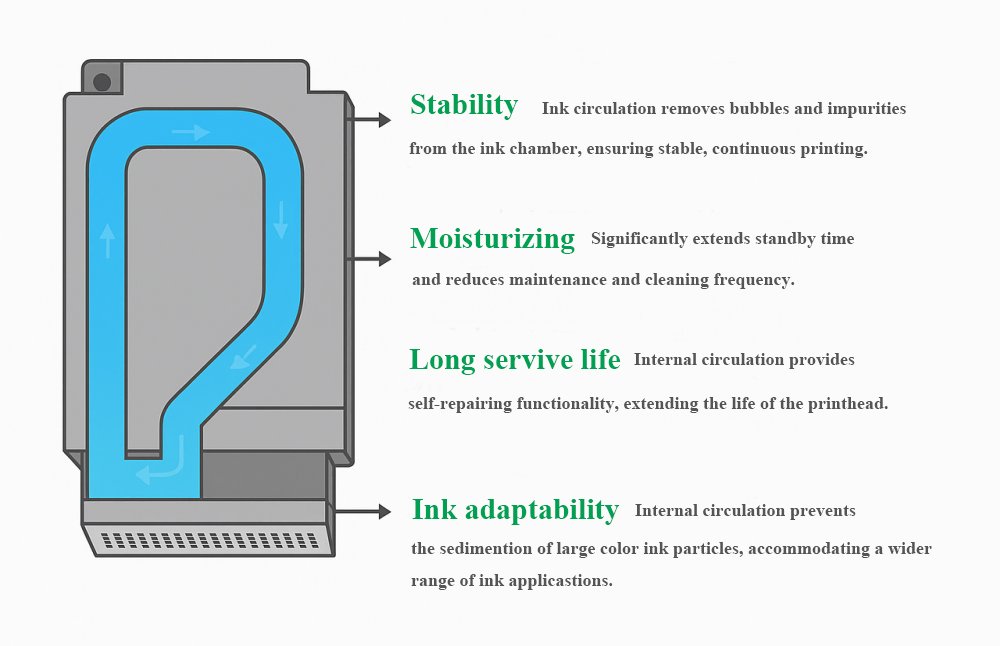
Recirculating printheads utilize a physical circulation mechanism to address the pain points of traditional printheads, such as sedimentation, bubbles, and viscosity fluctuations. They are particularly well-suited for high-load, high-precision industrial applications. Their core value lies in reducing overall costs (maintenance, consumables, and downtime) while improving production stability. They are a key technology for digital printing in the Industry 4.0 era.