Kyocera printheads are widely used in industrial digital printing, especially where high speed, long production runs and stable output are more important than low equipment cost.
Over the years, the Kyocera KJ4 platform has been used in:
- commercial and transaction printing,
- textile printing,
- ceramic decoration,
- labels and packaging,
- sign graphics,
- corrugated printing,
- and other industrial applications.
Today, newer models such as the KJ4B-EX600-RC, KJ4B-EX1200-RC, and KJ4A-EX1200-RC combine high production speeds with improved resolution and ink recirculation.
So, what are the main Kyocera printhead models? What industries use them? And is a Kyocera printhead better than an Epson printhead?
This guide explains the answers practically.
What Is a Kyocera Printhead Best Known For?
A Kyocera printhead is an industrial piezoelectric inkjet printhead designed for high-speed and continuous production.
Its main strengths are:
- wide effective print width,
- high jetting frequency,
- stable dot placement at high speed,
- strong industrial construction,
- and suitability for long production runs.
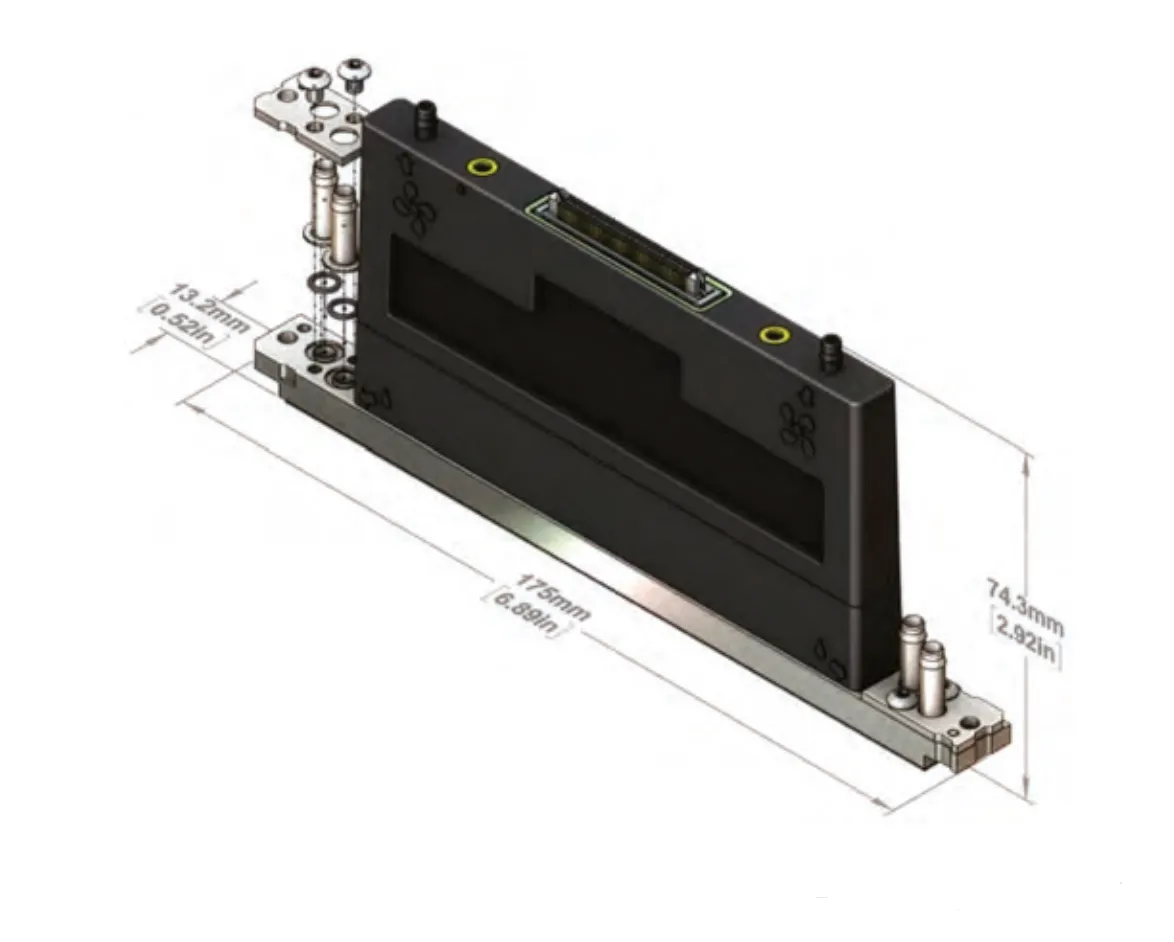
Many Kyocera KJ4 printheads have an effective print width of about 108 mm, making them especially suitable for industrial printers and single-pass systems.
In simple terms:
Epson is often chosen for flexible, high-detail multi-pass printing, while Kyocera is often chosen for industrial productivity and continuous high-speed production.
That is not an absolute rule, but it is a useful starting point.
How Kyocera Printheads Developed
Kyocera became a major name in industrial inkjet printing during the early 2010s, when the KJ4 series began entering large-scale commercial production.
At that time, most manufacturers were not looking only for higher resolution.
They also needed printheads that could:
- print for long hours,
- cover a wider area,
- work at higher speeds,
- and handle demanding industrial production environments.
This made Kyocera especially attractive in several industries.
Ceramic and Decorative Printing
Ceramic printing was one of the best-known early applications of Kyocera technology.
The KJ4C-0360 became associated with applications that required:
- larger ink drops,
- ink circulation,
- high ink deposition,
- and compatibility with demanding industrial fluids.
Typical uses included:
- ceramic tiles,
- carpets,
- decorative surfaces,
- and functional printing.
Why was this important?
Traditional ceramic decoration relied heavily on screens and analog processes. Digital inkjet printing allowed manufacturers to change designs faster and produce more design variations without changing physical printing plates.
For these applications, the smallest possible ink drop was not always the priority.
Stable jetting, large ink volume and reliable industrial operation were often more important.
Transaction and Variable Data Printing
Another important early market was high-speed document printing.
Kyocera KJ4 printheads were used for:
- bank statements,
- bills,
- direct mail,
- forms,
- security documents,
- and other variable-data jobs.
These applications require more than readable text.
A printhead must maintain stable output while the press runs continuously at high speed.
This is where Kyocera built much of its industrial reputation.
The goal was not simply to achieve the highest possible resolution on paper. The goal was to maintain clear text, barcodes and variable information during long production runs.
Digital Textile Printing
Textile printing also became an important market for the KJ4 platform.
Kyocera printheads attracted industrial textile manufacturers because of their:
- wide print width,
- high productivity,
- long-run stability,
- and suitability for large-volume production.
They have been used in applications such as:
- fashion fabrics,
- home textiles,
- direct-to-fabric printing,
- pigment printing,
- reactive printing,
- and other water-based textile systems.
For textile factories, daily output and machine uptime often matter more than achieving the smallest possible drop size.
That makes Kyocera a natural fit for high-volume textile production.
Packaging, Coding and Product Identification
Kyocera printheads also expanded into packaging and variable information printing.
Typical applications include:
- QR codes,
- barcodes,
- variable text,
- product identification,
- corrugated packaging,
- short-run packaging,
- and personalized packaging.
Models such as the KJ4B-0300 became popular where manufacturers needed wide print coverage and high productivity.
Newer EX-series printheads now bring higher resolution to these same industrial applications.
Understanding the Kyocera KJ4 Printhead Family
The easiest way to understand Kyocera printheads is to start with the series.
KJ4A Series: Mainly for UV Printing
The KJ4A series is mainly used with UV-curable and relatively high-viscosity inks.
Typical applications include:
- label printing,
- sign graphics,
- direct-to-material printing,
- offset overprinting,
- and industrial UV printing.
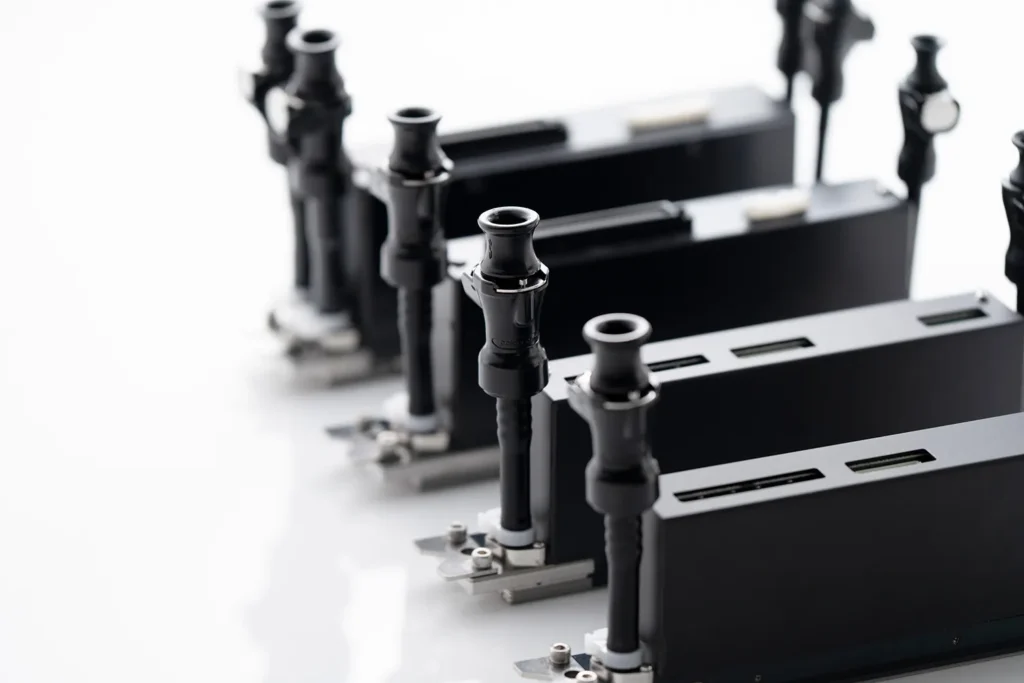
Common KJ4A models include:
- KJ4A-RH
- KJ4A-TA
- KJ4A-AA
- KJ4A-0300
- KJ4A-EX1200-RC
The newer KJ4A-EX1200-RC brings 1200 dpi resolution and nozzle-level ink recirculation to high-resolution UV printing.
KJ4B Series: Mainly for Water-Based Printing
The KJ4B series is mainly designed for high-speed aqueous printing.
Typical applications include:
- textile printing,
- commercial printing,
- transaction printing,
- document printing,
- packaging,
- security printing,
- and corrugated printing.
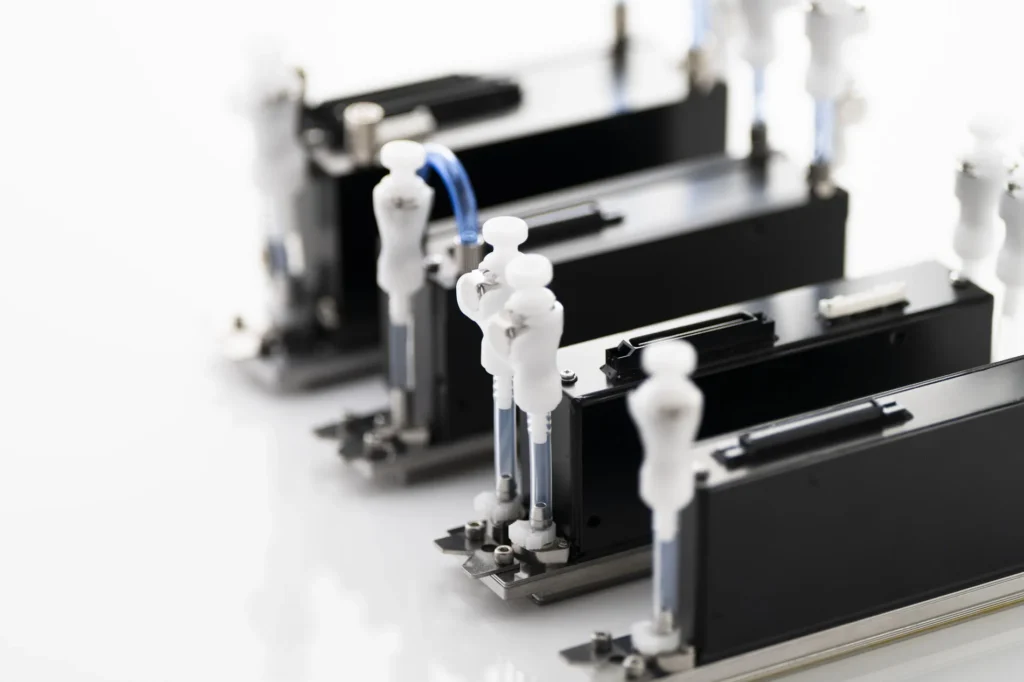
Common KJ4B models include:
- KJ4B-QA
- KJ4B-YH
- KJ4B-0300
- KJ4B-1200
- KJ4B-EX600-RC
- KJ4B-EX1200-RC
The KJ4B family is one of Kyocera's most important industrial inkjet platforms.
KJ4C Series: Large-Drop Specialist Printing
The KJ4C series, especially the historical KJ4C-0360, was developed for applications that needed larger drop volumes and specialist fluids.
Typical uses included:
- ceramic tile printing,
- decorative printing,
- carpets,
- and functional material deposition.
Today, Kyocera's current product development is more focused on the KJ4A and KJ4B families.
For this reason, the KJ4C-0360 is best understood as an important specialist and historical industrial platform.
Important Kyocera Printhead Models at a Glance
| Model | Resolution | Main Ink Type | Typical Applications |
|---|---|---|---|
| KJ4A-RH | 600 dpi | UV | Industrial UV printing |
| KJ4A-0300 | 300 dpi | UV | Sign graphics and multi-pass printing |
| KJ4A-EX1200-RC | 1200 dpi | UV | Labels and high-resolution packaging |
| KJ4B-QA | 600 dpi | Aqueous | Textile and document printing |
| KJ4B-YH | 600 dpi | Aqueous | High-speed document and transfer printing |
| KJ4B-0300 | 300 dpi | Aqueous | Textile and industrial printing |
| KJ4B-1200 | 1200 dpi | Aqueous | High-resolution commercial printing |
| KJ4B-EX600-RC | 600 dpi | Aqueous | Textile, corrugated and industrial printing |
| KJ4B-EX1200-RC | 1200 dpi | Aqueous | Commercial printing and packaging |
| KJ4C-0360 | 360 dpi | Specialist fluids | Ceramic and decorative printing |
The main point is simple:
There is no single “Kyocera printhead.” Different KJ4 models are designed for different inks, resolutions and applications.
A KJ4A UV printhead and a KJ4B aqueous printhead may belong to the same family of industrial technology, but they are not interchangeable.
Current and New-Generation Kyocera Printheads
The newest generation of Kyocera printheads focuses on three major improvements:
- higher resolution,
- better ink circulation,
- higher productivity.
The following models are especially important.
KJ4B-EX600-RC
Best for: High-Output Textile and Industrial Printing
The KJ4B-EX600-RC is a high-productivity 600 dpi printhead for aqueous inks.
Key specifications:
- 600 dpi resolution
- 108.3 mm effective print width
- up to 101.6 m/min print speed
- up to 40 kHz jetting frequency
- up to 14 pL drop volume
- nozzle-level ink recirculation
Typical applications include:
- textile printing,
- corrugated board,
- building materials,
- and other high-volume industrial printing.
Its biggest advantage is not ultra-small droplets.
It is the combination of speed, ink delivery and production stability.
The ink recirculation system helps reduce problems such as:
- nozzle drying,
- ink sedimentation,
- temperature variation,
- and unstable jetting.
Choose the KJ4B-EX600-RC when:
You need high output, strong ink coverage and stable industrial production.
KJ4B-EX1200-RC
Best for: High-Resolution Commercial and Packaging Printing
The KJ4B-EX1200-RC is designed for applications that require both fine detail and industrial speed.
Key specifications:
- 1200 dpi resolution
- 108.3 mm effective print width
- up to 101.6 m/min print speed
- up to 80 kHz jetting frequency
- 2–4 pL drop volume
- aqueous ink compatibility
- nozzle-level ink recirculation
Typical applications include:
- commercial printing,
- digital packaging,
- coated paper,
- films,
- fine text,
- and high-quality graphics.
This model is important because it challenges an old assumption:
Kyocera printheads are no longer only about large drops and high speed.
Modern Kyocera printheads can also achieve:
- small drops,
- fine text,
- 1200 dpi resolution,
- and high image quality.
Choose the KJ4B-EX1200-RC when:
You need high-resolution aqueous printing without giving up industrial productivity.
KJ4A-EX1200-RC
Best for: High-Resolution UV Labels and Packaging
The KJ4A-EX1200-RC is a 1200 dpi UV-compatible industrial printhead.
Key specifications:
- 1200 dpi resolution
- 108.27 mm effective print width
- up to 81.3 m/min print speed
- up to 64 kHz driving frequency
- 2–4 pL drop volume
- UV ink compatibility
- nozzle-level ink recirculation
Typical applications include:
- high-quality labels,
- variable-data labels,
- personalized packaging,
- and other high-resolution UV printing systems.
Choose the KJ4A-EX1200-RC when:
You need fine text, small barcodes and premium UV print quality at industrial production speeds.
Which Kyocera Printhead Is Best for Each Application?
High-Resolution Coding and Variable Data
For:
- QR codes,
- barcodes,
- small text,
- serial numbers,
- and personalized information,
the most suitable model depends on the required resolution.
Practical options:
KJ4B-0300
Suitable for high-productivity industrial printing where very high resolution is not the main priority.
KJ4B-EX600-RC
Better when stronger coverage and industrial output are required.
KJ4B-EX1200-RC
Better for small text, fine graphics and higher-resolution packaging.
KJ4A-EX1200-RC
Suitable for high-resolution UV label and packaging systems.
High-Speed Document and Commercial Printing
Typical applications include:
- books,
- bank statements,
- bills,
- direct mail,
- forms,
- and transaction documents.
Common Kyocera platforms include:
- KJ4B-QA,
- KJ4B-YH,
- KJ4B-1200,
- and newer EX1200 models.
The main requirement is stable print quality during long, continuous production.
For these applications, speed without consistency has little value.
Kyocera's strength is its ability to combine both.
High-Quality Label Printing
For modern label production, the KJ4A-EX1200-RC is one of the most relevant Kyocera models.
Modern labels increasingly require:
- short runs,
- variable information,
- personalization,
- fine text,
- small barcodes,
- and premium graphics.
The combination of 1200 dpi resolution, small droplets and UV compatibility makes this model well suited to high-end digital label systems.
Digital Textile Printing
For industrial textile printing, the KJ4B family is the main choice.
Suitable models may include:
- KJ4B-0300,
- KJ4B-EX600,
- KJ4B-EX600-RC,
- and other aqueous KJ4B configurations.
The newer EX600-RC is especially suitable for applications requiring:
- high daily output,
- continuous production,
- larger ink delivery,
- and improved ink circulation.
Typical textile applications include:
- fashion fabrics,
- home textiles,
- pigment printing,
- reactive printing,
- and direct-to-fabric production.
Ceramic and Decorative Printing
The historical KJ4C-0360 is one of the best-known Kyocera models for this field.
Its main strengths were:
- larger drop volumes,
- specialist fluid compatibility,
- ink circulation,
- and stable industrial deposition.
This made it suitable for:
- ceramic tiles,
- carpets,
- decorative surfaces,
- and functional printing.
Sign Graphics
For sign and graphics applications, the KJ4A family is more relevant because of its UV ink compatibility.
Common models include:
- KJ4A-0300,
- KJ4A-RN,
- and other KJ4A configurations.
These printheads can be used in industrial systems for:
- signs,
- graphics,
- direct-to-material printing,
- and other UV applications.
Where Is Kyocera Printhead Technology Going Next?
Kyocera is moving beyond traditional image printing.
Its latest development direction includes printheads for high-viscosity industrial materials.
Potential applications include:
- automotive coatings,
- industrial painting,
- 3D printing,
- molds,
- tooling,
- and functional material deposition.
This is an important change.
In the future, a Kyocera printhead may not only print images.
It may also precisely deposit:
- paint,
- coatings,
- functional fluids,
- and manufacturing materials.
This shows how industrial inkjet technology is becoming part of advanced manufacturing, not just the printing industry.
Kyocera Printhead vs Epson Printhead: Which Is Better?
There is no universal winner.
The better choice depends on:
- print quality requirements,
- production volume,
- machine architecture,
- ink type,
- and investment level.
A simple comparison is:
Choose Epson for flexible, detail-oriented production. Choose Kyocera for high-volume industrial production.
However, modern printhead technology is becoming more complex, so the full answer requires a closer look.
Which Is Better for High Resolution?
Epson: Strong in Fine Detail and Smooth Gradients
Epson is well known for:
- small droplet control,
- variable-sized droplets,
- smooth gradients,
- fine photographic detail,
- and flexible multi-pass printing.
This makes Epson a strong choice for:
- photo-quality graphics,
- fine-art reproduction,
- signage,
- DTF,
- UV printing,
- and color-sensitive applications.
Kyocera: Strong in High Quality at Industrial Speed
Kyocera focuses more on:
- wide print coverage,
- high-frequency jetting,
- accurate dot placement,
- and stable output at high production speeds.
Modern Kyocera models can also reach 1200 dpi and use droplets as small as approximately 2 pL.
Therefore, the old statement that:
“Epson is high resolution, while Kyocera is only high speed”
is no longer accurate.
The practical difference is:
Epson is often better for flexible multi-pass printing and fine tonal control.
Kyocera is often better when high image quality must be maintained at industrial production speed.
Which Printhead Lasts Longer?
This question is often oversimplified.
You may hear claims such as:
- “A Kyocera printhead lasts five years.”
- “An Epson printhead only lasts one year.”
These statements should not be treated as universal facts.
The actual life of a printhead depends on:
- ink chemistry,
- ink filtration,
- waveform settings,
- voltage,
- negative pressure,
- temperature,
- humidity,
- cleaning methods,
- maintenance quality,
- and daily operating hours.
Why does Kyocera have a reputation for long service life?
Because Kyocera printheads are designed for demanding industrial environments.
Their design emphasizes:
- industrial construction,
- chemical resistance,
- stable fluid channels,
- continuous operation,
- and high production loads.
This gives Kyocera a strong reputation in factories where machines run for long hours.
Does this mean Epson industrial printheads are not durable?
No.
Modern Epson industrial printheads, such as the S3200 series, are also designed for industrial production.
The better conclusion is:
Kyocera generally has a strong advantage in heavy-duty continuous production, but printhead life can never be judged by brand name alone.
Investment Cost: Kyocera or Epson?
The price of the printhead itself should not be your only consideration.
The real question is:
How much output and profit can the complete printing system generate?
Choose a Kyocera-Based Printer When:
You have:
- stable high-volume orders,
- long daily production hours,
- strict uptime requirements,
- single-pass production needs,
- industrial textile output,
- commercial print production,
- packaging production,
- or high-speed label applications.
The initial investment may be higher.
However, when production volume is large, higher productivity can reduce the cost per printed unit.
Choose an Epson-Based Printer When:
You need:
- a lower entry barrier,
- flexible production,
- frequent job changes,
- multi-pass printing,
- small-batch orders,
- detailed graphics,
- or a wider range of machine configurations.
For startups and businesses with fluctuating order volumes, Epson can often provide a more flexible investment path.
Kyocera vs Epson Printhead Comparison
| Factor | Kyocera Printhead | Epson Printhead |
| Main strength | Industrial speed and continuous production | Fine image control and flexibility |
| Typical system | High-output industrial and single-pass printers | Multi-pass and industrial printers |
| Print width | Many KJ4 models are about 108 mm | Depends on the printhead series |
| Small drop capability | Modern models down to about 2 pL | Some systems down to about 1.5 pL |
| Resolution | Up to 1200 dpi on current EX models | Strong high-resolution platforms |
| Typical industries | Commercial, textile, packaging, labels | DTF, UV, signage, textile, graphics |
| Entry cost | Often higher | Often lower |
| Best for | Stable high-volume production | Flexible and detailed production |
The two technologies now overlap more than before.
Kyocera is improving:
- small-droplet control,
- resolution,
- and high-quality graphics.
Epson is expanding:
- industrial printhead width,
- productivity,
- and high-volume applications.
This is why buyers should compare the complete printer, not only the printhead brand.
How to Choose the Right Kyocera Printhead
Before choosing a Kyocera printhead, answer four questions.
What Ink Are You Using?
This is the first question to answer.
General rule:
- UV ink → start with the KJ4A family
- water-based ink → start with the KJ4B family
- specialist large-drop materials → use an application-specific industrial model
Never assume that two printheads with similar resolution can use the same ink.
What Resolution Do You Need?
For:
- heavy ink coverage,
- industrial deposition,
- or very high output,
300–600 dpi may be enough.
For:
- fine text,
- premium labels,
- commercial graphics,
- and high-quality packaging,
1200 dpi may provide more value.
Higher resolution is not automatically better.
The correct resolution is the one your application actually needs.
How Much Do You Print Every Day?
A high-end industrial printhead only makes financial sense when your production volume supports the investment.
A lower-cost printer with high utilization can be more profitable than an expensive machine that sits idle.
However, once production volume becomes large enough, low speed and frequent downtime can cost more than the original machine price.
Is the Printer Single-Pass or Multi-Pass?
The printhead cannot be selected separately from the machine.
You must also consider:
- machine structure,
- carriage design,
- print width,
- ink delivery system,
- waveform control,
- drying or curing,
- RIP software,
- and target production speed.
The best printhead is always part of a complete printing system.
Final Conclusion
Kyocera printheads have evolved from early industrial KJ4 platforms into a much broader range of high-speed and high-resolution inkjet technologies.
Earlier models became well known in:
- ceramic decoration,
- commercial printing,
- transaction printing,
- textile printing,
- and industrial variable-data applications.
Today, models such as the:
- KJ4B-EX600-RC,
- KJ4B-EX1200-RC,
- and KJ4A-EX1200-RC
combine industrial productivity with better ink circulation, smaller droplets and higher resolution.
At the same time, Kyocera is moving beyond traditional printing into areas such as coatings, advanced manufacturing and material deposition.
So, is a Kyocera printhead better than an Epson printhead?
The answer depends on your business.
Choose Epson for flexible production, fine detail and a lower entry barrier.
Choose Kyocera for stable, high-volume industrial production where speed, uptime and long production runs directly affect profitability.
The best printhead is not the one with the highest specification.
It is the one that matches your:
- ink,
- application,
- daily output,
- budget,
- and complete printing system.