Because white ink contains a large amount of titanium dioxide (TiO₂) to achieve high hiding power, it is inherently more susceptible to sedimentation, impurities, and graininess than colored inks. When noticeable graininess appears in prints, the following two aspects can typically be used to troubleshoot and resolve the issue:
I. White UV Ink Quality Issues
1. Core Cause
Titanium Dioxide Characteristics: Titanium dioxide has a high specific gravity and is prone to sedimentation. Poor-quality inks exhibit poor dispersion, resulting in severe pigment particle agglomeration or sedimentation.
High Impurity Content: Low-quality inks may introduce more impurities or contain insufficiently ground, large particles during production.
Poor Stability: Poor ink formulations can easily lead to stratification, agglomeration, or chemical reactions that produce sedimentation.
2. Consequences
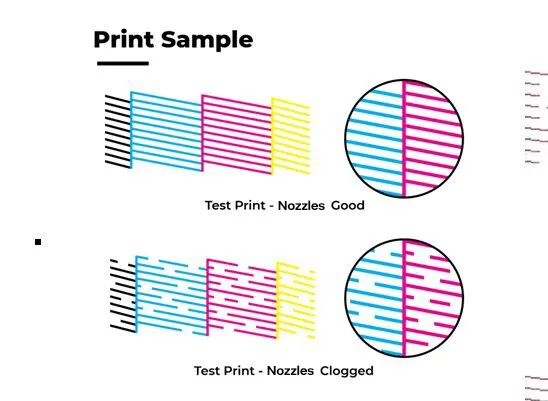
High Risk of Printhead Clogging: Large particles and sediment can easily clog the nozzles, accelerating printhead wear and significantly shortening printhead life.
Poor Printing Quality: Uneven ink droplets can result in noticeable graininess, roughness, uneven color, and even ink breakage and stringing on the printed surface.
Increased Maintenance Costs: Frequent printhead cleaning and filter replacement are required, increasing downtime.
3. Long-term Solution
Upgrading ink quality: This is the most fundamental solution. Choose reputable, market-proven white ink from a well-known brand.
High-quality white ink features:
- Improved dispersion stability (reduced sedimentation).
- Finer pigment grind (smaller particles).
- Tighter impurity control.
- Compatible with your printer model and printhead.
4. Temporary Preventive Measures
(1) Use high-quality ink filters (typically 5-10 micron grade).
(2) Reduce replacement intervals: Low-quality ink clogs filters more quickly. Replace the primary and secondary ink tanks, as well as the filters in front of the printheads, more frequently than when using high-quality or color inks. Follow the ink manufacturer's recommendations and adjust them based on actual usage (e.g., print volume and downtime).
(3) Enhance routine maintenance:
Perform printhead cleaning and moisturizing procedures regularly.
Be sure to thoroughly clean the white ink circulation system and moisturize the printheads before any extended downtime.
II. Printing Curve (Waveform/Dot Setting) Mismatch
1. Core Cause
Ink droplets are too large: Using a "large dot" or "coarse dot" printing curve designed for high coverage or high speed. This curve produces larger ink drops. While this provides greater coverage and faster speed, the dots formed by individual droplets landing on the media are also larger, resulting in a more noticeable graininess.
The curve is mismatched with the ink/media: The curve is not optimized for the specific white ink brand and batch characteristics, as well as the media type being printed.
2. Solution
(1) Switch to a finer print profile: Prefer "Small Dot" or "Medium Dot" profiles. These profiles control the printhead to eject smaller ink droplets. Small droplets create finer dots on the media, significantly reducing graininess and improving image smoothness.
(2) Sacrifice speed for quality: Using a small dot profile typically reduces print speed, but this is a necessary trade-off for achieving a fine, smooth white ink layer.
(3) Test and optimize the profile: Before printing, print test strips on the target media using different "Small Dot" and "Medium Dot" profiles. Observe the hiding power, surface smoothness (graininess), adhesion, and curing, and select the profile that provides the best overall results. If the printer manufacturer or ink supplier provides white ink profiles optimized for specific media, try these first.
(4) Consider the number of passes: While maintaining hiding power, increasing the number of print passes (the number of print head passes) can sometimes help disperse the ink dots and achieve a more uniform surface (but this requires a trade-off in speed).
III. Ink Cartridge Agitation
Criticality: Agitation is essential for white ink and effectively mitigates sedimentation.
Operation: With Automatic Agitation: Before each print (especially after extended downtime), ensure the automatic agitation function of the white ink circulation system is enabled and runs for 5-15 minutes (refer to the ink and device manuals for specific times). This ensures that any settled titanium dioxide is thoroughly agitated.
Without Automatic Agitation: Manual Agitation: Before refilling or after extended downtime, manually shake the ink bottle (or bag) for at least 2-3 minutes to ensure there is no sediment at the bottom. Manual agitation should also be attempted for white ink within the machine, if the structure allows and is safe (with extreme caution).
Adding an Agitator: It is strongly recommended to subsequently install an automatic agitation device (circulation pump or internal agitator) in the white ink system. This is a long-term solution to address white ink sedimentation, ensuring stable printing and printhead life. Constant, gentle agitation maintains ink uniformity.