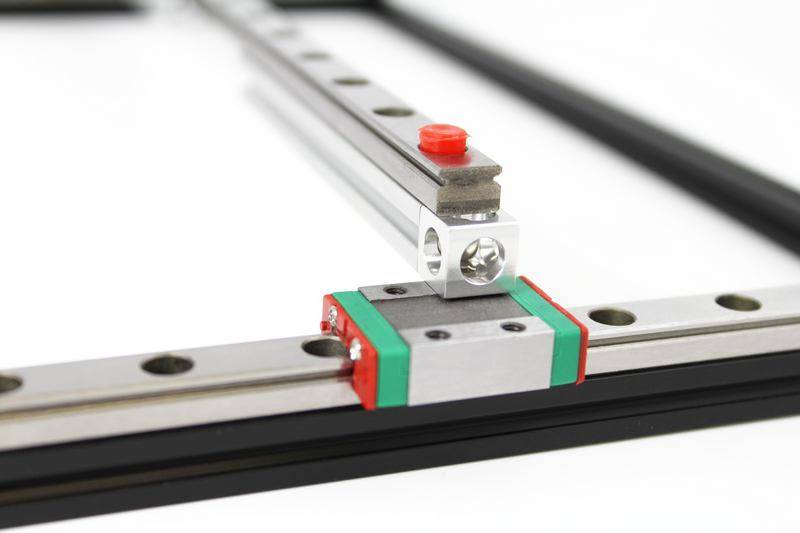
In digital inkjet printing equipment, the printer slider (linear guide block)—also known as a carriage slider or sliding module—is a critical mechanical component responsible for guiding the printhead smoothly along the X-axis or Y-axis. Working together with linear guide rails, motors, belts, or lead screws, the slider ensures precise positioning, stable motion, and consistent high-speed printing performance.
A high-quality printer slider features high rigidity, low friction, long service life, and excellent stability, playing a vital role in improving print accuracy, extending machine lifespan, and reducing long-term maintenance costs.
Role and Importance of Printer Sliders
During printing, the printhead carriage moves back and forth at high speed, placing extremely high demands on motion accuracy and stability. The printer slider acts as the mechanical bridge between the printhead carriage and the linear guide rail, delivering:
- Accurate printhead positioning and repeatability
- Smooth and stable linear motion
- Reliable support for the printhead, ink system, and cable assemblies
- Reduced vibration during high-speed operation
The performance of the slider directly affects print quality, production speed, and overall machine reliability.
Structure of a Printer Slider
A standard printer slider consists of several core components:
1. Slider Body
Manufactured from high-strength alloy steel or stainless steel, the slider body provides excellent rigidity and load-bearing capacity to support the printhead carriage and associated components.
2. Rolling Elements (Balls or Rollers)
High-precision steel balls or rollers are embedded inside the slider, forming a rolling contact with the guide rail. This design converts sliding friction into rolling friction, significantly reducing resistance and improving motion smoothness.
3. Recirculating Track System
An internal circulation channel allows the rolling elements to move continuously within the slider, ensuring stable performance even during high-speed and long-stroke operation.
4. Dust Protection and Sealing
End caps are equipped with seals or wipers to prevent dust, ink mist, and fibers from entering the rolling system, ensuring long-term reliability and consistent motion accuracy.
5. Lubrication System
Some sliders include internal lubrication grooves or pre-filled grease, helping to minimize wear, reduce maintenance frequency, and extend service life.
6. Mounting and Positioning Holes
Standardized mounting and positioning holes allow precise installation and easy integration with the printhead carriage and motion system.
Working Principle
The operating principle of a printer slider is based on rolling motion instead of sliding motion:
- The linear guide rail is fixed to the printer frame
- The slider is mounted to the printhead carriage
- A motor-driven system moves the slider along the guide rail in a linear, reciprocating motion
The rolling elements inside the slider continuously circulate along the rail grooves, minimizing friction and energy loss. This allows the printhead to maintain accurate positioning, smooth travel, and stable dot placement, even at high speeds.
Core Functions of Printer Sliders
1. Smooth and Accurate Printhead Movement
The slider guides the printhead carriage precisely along the printing area, ensuring accurate alignment and consistent image quality.
2. Structural Support for the Printhead System
It provides stable mechanical support for the printhead, carriage board, ink tubes, and signal cables, forming the physical foundation of the printhead assembly.
3. Vibration Reduction and Wear Resistance
By distributing dynamic loads through rolling elements, the slider reduces vibration and mechanical stress, extending the service life of both the motion system and the printer as a whole.
Typical Applications
Thanks to their precision and durability, printer sliders are widely used in various digital and industrial printing systems, including:
- UV Flatbed Printers – Supporting heavy printheads and UV curing lamps
- DTF / DTG Printers – High-speed reciprocating motion for sharp image output
- Wide-Format Inkjet and Solvent Printers – Large printing widths with strict accuracy requirements
- Industrial Textile Printing Machines – Long-duration, continuous production environments
- Laser Engraving and Cutting Systems – High repeatability and positioning accuracy
Conclusion
The printer slider is the core precision component of the printer motion system. Its structural design, material quality, and manufacturing accuracy directly influence print quality, production efficiency, and long-term machine stability. Selecting a high-quality, well-matched slider is essential for achieving reliable, high-performance printing and reducing total operating costs.