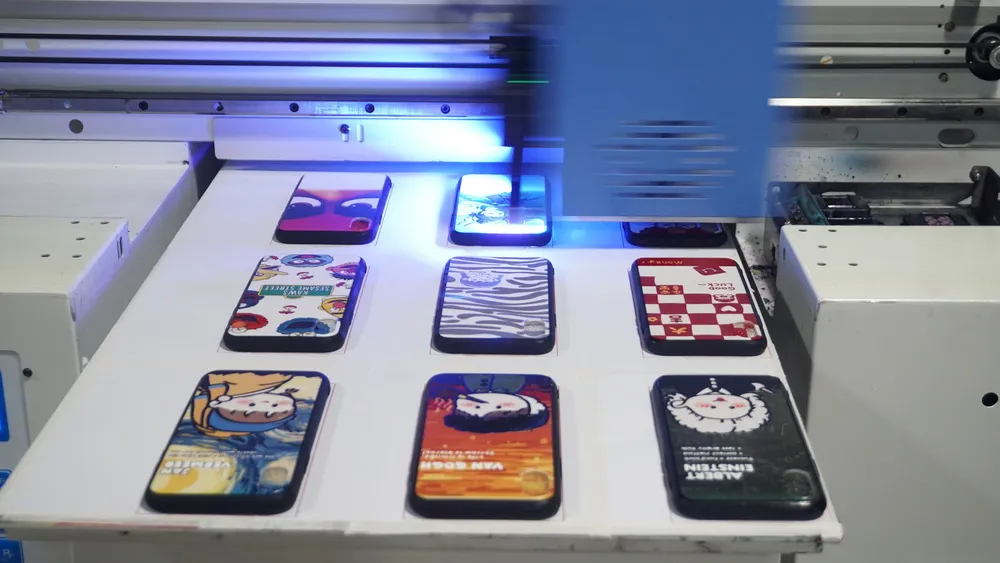
In conventional UV inkjet printing, the printhead normally maintains a relatively stable and short distance from the substrate. However, when printing on screws, embossed surfaces, irregular boards, three-dimensional decorative parts, and other uneven workpieces, the printhead cannot always remain close to the material surface.
This is where a more demanding industrial inkjet process comes into play—high-gap printing.
High-gap printing refers to maintaining a relatively large distance between the printhead and the substrate while still allowing ink droplets to fly stably and land accurately at the target position, producing clear and uniform print results.
Compared with conventional flat-surface printing, high-gap printing has to address several additional challenges:
- Ink droplets are more likely to deviate as the flight distance increases.
- Satellite droplets and overspray can become more noticeable.
- Longer ink filaments can cause stringing and trailing.
- Changes in printhead-to-substrate distance can affect image accuracy.
- Negative-pressure fluctuations can lead to ink starvation or dripping.
- Differences in workpiece height can further amplify printing errors.
Therefore, high-gap printing is not simply a matter of raising the printhead. It is a system-level process involving the printhead, waveform, ink supply, mechanical motion, and ink.
This article examines the five core technical requirements for high-gap printing and explains why the process is challenging and what is needed for stable production.
1. Industrial Printheads: The Hardware Foundation for High-Gap Printing
High-gap printing first places demanding requirements on the jetting performance of the printhead.
When the printhead is positioned farther from the material surface, ink droplets must travel through the air over a longer distance. During this flight, droplets can be affected by air resistance, gravity, and surrounding airflow. If the initial droplet velocity is insufficient or jetting is unstable, the droplets can deviate from their intended landing positions.
For this reason, high-gap printing generally requires industrial piezoelectric printheads with stable jetting performance and sufficient droplet control.
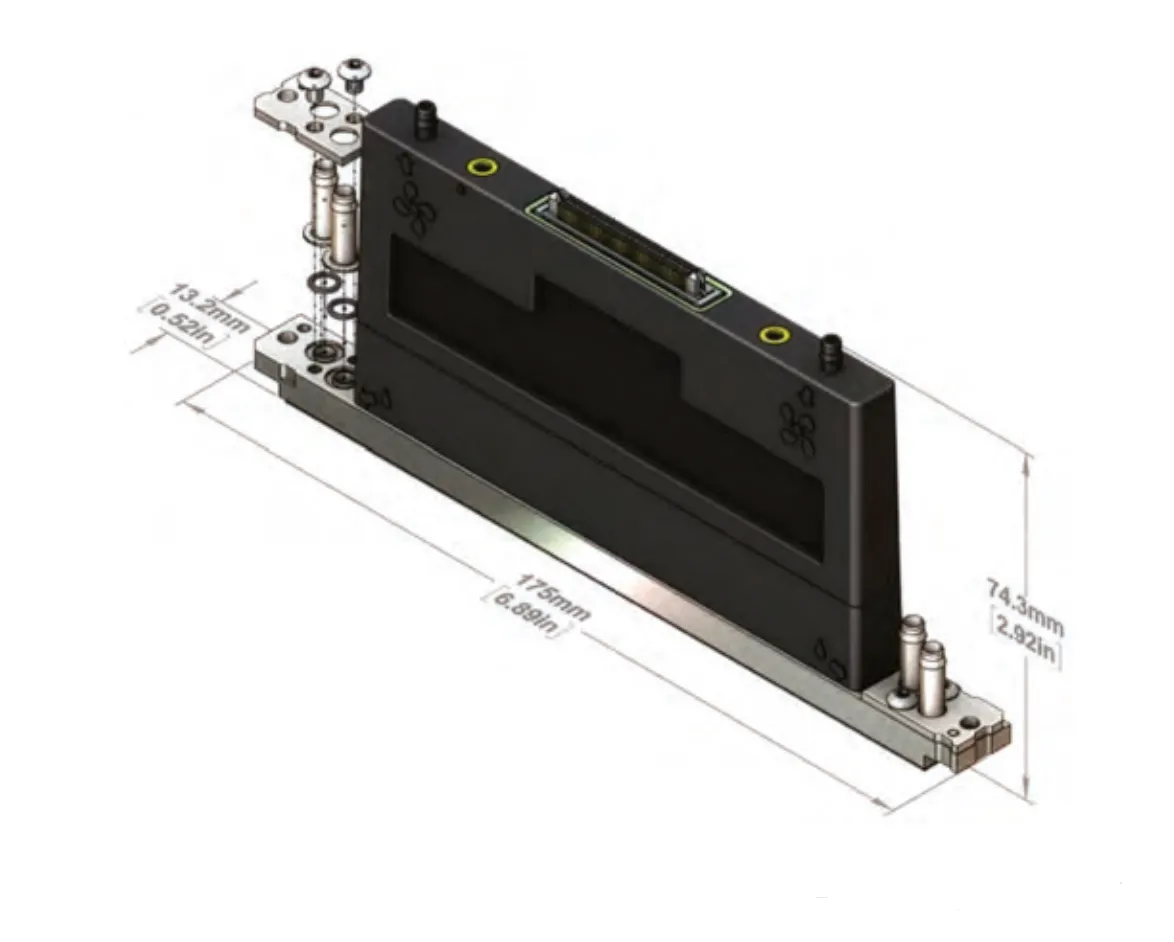
Industrial UV printing systems commonly use printheads such as Ricoh G5, G6, and GH2220 in applications where stable jetting and continuous operation are important.
Why Does Printhead Performance Matter in High-Gap Printing?
The printhead needs to address three key factors:
First: Initial droplet velocity. The droplet needs sufficient initial velocity to maintain a relatively stable trajectory over a longer flight distance.
Second: Droplet consistency. If droplet size and velocity vary during continuous firing, the resulting error can become more noticeable over a longer flight path, appearing as blurred edges, increased graininess, or local dot deviation.
Third: Nozzle consistency. The more consistent the jetting behavior between nozzles, the more stable the overall droplet array and image formation will be under high-gap conditions.
Therefore, printhead selection for high-gap applications should not be based only on resolution or maximum firing frequency. Jetting velocity, droplet control, nozzle consistency, and long-term stability should also be considered.
2. Jetting Waveform: Controlling How the Droplet Flies
If the industrial printhead is the hardware foundation, the jetting waveform is one of the core parameters controlling droplet behavior.
A piezoelectric printhead does not simply operate through a basic ‘power on—ink out’ process. The drive voltage acts on the piezoelectric actuator and creates pressure changes inside the ink chamber, which push the droplet out of the nozzle.
For a deeper understanding of the challenges involved, read our guide to High-Gap UV Printing: Printhead Life, Ink Mist, and Stringing, which explores printhead performance, ink mist, stringing, and system-level optimization.
Different drive waveforms directly affect:
- Droplet velocity
- Droplet volume
- Droplet formation
- Ink filament length
- Number of satellite droplets
- Jetting stability
- Firing frequency
Why Is Waveform Tuning More Important in High-Gap Printing?
As the distance between the printhead and substrate increases, problems occurring during droplet flight can become more pronounced.
- Insufficient jetting velocity → longer flight time → greater landing-position deviation
- Excessively long ink filament → breakup during flight → greater risk of satellite droplets
- Unstable droplet volume → less uniform landing and coverage over a longer flight distance
Therefore, the waveform should be matched and optimized according to the printhead, ink, printing distance, and printing speed.
During actual tuning, simply increasing the drive voltage is not necessarily the solution. Excessive drive conditions can also cause satellite droplets, unstable nozzle behavior, and unnecessary stress on the printhead.
A more appropriate approach is to find a balance between droplet velocity, droplet volume, firing frequency, and jetting stability while maintaining stable droplet formation.
3. Stable Negative-Pressure Ink Supply: Maintaining Continuous Jetting
High-gap printing does not only test whether the droplets can travel farther. It also tests whether the printhead can continue receiving ink consistently.
During printing, ink continuously moves from the ink chamber toward the nozzles. As printing speed and firing frequency increase, the ink supply system must continuously replenish the ink consumed by the printhead.
If negative pressure in the ink path is unstable, the system may experience:
- Nozzle dripping
- Ink starvation
- Insufficient ink supply
- Uneven color density
- Fluctuating nozzle performance
High-gap industrial printing equipment therefore requires a more stable negative-pressure ink supply system.
Why Is Negative Pressure So Important?
The printhead needs to operate within an appropriate pressure range.
Excessive negative pressure: Ink may not reach the nozzles properly, resulting in insufficient ink supply or ink starvation.
Insufficient negative pressure: Ink may flow out of the nozzles unintentionally, causing dripping and nozzle contamination.
In high-gap printing, the operating relationship between the printhead and the ink path becomes even more sensitive. The ink supply system therefore needs to maintain stable operating conditions as much as possible.
A complete industrial ink supply system typically includes:
- Ink pumps
- Ink tanks or sub-tanks
- Filters
- Valves
- Ink tubes
- Negative-pressure control
- Liquid-level detection components
The stability of ink pumps, filters, valves, and other ink-path components can directly affect the reliability of the complete jetting system.
For industrial printing equipment, stable ink delivery is not the result of a single component. It is the result of the entire ink-path system working together.
4. High-Precision Mechanical System: Controlling the Distance Between Printhead and Workpiece
Another easily overlooked issue in high-gap printing is the actual printhead-to-substrate distance.
A greater printhead distance is not always better, and maintaining a fixed distance does not necessarily produce the best result.
For flat materials, the printhead can maintain a relatively stable printing height. However, with embossed, curved, uneven, or three-dimensional workpieces, the surface height may change continuously.
If a local area becomes too far from the printhead, the result may include:
- Droplet deviation
- Blurred image edges
- Reduced image sharpness
- Increased overspray
- Uneven pattern quality
Therefore, high-gap printing equipment requires not only a high-performance printhead but also a mechanically stable and accurate platform.
Key Mechanical Requirements Include:
High-precision motion platform: The X/Y motion system needs to remain stable and minimize noticeable vibration during high-speed movement.
Stable guides and frame: Insufficient frame rigidity or unstable guide movement can introduce small printhead vibrations that affect droplet landing.
Accurate printhead height control: The distance between the printhead and workpiece needs to be adjusted accurately according to the application.
Height detection and compensation: For complex three-dimensional workpieces, measurement, scanning, or height-compensation technologies can identify surface variations and adjust the printing height.
A mature high-gap printing system is therefore essentially a combination of a jetting system + motion system + height-control system.
5. Ink Compatibility: The Final Variable That Cannot Be Ignored
Even if the printhead, waveform, and mechanical system are properly configured, high-gap printing can still become unstable if the ink itself is not well matched.
Ink viscosity, surface tension, volatility, and curing characteristics can all influence droplet formation and flight behavior.
Viscosity that is too high: May affect droplet formation and jetting speed.
Viscosity that is too low: May increase the risk of satellite droplets, overspray, or excessive spreading.
Unsuitable surface tension: May affect droplet detachment from the nozzle and spreading after landing on the substrate.
Unsuitable curing behavior: May affect image edges, adhesion, and the final surface finish.
Therefore, high-gap printing should not be discussed only in terms of printhead parameters. The printhead + waveform + ink should be treated as an integrated jetting system.
6. Common High-Gap Printing Problems
| Printing Problem | Possible Causes |
|---|---|
| Soft or blurred image edges | Printing distance is too large; droplet trajectory deviation |
| Visible overspray | Waveform mismatch, droplet breakup, or insufficient ink compatibility |
| Satellite droplets | Unsuitable drive parameters or unstable droplet formation |
| Stringing or trailing | Waveform parameters, ink characteristics, or abnormal jetting |
| Local ink starvation | Negative-pressure abnormality, insufficient ink supply, or filter blockage |
| Local dripping | Negative pressure is too low or nozzle condition is abnormal |
| Uneven sharpness on uneven areas | Workpiece height changes or insufficient printhead height compensation |
| Image instability at high speed | Mechanical vibration, ink-supply fluctuation, or excessive firing frequency |
It is important to note that the same printing symptom may have more than one cause.
For example, when ink starvation occurs, it should not automatically be assumed that the printhead has failed. A clogged filter, insufficient pump supply, abnormal negative pressure, changes in ink viscosity, or the condition of the printhead itself may produce similar symptoms.
Industrial equipment troubleshooting should therefore examine the complete ink path and jetting system rather than focusing on a single component.
7. How to Build a Stable High-Gap Printing System
A stable high-gap printing system can be understood as the coordination of five levels:
- Printhead Level: Select an industrial printhead with stable jetting performance to provide the foundation for long-distance droplet flight.
- Parameter Level: Optimize the drive waveform according to the printhead, ink, and printing distance so that droplets form consistently and fly stably.
- Ink Supply Level: Use stable ink pumps, filters, valves, ink tubes, and negative-pressure control to provide continuous, clean, and stable ink delivery.
- Mechanical Level: Use high-precision motion mechanisms, height detection, and height compensation to control the actual distance between the printhead and workpiece.
- Ink Level: Select UV ink compatible with the printhead and waveform so that droplet formation, flight, landing, and curing work together as a complete process.
Only when these five areas are properly matched can the stability of high-gap printing be significantly improved.
8. JOHOPE: Stable Ink-Path Support for High-Gap Printing
For industrial inkjet equipment, the printhead is only one part of the complete printing system.
Even when a high-performance industrial printhead is used, unstable pumps, filters, valves, ink bags, dampers, or other ink-path components can still affect final printing performance.
As a manufacturer and supplier of inkjet printer parts, JOHOPE focuses on industrial inkjet ink-path components and related parts for UV, solvent, water-based, and other wide-format printing equipment.
JOHOPE supplies product categories including:
- Ink Pumps
- Ink Filters
- Dampers
- Ink Cappings
- Ink Tanks
- Solenoid Valves
- Ink Tubes
- Maintenance Components
These components support the complete ink path from ink storage and transportation to filtration and printhead supply.
For high-gap printing and other applications that require stable ink delivery, reliable ink-path components can help maintain consistent ink supply and reduce printing problems caused by ink-delivery instability.
If you are developing or maintaining high-gap UV printing equipment, or need reliable industrial inkjet ink-path components, contact JOHOPE for product information and sourcing support.
Conclusion: High-Gap Printing Is Ultimately a System-Level Process
The real difficulty of high-gap printing is not simply making the printhead ‘print farther.’
The real challenge is to make droplets eject consistently, fly stably, land accurately, and maintain stable ink delivery and mechanical movement throughout the printing process.
A mature high-gap printing system therefore needs to address five key areas:
Industrial Printhead → Jetting Waveform → Stable Ink Supply → Precision Mechanics → Ink Compatibility
Any significant mismatch in one of these areas can be amplified under high-gap conditions.
This is why high-gap printing is better understood as a system-level industrial inkjet technology, rather than simply a printhead parameter adjustment.
For printing equipment manufacturers, industrial printer users, and inkjet printer-parts suppliers, optimizing the complete jetting and ink-delivery system is essential for moving high-gap printing from being merely possible to becoming stable and repeatable in production.