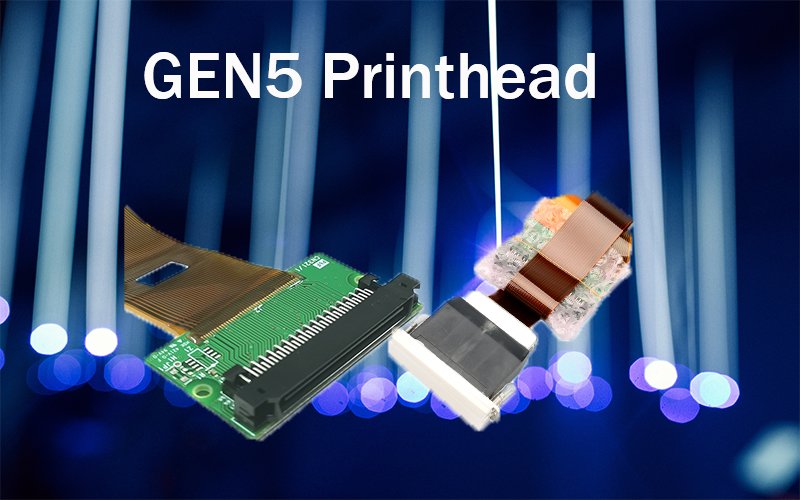
The Ricoh gen5 print head is a printhead specially designed for industrial printing applications. It has been on the market for a long time and is currently the most widely accepted by customers.
The printhead is not only a core component of the entire printing equipment but also a consumable item. The quality of the printhead and the printing effect determine whether the production company can successfully receive orders and deliver them on time. The price of the printhead also accounts for a very large proportion of the price of the printer. Improper daily use and maintenance will also directly affect its service life, increasing production costs. Therefore, it is crucial to choose a good and durable printhead.
Ricoh Gen5 Print Head Characteristics
1. Grayscale Piezoelectric Printhead
The Ricoh G5 is a grayscale piezoelectric printhead with 1280 nozzles and can produce variable ink droplets, with a minimum ink droplet of 7 pl and a maximum of 35 pl. The physical resolution of the nozzle is 600 dpi, which is suitable for high-precision printing. The maximum ignition frequency of the G5 is 30 kHz. Even the ignition frequency of multi-point printing can be maintained above 20 kHz, unlike some printheads, which will drop by more than 50%. In addition, the trolley uses a fixed linear grating to ensure high-precision printing. The lightweight platform makes plate transfer easier, positioning more precise, and repeated printing without deviation possible.
2. All Steel Material
The Ricoh Gen5 printhead is highly durable and resistant to corrosion and clogging. It features a piston-based automatic cleaning system that effectively maintains the nozzles without causing damage. The printhead and data cable are integrated, ensuring stable connectivity and eliminating the risk of loose connections.
It supports both single-row and double-row inkjet configurations, offering excellent ink control. The printhead can also switch between single and double-row variable modes, allowing for both high-speed and high-precision printing as needed.
3. Save ink up to 30%~50%
Since grayscale printheads use variable dot technology, the four-color printing effect can match that of six-color printing even without light inks. In non-grayscale printing, dark areas are printed using CMYK, while lighter tones are achieved using light colors such as Lc and Lm. However, the droplet size remains constant regardless of color depth.
In contrast, Ricoh grayscale printheads adjust droplet size dynamically: around 21 pl for dark areas, 14 pl for mid-tones, and 7 pl for very light areas. In other words, grayscale technology adapts to image color depth by varying ink droplet size, achieving smoother gradation and reducing ink consumption. Traditional printheads rely on adding light-colored inks to create lighter tones, which results in higher overall ink usage.
4. Jump White Printing in X and Y Directions
Ricoh Gen5 printheads can automatically identify blank areas and quickly skip them. It supports multiple copy printing and area printing, which is convenient for batch printing of small pictures and sampling printing of large pictures. It supports recovery printing, mirror printing, the dual zero positioning function (double starting point printing), reverse printing, and alternating forward and reverse printing, which further improves production efficiency and does not waste any useful materials.
5. Humanized Design
The printer features automatic media thickness detection and an auto height control system, which automatically adjusts to different media thicknesses and prevents damage caused by human error. Its automatic white-out printing function greatly enhances production efficiency by intelligently identifying and skipping blank areas during printing.
The system allows independent adjustment of UV lamp power and automatically rotates the lamps during bidirectional printing to reduce banding and uneven darkness. With a powerful nozzle compensation feature, faulty nozzles can be replaced by functioning ones to ensure consistent ink coverage without white lines or channel gaps.
Optional software template printing technology ensures splicing errors remain under 0.5 mm, while the assembly line printing mode supports seamless integration into industrial production workflows. In addition, the anti-collision device on the carriage automatically stops movement upon detecting obstacles, effectively protecting both the printhead and the carriage.
6. Wide Range of Applications
Because the Ricoh G5 printhead can print directly on various materials, it can partially replace the application of traditional silk screen printing and achieve richer colors and higher efficiency. It is widely used in large-format UV flatbed and roll-to-roll printers, and can print on ceramic tiles, wood boards, glass, acrylic, metal plates, PVC boards, corrugated boards, and plastics. Therefore, it breaks through traditional processes and enables rapid development in the field of personalized product processing.
Contact us today for pricing and detailed specifications.
| Size | 89(W)*25(D)*69(H) mm (excluding cables & connectors) |
| Head materials | SST, Nickel alloy & Epoxy adhesive (Direct contact with ink) |
| Compatible jetting fluids | Nozzle spacing A: Within a single row B: Within a color C: Single pass D: Row-to-row distance E: Color to color |
| Nozzle plate surface | Coated SST |
| Number of nozzles | 4*320 channels |
| Nozzle spacing
A: Within a single row B: Within a color C: Single pass D: Row to row distance E: Color to color | 0.1693 mm (1/150'')
0.0847 mm (1/300'') 0.0423 mm (1/600'') 0.55 mm 11.811 mm |
| ink inlet port | 2*dual ports |
| Piezo type | D33 stacked PZT |
| Drop ejection mode | Piston pusher with metallic diaphragm plate |
| Integrated electronics | Low-voltage serial to high-voltage parallel converter;
3-bit shift resistors; transmission gate outputs |
| Temperature control | Integrated heater and thermistor |
| Viscosity | 11 cP (at operating temp.) |
| Surface tension | 32 dynes/cm |
| Native drop volume | 7 pico-liter |
| Drop volume range/variation | 7-35 picoliters with gray scale/±10% |
| Drop velocity normal/variation | 7 m/sec/±15% |
| Crosstalk | 10% or less with all channels firing |
| Jet straightness 1 sigma | <3.5 milli-radian from nozzle centerline |
| Native drop operating frequency | 60 kHz (Higher burst possible under idea condition) |
| Life | 100 billion actuation's per nozzle |
How to Identify the Specific Models of the Ricoh Gen5 Printhead?
In daily work, we often encounter a common issue: many users who purchase printheads are unsure which specific Ricoh G5 model is used in their equipment. To help you avoid making the wrong purchase, let’s take a closer look at how to identify the specifications and models of the Ricoh Gen5 printhead.
The Ricoh G5, manufactured by RICOH Company (Japan), is an industrial-grade inkjet printhead designed for high-precision printing. It features a printing width of 54.1 mm (2.1 inches) and includes 1,280 nozzles (4 × 320 channels) with a nozzle pitch of 0.55 mm. The ink drop size is adjustable from 7 to 35 picoliters, and it is compatible with UV, solvent, and water-based inks.
Renowned for its stability, reliability, and cost-effectiveness, the Ricoh G5 supports high-duty printing applications. Because of its excellent performance, many printer manufacturers have developed a wide range of printing equipment based on this model, making it one of the most widely used industrial printheads in the market today.
Currently, there are many models of Ricoh GEN5, including:
| Type | Sort | P/N |
| GEN5 | MH5420 | N221414J
N221414L |
| MH5420(A+) | N221414J=
N221414L= | |
| MH5440 | N221345L | |
| Exclusively for MIMAKI devices | N221345A
N221345K N221345F J36008 J36009 | |
| MH5422 | ||
| MH5442 | ||
| GEN5F | MH5421F | J36600 |
| MH5421MF | ||
| GEN5E | MH5421 | J36602
J36604 |
| MH5441 | N221345A
N221345P N221345Q | |
| GEN5S | MH5220 | J35000 |
With so many models and specifications, how do we identify them?
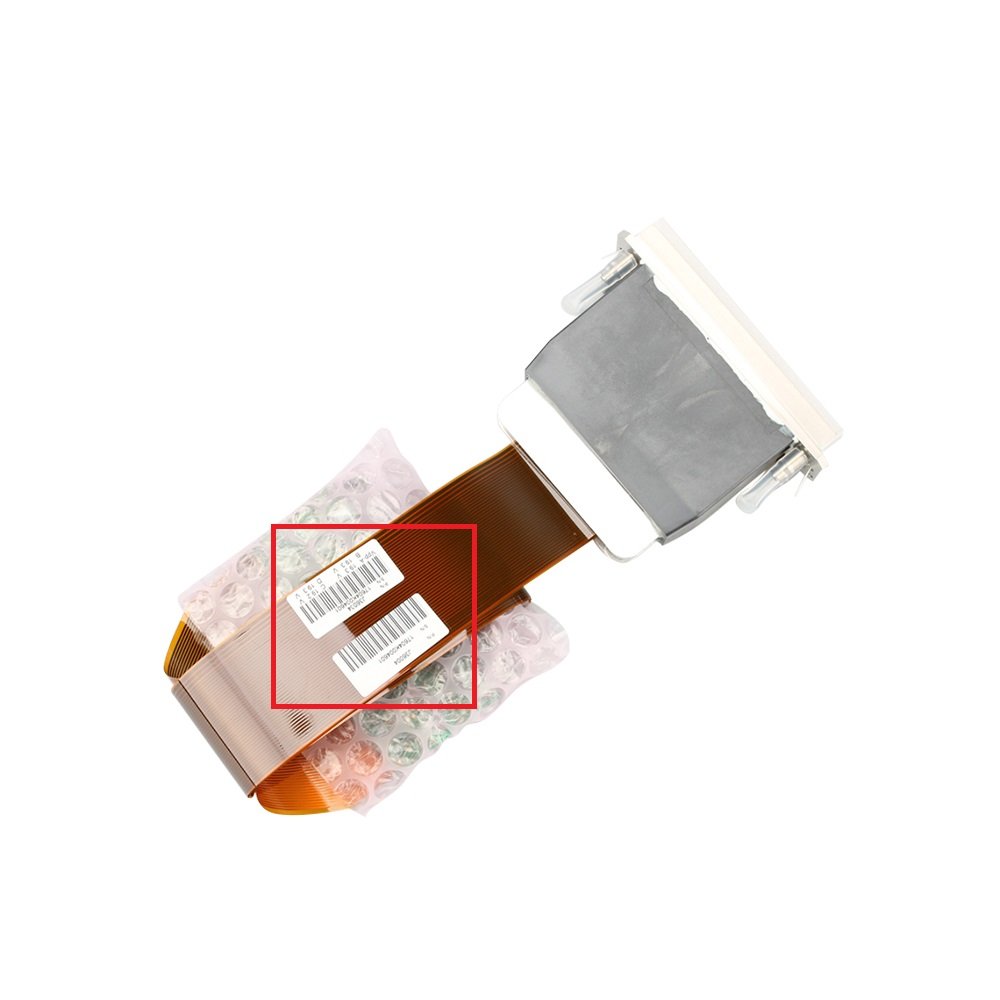
Identifying a Ricoh G5 printhead is quite straightforward. Each Ricoh Gen5 printhead comes with a P/N (Part Number) and S/N (Serial Number) label—usually found on the packaging box or the data cable. The P/N code allows you to determine the exact model of the printhead, while the S/N code serves as a unique ID for traceability purposes, ensuring that every printhead can be individually identified.
By reading the P/N code, you can also distinguish the type of ink compatibility and cable length:
- P/N codes starting with “N” indicate oil-based printheads.
- P/N codes starting with “J” indicate water-based printheads.
- For oil-based printheads, P/N codes ending with “L” represent long cables (500 mm), while those ending with “J” represent short cables (248 mm).
- For water-based printheads, P/N codes ending with “4” denote long cables, and those ending with “2” denote short cables.
With this simple identification method, users can quickly confirm the correct Ricoh G5 printhead model for their equipment and avoid mismatched purchases.