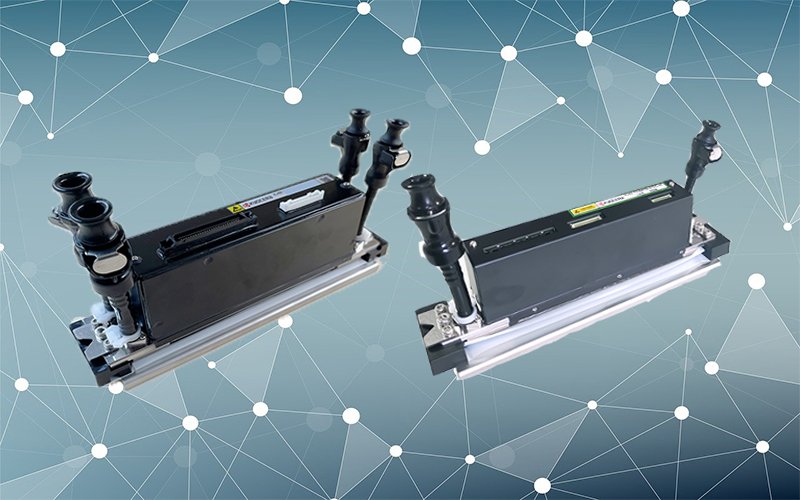
In the field of industrial printing, Kyocera printheads are widely used in the inkjet industry as mainstream printheads. Currently, there are two main series of Kyocera printheads on the market: KJ4A and KJ4B. The KJ4A series is designed for oil-based inks, such as UV inks, which are mainly used in the advertising field, while the KJ4B series is designed for water-based inks, such as reactive and disperse inks, which are mainly used in the field of digital printing. In this article, Johope would like to share with you the ink supply principle of the printheads.
KJ4A Series (Oil-Based)
As shown in the figure below, the KJ4A series has four models, corresponding to curved surface printing, standard printing, small ink droplet and high-precision printing, and dual-channel scanning printing. The maximum jetting frequency, maximum printing speed, and ink drop size corresponding to different printhead models are different, but the actual ink parameters (viscosity and surface tension) are similar.| KJ4A series UV | ||||
| KJ4A-RH | KJ4A-TA | KJ4A-AA | KJ4A-0300 | |
| Type | Curved surface printing | standard | small ink droplet | dual channels |
| Nozzle Number | 2656 | 2656 | 2656 | 1328*2 channels |
| DPI | 600*600 | 600*600 | 600*600 | 300*300 |
| Printing Width(mm) | 108.25 | 108.25 | 108.25 | 112.35 |
| Jetting Frequency (Max.) (kHz) | 30 | 20 | 20 | 30 |
| Printing Speed (Max.) (m/min) | 75 | 50 | 50 | 30 |
| Ink Droplet Volume (pl) | 3/7/11/14 | 6/7/11/14 | 3/6/13 | 4/6/10/14 |
| Size(W*D*H) (mm) | 200*30*69.4 | 200*25*57.9 | 200*25*57.9 | 200*36*61.4 |
| Weight (g) | 438 | 420 | 420 | 540 |
| Ink Viscosity (mPa*s) | 7 | 7 | 7 | 6.5-7.0 |
| Ink Surface Tension (mN/m) | 22 | 22 | 22 | 22 |
KJ4B series (Water-Based)
As shown in the picture below, there are six models in the KJ4B series. You can see the detailed models and parameters in the picture below. We mainly talk about the KJ4B-0300 printhead. This is the most widely used Kyocera in the inkjet industry. The printhead is a water-based model with dual channels. The frequency and printing speed are relatively fast, and the ink drop size is also relatively small, which ensures printing accuracy. It is a printhead with a good combination of accuracy and speed.| KJ4B series AQ | |||
| KJ4B-1200 | KJ4B-TA | KJ4B-YH | |
| Type | high-precision printing | standard | high-speed printing |
| Nozzle Number | 5312 | 2656 | 2656 |
| DPI | 1200*1200 | 600*600 | 600*600 |
| Printing Width(mm) | 112.42 | 108.25 | 108.25 |
| Jetting Frequency (Max.) (kHz) | 64 | 30 | 40 |
| Printing Speed (Max.) (m/min) | 80 | 75 | 100 |
| Ink Droplet Volume (pl) | 1.5/3/5 | 5/7/12/18 | 5/7/12 |
| Size(W*D*H) (mm) | 200*45*79.1 | 200*25*57.9 | 200*30*69.1 |
| Weight (g) | 760 | 420 | 438 |
| Ink Viscosity (mPa*s) | 5.5-6.0 | 6 | 6 |
| Ink Surface Tension (mN/m) | 30-35 | 35 | 35 |
| KJ4B series AQ | |||
| KJ4B-0360 | KJ4B-0300 | KJ4B-0150 | |
| Type | large ink droplet | standard | high-speed printing |
| Nozzle Number | 1584 | 1328*2 channels | 664*4 channels |
| DPI | 360*360 | 300*300 | 150*150 |
| Printing Width(mm) | 102.66 | 112.35 | 112.35 |
| Jetting Frequency (Max.) (kHz) | 12 | 30 | 30 |
| Printing Speed (Max.) (m/min) | 50 | 152 | 152 |
| Ink Droplet Volume (pl) | 15-84 | 5/7/12/18 | 5/7/12/18 |
| Size(W*D*H) (mm) | 200*39*54 | 200*36*61.1 | 200*45*66.8 |
| Weight (g) | 424 | 540 | 640 |
| Ink Viscosity (mPa*s) | 15 | 6 | 15 |
| Ink Surface Tension (mN/m) | 30 | 35 | 35 |
Overview of Ink Supply Principle
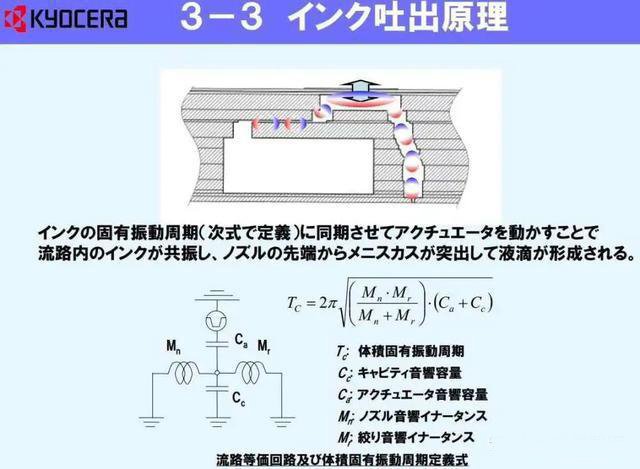
As shown in the figure, this is the jetting principle of a printhead. The blank area is the groove, which is the total ink channel inside the printhead. The ink flows from one end of the groove. When there is a backflow, it can flow out from the other end. There is a small ink channel at the top of the groove that can flow the ink upward into the ultra-small ink storage space under the piezoelectric sheet. When the ejection signal is received, the piezoelectric sheet will bend according to the time and intensity set by the waveform, and the ink will be squeezed into the ultra-small ink storage space and ejected through the nozzles.
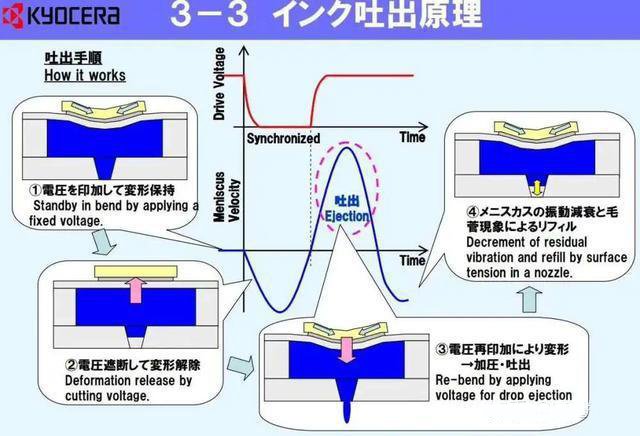
As shown in the figure above, this is the squeezing, deformation, and ejection process of Kyocera printhead ink droplets driven by waveforms.
Compared with other industrial printheads, the structural design of the 11-layer nozzle sheet means that the repairability of this printhead is very difficult. It is very difficult to find and repair the 11-layer nozzle sheet bonding and which layer of the nozzle sheet has abnormalities. But this is precisely the advanced nature of Kyocera printhead manufacturing technology. It can make the printhead so precise and have comparative advantages in printing speed and accuracy in the market. This is the hard power of technology.
Why are Kyocera Printheads Used More and More?
Kyocera inkjet printheads (hereinafter referred to as Kyocera printheads) have the characteristics of high precision, high productivity, and long life, and are very suitable for industrial printing purposes. UV printers paired with Kyocera have always been in a leading position in terms of speed and productivity. However, the price of Kyocera print heads is relatively high and it is called "upstart", which also discourages many UV printer users. So, what are the outstanding advantages of Kyocera heads compared with other UV printer printheads?First of all, the printing width of Kyocera printheads can reach up to 112 mm, which is approximately equivalent to the width of two Ricoh GEN5 printheads. The effective printing range is increased, which can reduce the overall printhead usage of UV printers.
Secondly, the multi-level variable droplet volume of the Kyocera printhead enables delicate and natural color transitions, making it suitable for printing with various image quality requirements. The ignition frequency is high, so high productivity can be achieved under high-resolution image-quality printing to meet the high requirements for UV printer productivity in the industrial production industry.
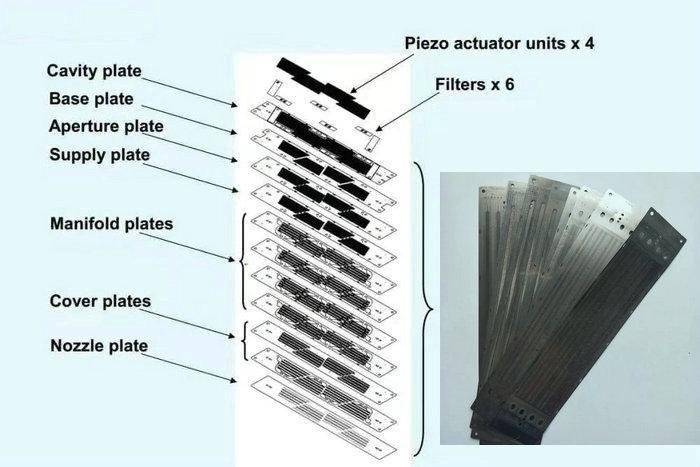
Thirdly, Kyocera printheads use stainless steel nozzle panels and metal casings, which are highly reliable in harsh industrial environments. The precise structure of the 11-layer nozzle sheet ensures printing accuracy and quality. Being able to achieve such a precise structure and having a comparative advantage in printing speed and accuracy in the market is also the technological strength of the Kyocera printheads.
Finally, one of the most easily overlooked advantages of Kyocera printheads due to price is their long service life. Of course, this is based on the correct use of the printheads and good maintenance. If the price is comprehensively evaluated in relation to performance, production capacity, stability, lifespan, etc., then Kyocera printheads may not be so expensive after all.
Main Reasons Affecting Service Life of Kyocera Printheads
1. The influence of the PH value in the ink - ensuring the freshness of the ink: Some inks require that the PH value should not be higher than 5. If the PH value is too low, it will corrode the glue used for sealing the nozzle. If ink enters the printer, it will corrode the circuit board, causing a short circuit on the circuit board, generating heat, and even damaging the nozzle. For reactive inks, black and sapphire blue are easier to hydrolyze. Once the ink begins to hydrolyze, the pH value will slowly decrease. The nozzle usually has no resistance to inks with a pH value below 4.5. In order to solve this problem, it is necessary to control the ink used to be no more than three months old from the factory.- Influence of colloids in ink---Control of colloidal impurities in ink: Another factor that shortens the life of the nozzle is that the ink contains more colloidal impurities. The last level of ink production is 0.1um level of precision. But for the nano-level colloids in the ink, people often ignore them and do not perform special filtration treatments. The colloid itself is charged and will slowly grow during storage. When it grows to a certain size, it will stick to the finer channels in the nozzle. In severe cases, these channels and nozzle holes will be completely blocked.
Solutions
1. Control the freshness of the ink or develop fresh ink yourself: The ideal ink used is to use it freshly made in order to ensure freshness. For inks that are particularly prone to hydrolysis, the quantity must be controlled in one production to ensure that the pH value of the ink is still within the agreed range when used.-
Timely replace the ink filters on the ink supply path: It is recommended to replace all the filters on the equipment within 3-6 months to extend the life of the printhead at a small cost. The time to replace the filter also depends on the actual printing volume.
-
Machines that are not in use should be turned on from time to time: in addition to the role of filters in capturing colloids, the other thing is to clean them up in time before the colloids grow to a certain large size. For equipment that does not start up very often, it is necessary to start up the ink press and clean it at least once every three days to ensure that the flow channels in the printhead are smooth.
-
Select the appropriate filter: In order to save costs, sometimes the wrong filter may be selected. Not only is the accuracy mark arbitrary and cannot be filtered, it may also have the opposite effect of bringing in pollutants (poor interception efficiency, PP fiber Severe shedding). Interception efficiency is the core of the filter, and there are strict internal control standards. Products that do not meet the standards cannot be shipped.
Choose the appropriate Kyocera printheads
1. Main printheads parameters| Compatible Ink | Model | Advantage | Jetting Frequency | Droplet Volume | DPI | Usage | |
| Water-based ink | KJ4B-0300 | Dual channel, suitable for scanners | One head has two colors, and the two channels can independently control the voltage and waveform. | 30kHz | 5/7/12/18 | 300dpi | Textile |
| KJ4B-QA | Standard | The highest operating frequency is 30kHz, corresponding to 600dpi resolution, and the highest printing speed is 75m/min. | 30kHz | 5/7/12/18 | 600dpi | Textile, Books | |
| KJ4B-YH | High speed | The highest operating frequency is 40kHz, corresponding to 600dpi resolution, and the highest printing speed is 100m/min | 40kHz | 5/7/12 | 600dpi | Books, Carton | |
| UV ink | KJ4A-0300 | Dual channels | One head has two colors, and the two channels can independently control the voltage and waveform. | 30kHz | 4/6/10/14 | 300dpi | Advertising |
| KJ4A-AA | Small droplet volume | Small droplet volume, high resolution, suitable for precision printing. | 20kHz | 3/6/13 | 600dpi | Label, Barcode | |
| KJ4A-RH | Small droplet volume, high resolution, suitable for precision printing. | The highest operating frequency is 30kHz, corresponding to 600dpi resolution, and the highest printing speed is 75m/min. | 30kHz | 3/7/11/14 | 600dpi | Advertising, Label, Barcode | |
| Textile | Advertising | Label | Carton |
| Water-based inkKJ4B-QA(600dpi)
KJ4B-YH (600dpi, high speed) KJ4B-0300(300dpi) KJ4B-0360(360dpi) KJ4B-0150(150dpi) | UV inkKJ4A-TA(600dpi)
KJ4A-AA (600dpi, small ink droplet) KJ4A-RH (600dpi, high speed) KJ4A-0300(300dpi) | UV inkKJ4A-TA(600dpi)
KJ4A-AA (600dpi, small ink droplet) KJ4A-RH (600dpi, high speed) KJ4A-0300(300dpi) | UV inkKJ4A-TA(600dpi)
KJ4A-AA (600dpi, small ink droplet) KJ4A-RH(600dpi,high speed) KJ4A-0300(300dpi) Water-based ink KJ4B-QA(600dpi) KJ4B-YH(600dpi,high speed) KJ4B-0300(300dpi) |
| PCB | Drug | 3D | Painting |
| UV inkKJ4A-TA(600dpi)
KJ4A-AA (600dpi, small ink droplet) KJ4A-RH (600dpi, high speed) KJ4A-0300(300dpi) Oil-based ink KJ4C-0360(360dpi) | Water-based inkKJ4B-QA(600dpi)
KJ4B-YH (600dpi, high speed) KJ4B-0300(300dpi) | UV inkKJ4A-TA(600dpi)
KJ4A-AA (600dpi, small ink droplet) KJ4A-RH(600dpi, high speed) KJ4A-0300(300dpi) Oil-based ink KJ4C-0360(360dpi) | UV inkKJ4A-TA(600dpi)
KJ4A-AA(600dpi, small ink droplet) KJ4A-RH(600dpi, high speed) KJ4A-0300(300dpi) Oil-based ink KJ4C-0360(360dpi) |
| Books | Building Materials |
| UV inkKJ4A-TA(600dpi)
KJ4A-AA(600dpi, small ink droplet) KJ4A-RH(600dpi, high speed) KJ4A-0300(300dpi) Water-based ink KJ4B-1200(1200dpi) KJ4B-QA(600dpi) KJ4B-YH(600dpi, high speed) KJ4B-0300(300dpi) | UV inkKJ4A-TA(600dpi)
KJ4A-AA(600dpi, small ink droplet) KJ4A-RH(600dpi,high speed) KJ4A-0300(300dpi) Water-based ink KJ4B-QA(600dpi) KJ4B-YH(600dpi,high speed) KJ4B-0300(300dpi) |
| UV ink (KT4A series) | Water-based ink (KJ4B series) | Oil-based ink (KJ4C series) |
| KJ4A-TA(600dpi)KJ4A-AA(600dpi, small in droplet)
KJ4A-RH(600dpi, high speed) KJ4A-0300(300dpi) | KJ4B-QA(600dpi)KJ4B-YH(600dpi, high speed)
KJ4B-0300(300dpi) KJ4B-0360(360dpi) KJ4B-0150(150dpi) KJ4B-1200(1200dpi) | KJ4C-0360(360dpi) |