Printing equipment on the market uses micro piezoelectric printheads and industrial printheads. Micro-voltage printheads refer to Epson 3200 or 4720, etc., while industrial printheads are from Ricoh and Starfire brands. At present, the most commonly used nozzles on the market are Epson printheads. Industrial types are only used in large-scale printing equipment or white ink pure cotton direct-jet printing equipment.
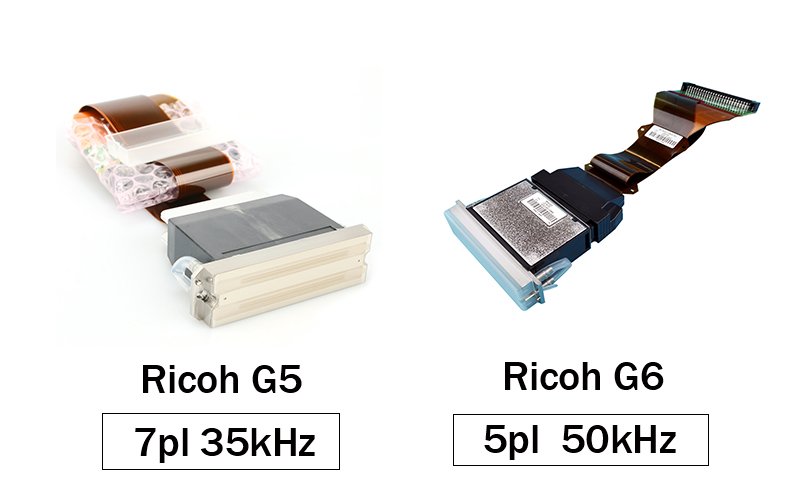
Today, we will explain in detail the difference between the industrial printheads Ricoh Gen 5 and Ricoh Gen 6.
Ricoh Gen 5 and Gen 6: Parameter Comparison
| General Properties | GEN 6 | GEN 5 |
| Print Width | 54.1 mm (2.1’’) | 54.1 mm (2.1’’) |
| # of Nozzles | 1,280 (4*320 channels) | 1,280 (4*320 channels) |
| DPI | 600 | 600 |
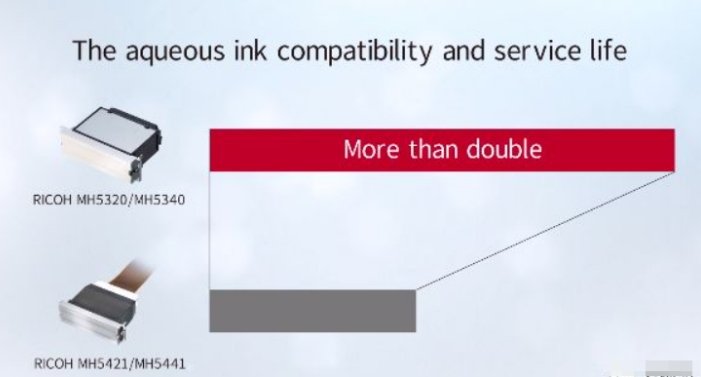
| Compatible Ink | UV, solvent, and aqueous | UV, Solvent |
| Max. # of Color | 4 | 4 |
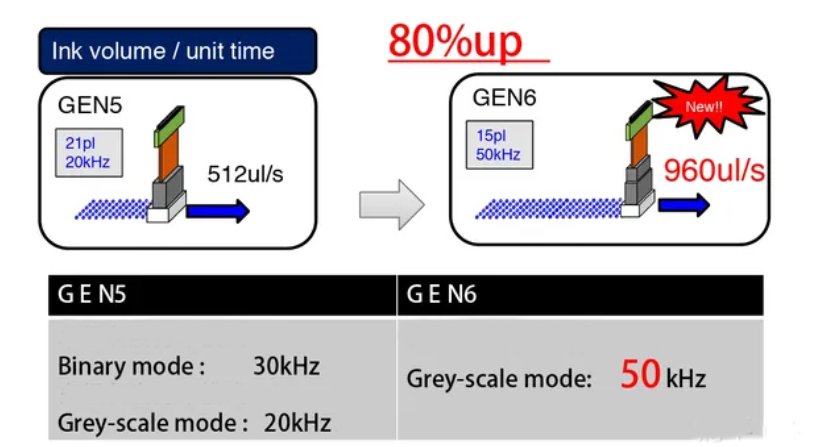
| Max. Jetting Frequency | 50 kHz | 30 kHz |
| Drop Volume | 5-15 pl | 7-21 pl |
| Viscosity Range | 10-12 mPa/s | 10-12 mPa/s |
| Cable Type | Detachable cable | Integrated cable |
Core Technical Differences
Structural Design (Maintenance Impact)
Gen5: Integrated Structure
- Printhead and data cable are permanently connected
- Requires full replacement during servicing
- Higher maintenance cost in long-term use
For deeper technical details, see: Ricoh Gen5 printhead deep analysis
Gen6: Modular Structure
- Printhead and data cable are detachable
- Individual component replacement is possible
- Significantly lower maintenance cost
More details available here: Ricoh Gen6 printhead features
Print Accuracy and Drop Control
Gen5:
- Drop size: 7–21 pl
- Strong coverage for solid fills
- Stable performance for large-area printing
Gen6:
- Drop size: 5–15 pl
- Smaller droplet control
- Higher precision and sharper image output
Key improvement: Gen6 achieves finer image quality through more precise piezoelectric control of smaller droplets.
Printing Speed and Productivity
Jetting Frequency:
- Gen5: 30 kHz
- Gen6: 50 kHz
Improvement: Approximately 66% higher jetting frequency
Practical impact:
- More droplets per second
- Faster production speed
- Better suited for industrial mass production lines
5. Ink compatibility: Ricoh G6 is compatible with both UV, solvent, and water-based inks, and has a wider range of uses.
In general, the G6 printhead is better than the G5 and can provide higher printing accuracy, more accurate inkjet control, and faster printing speed. But this also means that the price of the G6 printhead is relatively high, and it is suitable for professional fields that require higher printing quality. The choice of which printhead needs to be considered based on specific printing needs and budget.
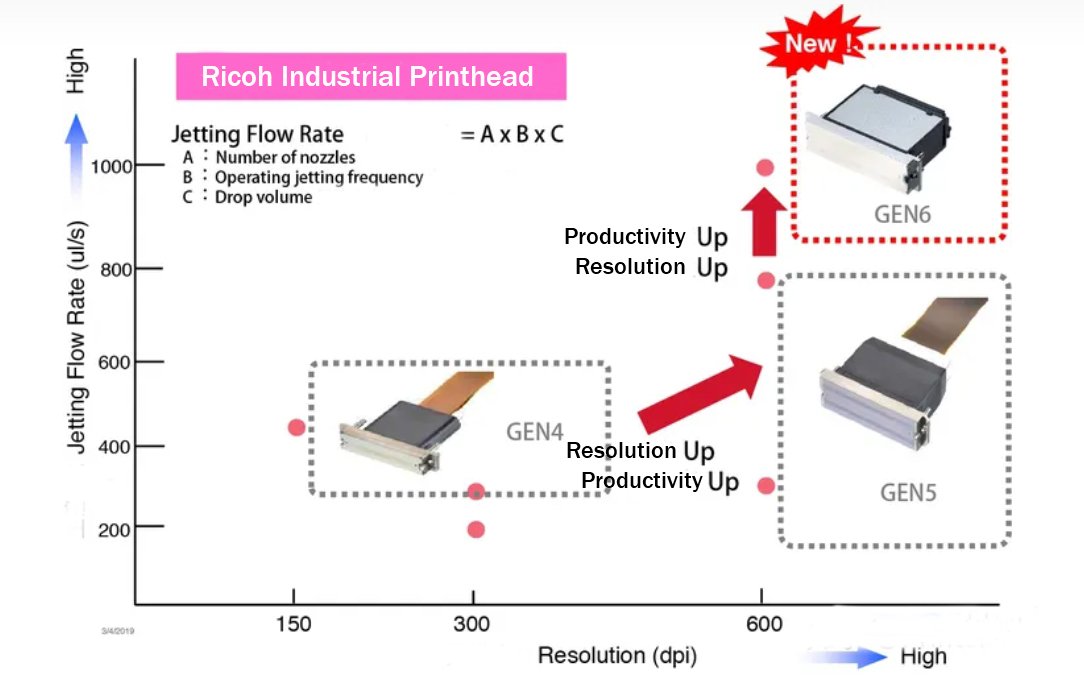
GEN5 has been tested in the market for 9 years, from 2014 to now, and has been recognized and highly praised by a wide range of customers. With the cultivation and development of the UV market, it has now become widely used, and the requirements for production capacity are getting higher and higher. From the above parameter chart, It can be seen that the emergence of GEN6 just meets the needs of this market. This is why GEN6 is now widely promoted quickly. It can increase production capacity while ensuring accuracy or even improving accuracy. According to the parameters, it can increase production capacity by 50%.
Color Block Performance
The Ricoh Gen6 printhead (MH5320) introduces a significant change in droplet size compared to Gen5.
- Gen5 droplet range: 7–21 pl
- Gen6 droplet range: 5–15 pl
Key Improvements:
Smaller ink droplets in Gen6 result in:
- Finer gradient transitions
- Higher image detail resolution
- Improved micro-pattern sharpness
Trade-off in Solid Color Areas:
However, reducing droplet size also introduces challenges in large color block printing:
- Coverage depth becomes slightly weaker compared to Gen5
- Uniformity in solid fills may be slightly reduced under identical pass conditions
Multi-pass Limitation:
Although multi-pass printing is often used to improve uniformity, in Gen6 systems:
- Multi-pass does not scale linearly in correcting uneven color blocks
- Some devices still show visible inconsistency in solid areas even with increased passes
Conclusion:
Gen6 improves detail quality but requires more system optimization for large-area color consistency.
Small Ink Droplet Behavior
Small droplets behave differently in air compared to larger ones.
Key Observation:
- Smaller droplets lose speed more quickly during flight
- Droplet trajectory stability is reduced compared to Gen5
Positioning Accuracy:
At the same printhead-to-media spacing:
- Gen5 provides more stable droplet placement
- Gen6 is more sensitive to environmental airflow
Image Depth:
- Gen5 produces stronger 3D visual depth perception
- Gen6 prioritizes fine detail over depth strength
Practical Requirement for Gen6:
To achieve optimal results:
- Printhead distance must be reduced
- Airflow control around the printhead must be improved
- Mechanical precision must be higher
Resulting Challenge:
Due to smaller droplet volume, Gen6 is:
- More prone to unevenness in solid color printing
- More sensitive to mechanical and environmental instability
Conclusion:
Gen6 requires tighter mechanical and airflow control to fully stabilize print quality.
Ink Supply System Requirements
Ink delivery demand increases significantly from Gen5 to Gen6.
- Gen5 ink consumption: ~33 ml/min
- Gen6 ink consumption: ~57 ml/min
Key Impact:
This increase requires:
- Higher flow capacity ink supply system
- More stable negative pressure control
- Reduced pressure loss across the system
Risk if Not Optimized:
If the ink system cannot meet demand:
- Ink starvation may occur
- Droplet breakage becomes more frequent
- Jetting stability decreases at high frequency
Conclusion:
Gen6 requires a redesigned or upgraded ink supply system compared to Gen5.
Printhead Heat Dissipation
As jetting frequency increases:
- Internal heat generation increases significantly
- Piezoelectric chip temperature rises more quickly
Impact on Printing:
Temperature instability may cause:
- Droplet size variation
- Jetting inconsistency
- Reduced long-run stability
System Requirement:
Proper thermal management must include:
- Consistent operating temperature management
- Improved heat dissipation design around the printhead
- Stable environmental airflow control
Ink Formulation (Ink Package Behavior)
At higher frequencies, ink behavior becomes more complex.
Key Concern:
Gen6 operates at much higher jetting frequency, so:
- High shear-rate behavior becomes critical
- Ink must maintain stability under dynamic conditions
Industry Issue:
Most ink manufacturers currently focus on:
- Static viscosity
- Surface tension
However, they often lack sufficient testing on:
- High-frequency dynamic flow behavior
- Rheological stability under continuous jetting
Result:
- Ink performance may differ significantly between Gen5 and Gen6 systems
- Some inks that work on Gen5 may be unstable on Gen6
Conclusion:
Gen6 requires more advanced ink formulation beyond traditional UV ink standards.
Mechanical Accuracy Requirements
To achieve 50 kHz jetting frequency, system precision becomes critical.
Operating Conditions:
- At 600 DPI: carriage speed ≈ 2.1 m/s
Key Physical Requirement:
To maintain stable print quality:
- Horizontal carriage movement must maintain a 1:4 ratio with droplet fall velocity
Droplet Behavior:
- Droplet velocity at 1 mm distance: ~6–7 m/s
DPI Recommendation:
- At 600 DPI → ratio may drop below safe threshold
- At 720 DPI → system stability improves significantly
Practical Recommendation:
- 720 DPI is preferred for high-quality output
Additional Mechanical Constraints:
- Acceleration should be kept below 1G
- High acceleration can destabilize ink pressure systems
- Acceleration zones should be minimized
System Optimization Requirements:
To maintain stability:
- Add damping or pressure absorption units
- Strengthen negative pressure control system
- Reduce sudden pressure fluctuations in ink path
Jetting Frequency Optimization
Although Gen6 supports up to 50 kHz:
Practical testing shows:
- Stable operating point: ~35 kHz
Behavior above this range:
- Ink droplet velocity becomes unstable
- Oscillation in jetting behavior increases
- Ink supply and mechanical system must be heavily optimized
Conclusion:
35 kHz is the most stable operating frequency for balanced performance.
Ink Compatibility Expansion
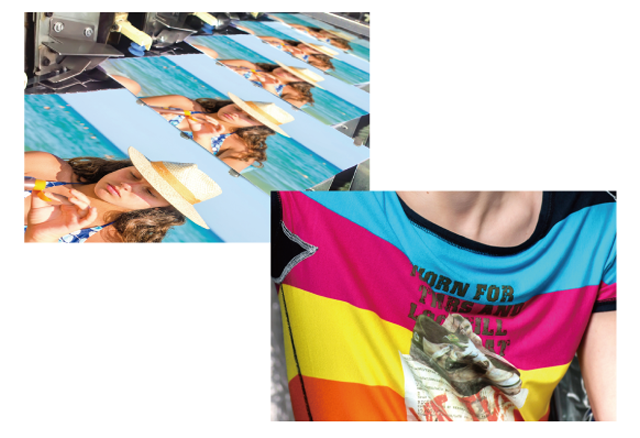
Compared to Gen5, Gen6 significantly expands ink compatibility.
Gen6 supports:
- UV ink
- Reactive ink
- Coating ink
- Dispersed ink
Application Expansion:
Gen6 extends usage into:
- Label printing
- High-end industrial decoration
- Packaging printing
- Textile applications
Get reliable supply and competitive pricing from our team.
Overall Summary
Gen5 Strengths:
- Strong stability in solid color printing
- Better uniformity in large color blocks
- Lower system sensitivity
- Mature, widely tested technology
Gen6 Strengths:
- Higher resolution and finer detail (5 pl droplets)
- Higher jetting frequency (50 kHz)
- Broader ink compatibility
- Stronger performance in high-end industrial applications
If you are comparing multiple Ricoh models, see our complete Ricoh printhead selection guide.